
Eight companies disclosed on one catalog is eight buying accounts and eight sets of pixel data. Nobody is looking at all of them at once.
Iron Maiden's official page ran 542 ad entries across the EU and UK in the past year. 275 of them name a payer, and between them they name fifteen different ones.
Global Merchandising Services, on 142 ad entries.
Iron Maiden, on 30.
ROCK BEASTS SLU, on 18.
EMAGIC, on 18.
AEG Presents France, on 17.
PRK DreamHaus GmbH, on 15.
Warner Music Benelux, on 12.
MC2 Live srl, on 10.
Warner Music Spain, on 4.
Live Nation Concerts, on 2.
Andrea Bocelli, on 2.
Live Brands Factory, on 2.
Live Nation Sweden AB, on 1.
Trafalgar Releasing Ltd, on 1.
Madness Live, on 1.
That is a merch company, the band itself, nine promoters and ticketing outfits across six countries, two Warner territorial labels and a cinema distributor. And Andrea Bocelli, who has no part in any of this. His name is in that field because somebody typed it into an ad account once and never typed it out.
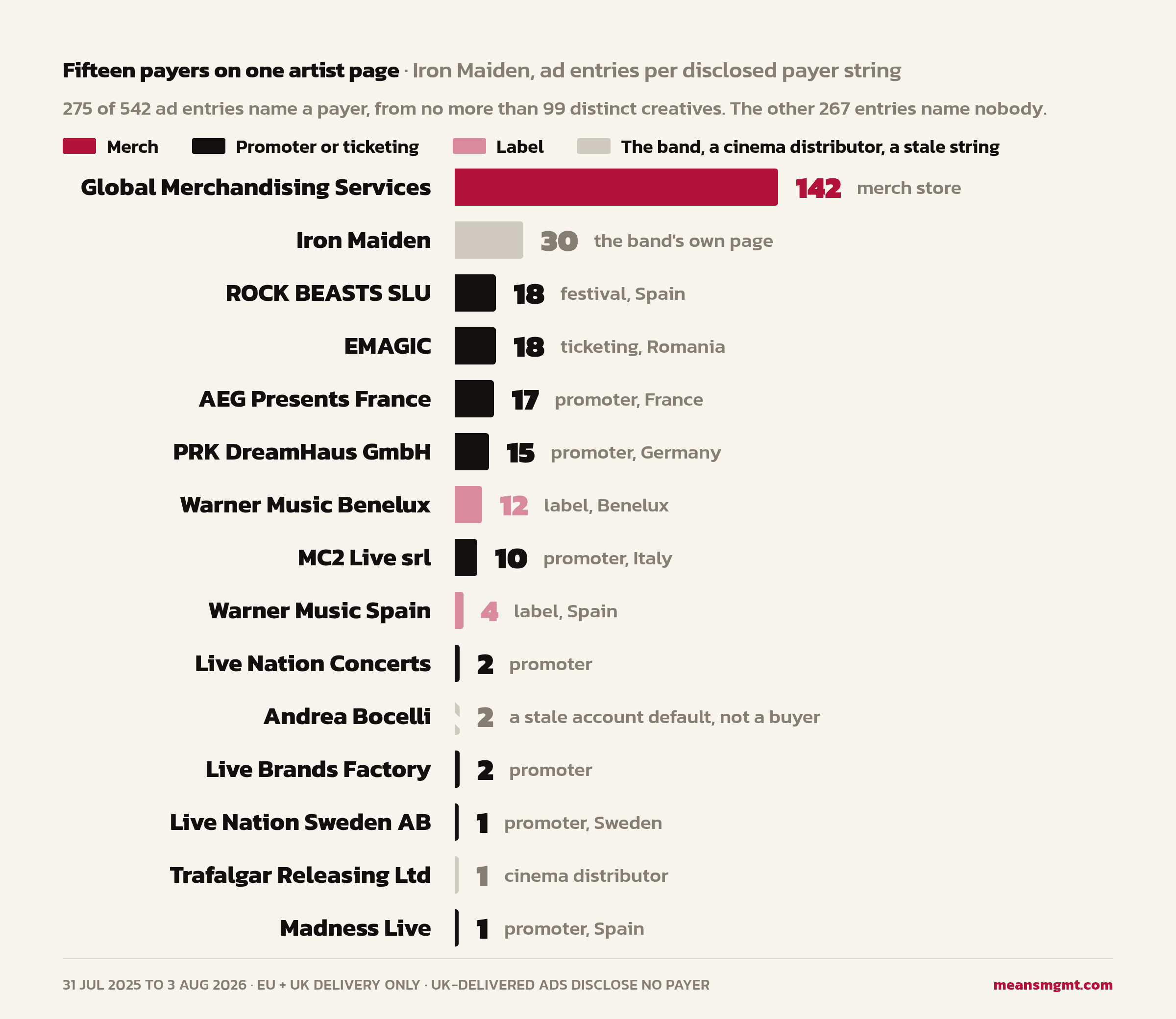
The other 267 entries name nobody. That is 49 percent of them, and they ran in the UK, where the disclosure rule doesn't apply. So fifteen is a floor.
The merch partner is on the merch ads and the Spanish promoter is on the ads for the Spanish show. That rests on what each ad was selling, which is how every one of them was checked.
They're just not looking at the same dashboard, and nobody above them is either.
Parts one and two were about a machine that works, catalog ads opening on release dates whether or not the artist is alive, bought by a small number of companies.
Sixty-nine pages, none of them his
EsDeeKid is a Liverpool rapper who performs in a balaclava and keeps his name and face to himself. Debut mixtape Rebel, currently touring Europe. He has no advertising presence in this archive at all, no page running ads, no smart link and nothing on ffm.to.
Search his name and 240 ad entries come back, across 69 pages, every one of them bought by somebody else.
That comes from searching his name rather than pulling every page's history, so 240 is an undercount.
Most of the 240 is All Things Live Denmark selling K.B. Hallen, Eventim Sweden, AEG Presents France, All Points East. Promoters marketing their own inventory, correctly disclosed.
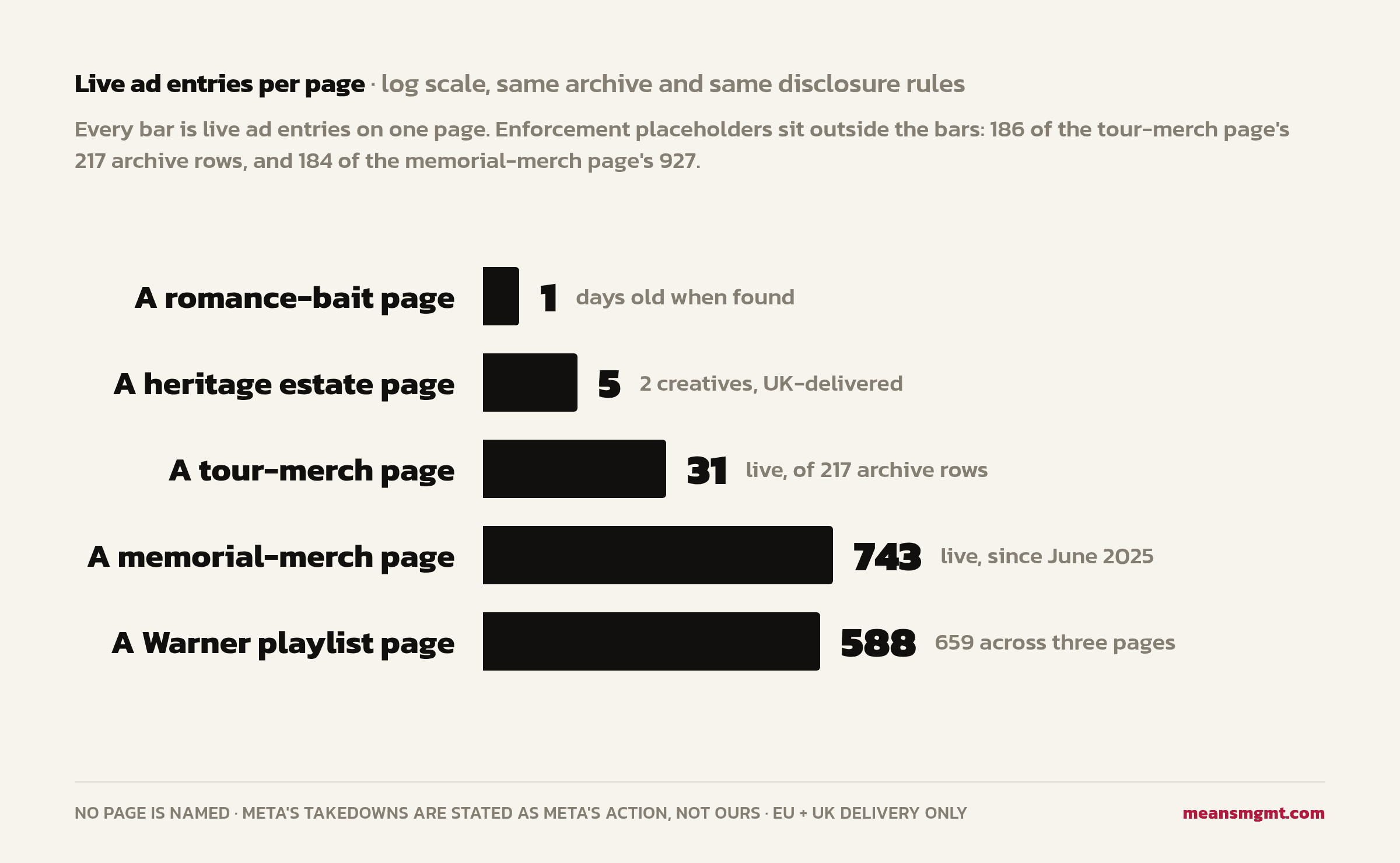
The residue starts with nobody on the rights side buying anything at all. A page selling "official tour merch" under his name and Yeat's ran 217 rows through link shorteners, 186 of them Meta enforcement placeholders. A second operation runs 923 live ad entries across Travis Scott, Yeat, EsDeeKid and Bad Bunny. Then sample-pack sellers renting the sound. "Heavily inspired by Esdeekid." Legal, correctly disclosed, and still somebody making money off the name while he spends nothing on it.
Every ad bought against his name in Europe this year was bought by a ticket agency, a merch operator or a beat seller. Meta had already removed most of the merch operator's entries by the time we read them, which is Meta's action on Meta's record.
One artist is an anecdote, so we checked three more currently-breaking UK acts.
fakemink has no visible page, and a search on his name still found 82 other pages buying it.
Chy Cartier's page ran ten ad entries, all in November 2025, which are one creative filed ten times.
Nemzzz is the exception, properly advertised, 445 ad entries since May with ATLANTIC RECORDS UK LTD on 218 of them.
Four acts is not a rate you can lean on. But the one with a major on the payer string is the one being advertised, so the buying follows the deal rather than the heat.
Nine Sony entities on one page
Bruce Springsteen's page names nine Sony entities, on 61 of the 70 ad entries there that disclose anything. Italy, Germany twice under two registered names, Ireland, Belgium, Austria, France, Spain, plus Legacy Recordings. The tenth string, Independent IP B.V., carries the other 9 and is not Sony. Two of the nine are one company written two ways, so collapse them and nine becomes eight.
A payer count is an upper bound on disclosed strings, not a count of companies that paid. The field is self-declared, Meta doesn't verify it, and a stale account default can sit there for months, which is how Andrea Bocelli ended up on an Iron Maiden ad. So we stripped every string we could prove belonged to somebody else, sixteen of them, and reran the counts. Springsteen 9, Bowie 5, the Stones 6, all unchanged. Iron Maiden drops Bocelli and goes to fourteen.
Across 63 artist pages with enough disclosure to test, the count tracks neither catalog age nor who owns the catalog, only how much marketing is running.
The distributor's own page ran 21 ad entries in thirteen months and disclosed itself on every one. That name is also the payer on six other artist pages in our set, 356 ad entries between them. It barely advertises as itself, and from any one of those pages you'd see a single tidy buyer and none of the rest.
Eight companies marketing one catalog is eight media plans and eight sets of pixel data. Nobody is looking at all eight at once.
The person who owns the rights generally sees least of all, because the ads run out of accounts that aren't theirs. Ten payer strings on Springsteen's page, and his own name is on none of them.
The label that isn't there
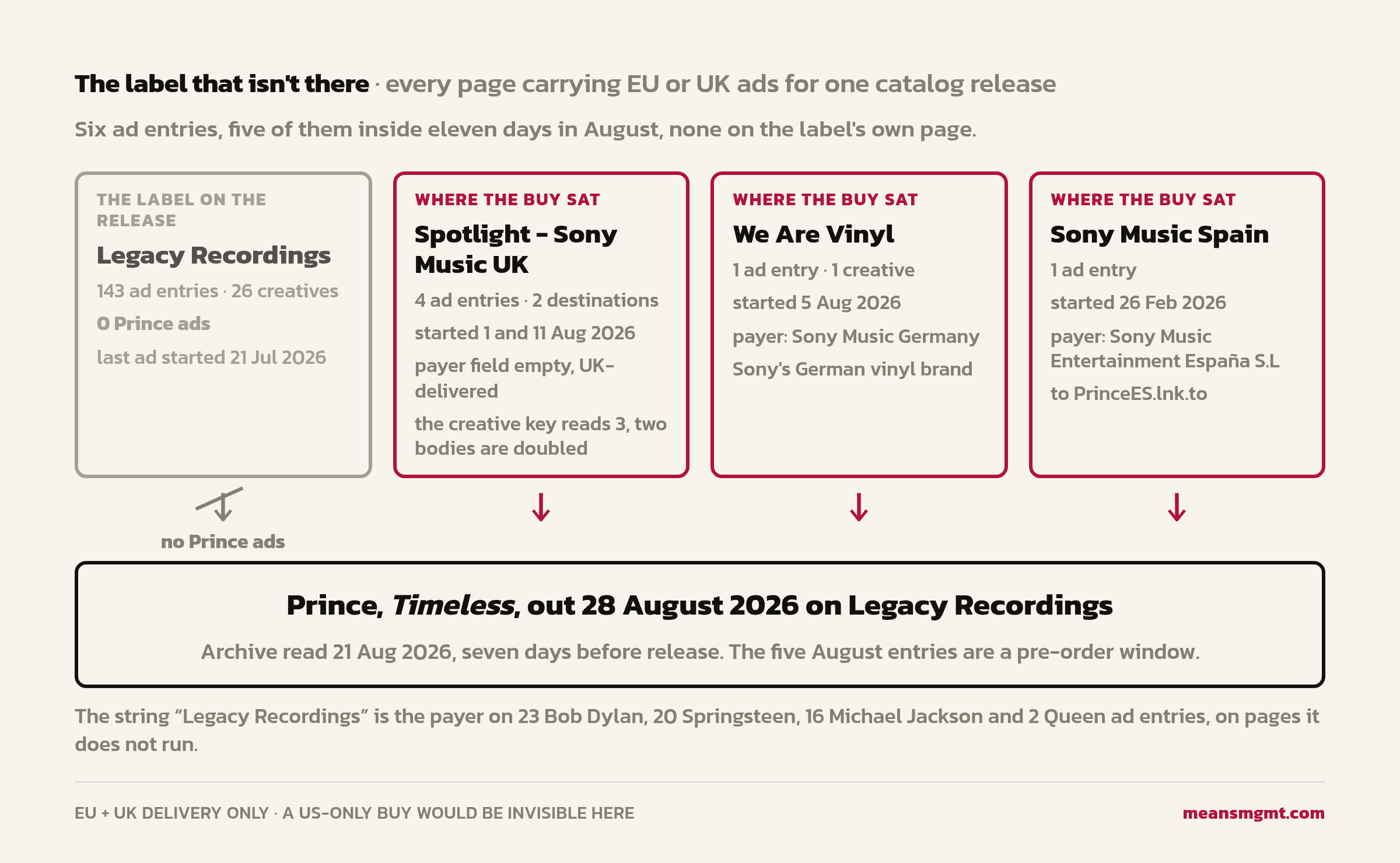
Prince's Timeless, a collection of unreleased vault recordings, came out on 28 August 2026 on Sony's catalog imprint, Legacy Recordings.
Legacy Recordings' own page has never run a Prince ad. Not one, in 143 ad entries and 26 distinct creatives, and its last ad of any kind started on 21 July. What it does advertise is Spotify playlists, with Filtr as the payer on 71 of the 143 and Legacy naming itself on four.
The visible EU and UK buy for Timeless was six ad entries across three other Sony pages. Four on Spotlight - Sony Music UK, all UK-delivered and naming no payer. One on We Are Vinyl, a Sony Germany vinyl brand, disclosed to Sony Music Germany. One from Sony Music Spain back in February.
Five of the six started between 1 and 11 August, and we read the archive on 21 August, a week before release. That's a pre-order window, and since part one of this series is about catalog ads opening on release dates, the release-week number simply is not in this data.
Search the archive for ads that mention Prince and sell something and 148 come back, 46 distinct creatives across 34 pages, spread over the year from August 2025. Mostly shirts, plus tribute nights, including a London club that ran a Prince party in the weeks around the tenth anniversary of his death.
Most of those come from a name search rather than a page history, so it is an undercount of the trade around his name. It does not divide by the six above. It also doesn't sort licensed from unlicensed, since two of the 148 are a major label's own page running a licensed film-soundtrack competition.
One entry in there is a memorial-merch operation reading "10 YEARS. STILL ICONIC. STILL PRINCE.", started eleven days before Sony's release.
Meanwhile the string "Legacy Recordings" is the most-used payer on Springsteen's page, 20 of his 70 disclosing entries. It also sits on 23 Bob Dylan entries, 16 Michael Jackson and 2 Queen.
The label whose name is on the release isn't the page buying it, and its name is doing work on pages it doesn't run. A US-only buy would be invisible here.
Six weeks after Bonnie Tyler died, no rights holder ran a visible ad
She died on 8 July 2026, and on 12 August a deep partial eclipse crossed the UK. A death, an eclipse and whatever the song did that week all sit inside five weeks of each other. Nothing here measures one against another.
A search on her name returns roughly 420 ad entries across about 124 pages. Zero came from Sony, Columbia, RCA, Legacy, any playlist brand, or anything resembling a rights holder. None pointed at a DSP or a smart link.
A name search reads shallower than a full page history, so those counts are undercounts. Zero is still zero.
The archive isn't blind to this, it holds 724 ad entries on Snoop Dogg's page alone, and the Prince pre-order flight above. The honest edges are that our pull only reaches back to 13 July, so the five days after her death are unobserved, and that a US-only buy would be invisible.
What did run was tribute-show ticketing, boosted funeral coverage, and merch.
The payer string "gnecom" appears across sixteen page names in that search, all pointing at one storefront. Its first Bonnie Tyler ad started 13 days after she died and was still running on the day of her funeral. We pulled two of those sixteen in full, and the string sits on 980 live ad entries between them, selling shirts for the recently dead.
Elvis. Ozzy Osbourne. Hulk Hogan. Prince. Bonnie Tyler.
One of the two has run since June 2025, and 20 percent of its entries are Meta enforcement placeholders.
Everything visible in the archive around her death was bought by parties other than her rights holders. What licences any of them hold is not something the Ad Library records, so this counts who was buying and stops there.
22 percent owned, unless smart links count
Take every classified creative on an official page, 5,898 of them, and ask whether the ad points somewhere the advertiser controls.
1,296 do. That's 22.0 percent.
Owned audience means an official store or site, or anything that captures fan data. Rented audience means a DSP, ticketing, social, or third-party retail, where somebody else keeps the customer record.
A Linkfire or Feature.fm page sits on about 42 percent of these creatives, it belongs to the label and it carries the label's pixel. Count it as owned and the same corpus reads about 64 percent. Count it as rented, which is what we did, and it reads 22.0. Drop the store domains we matched on a URL pattern rather than checked by hand and it reads 13.6. The same choice flips the ranking by page type, so don't read one of those off this either.
The same ads over the same thirteen months give three answers, between a seventh and two thirds.
I'd defend the 22. A smart link captures a click and a pixel fire, and it doesn't capture a customer. The fan on the far side lands on Spotify or Apple as their user rather than the label's. That's a position rather than a fact, anyone running D2C for a label will argue the other side, and the number should carry its coding or not get quoted.
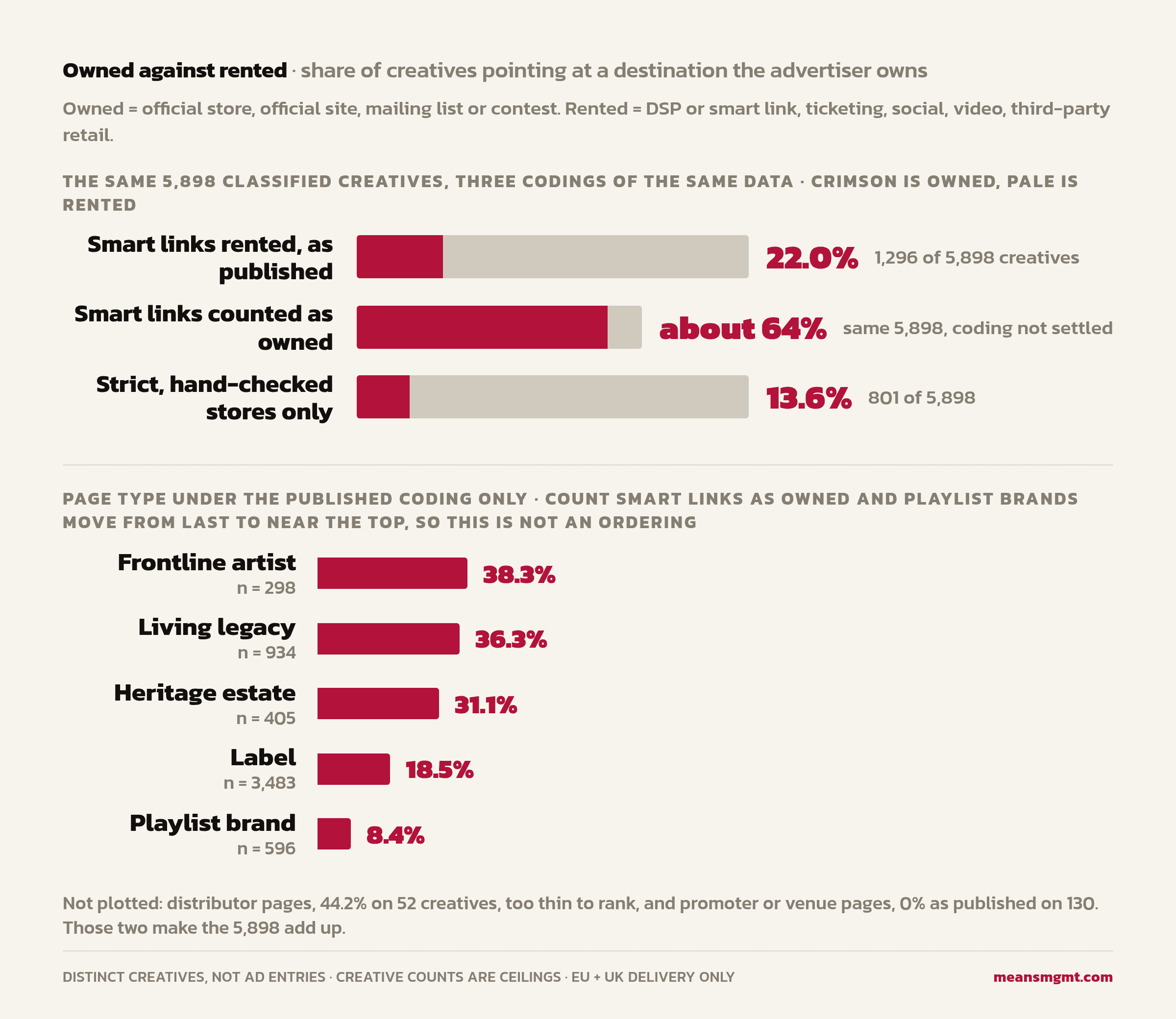
However you code the link, the thing on the far side is a DSP, a ticket platform, a retailer or a social feed. Every one of those keeps the record of who showed up.
There's no shift toward D2C in here either, which is not what I expected in 2026. The 57 pages with enough volume to compare the first half of the year against the second split 20 up, 20 flat and 17 down on store share.
The name is a field you can edit
We took 287 artist names, dead artists and living legends, and searched every one against the Ad Library. 16,310 pages surfaced, 272 matched an artist's full name, and I read 21 of those in full rather than trusting the page name. Fourteen were running ads under a musician's name that wasn't theirs, across twelve artist names, three of them dead.
Mostly romance bait aimed at women, no destination, copy inviting a reply. One page ran thirteen ads for male-enhancement products in Italian under the exact name of a soul musician who died in 2008…
None of it is large. One to thirteen ads a page, most days old when we found them, all aimed at individuals through direct messages. There is no commercial-scale impersonation in here and I did go looking.
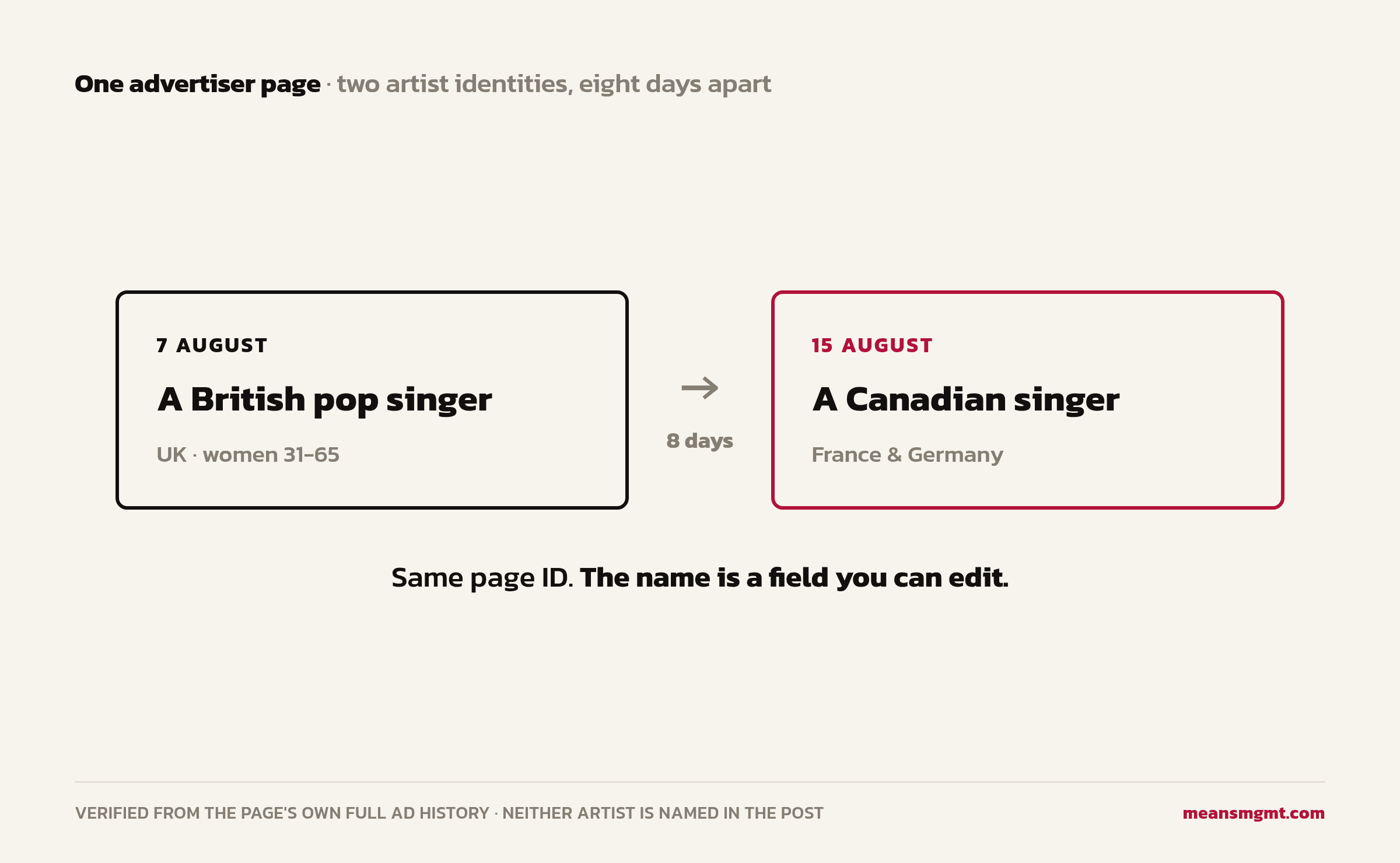
On 7 August 2026 one page ID ran an ad in the UK at women aged 31 to 65, under the name of a British pop singer. On 15 August the same page ID ran an ad in France and Germany, in French, under the name of a Canadian one.
It did not get hacked and it did not get sold. Somebody changed the name on it, because the name is a field you can edit. To whoever runs that page, a globally recognized musician is a variable, swapped when the last one stops converting.
Reuters reported on 7 August that Meta staff pre-ran regulators' Ad Library searches and deleted the matching scam ads, part of what internal documents called a global playbook. So every bootleg and impersonation count above is a floor, and this archive is not a neutral record.
There is no field in the Ad Library that flags a page as legitimate, only the absence of a takedown, which is not the same thing.
The field cannot tell them apart
At one end, somebody rents a famous name for a week, spends what a week costs, and collects DMs.
At the other end sits an ordinary campaign that broke no rule. The Warner playlist page from part two ran 588 ad entries with a single word in the payer field. That word is the name of a Romanian singer signed to Warner's licensee in Romania. She had no part in those campaigns, and the string is an account default somebody set once and never reset.
What those two have in common is the field and nothing else. It records how an ad account was registered rather than who was billed, so it gives the same kind of answer either way. It is a text box, and Meta prints what the advertiser typed.
Frank Sinatra's own official page ran five ad entries all year, two distinct creatives, all UK-delivered and carrying no payer field at all. Five entries, two creatives, all UK-delivered, and the payer field is empty on all five.
What accrues, and to whom
Follow every campaign in this series to its end.
Warner keeps the Topsify followers.
Amazon keeps the subscriber it pulled onto its app from Michael Jackson's page.
Trafalgar keeps the ticket buyer who booked a Lennon screening.
The merch operator keeps the customer record.
The scammer keeps the message thread.
The artist gets royalties (hopefully) and a credit line. The catalog gets streams it cannot attribute to anything.
The destination usually belongs to somebody else too, so the audience belongs to whoever paid for the ads, and it stays there when the campaign ends.
This is not a scandal so much as how paid media works, for a living act with a new album as much as for anyone here. But catalog is where it bites hardest, because the artist is not around to build anything else. The people who inherit or acquire a catalog often do not know the marketing is happening at all, let alone who is doing it and under what name.
The only reason Iron Maiden's page shows fifteen of them in one place is a European disclosure rule. Cross the Channel and the same page names nobody.
If you own or manage a catalog
Search the Ad Library for your artist. It takes ten minutes and it is free. It will show you every page running ads under that name in the EU and UK, plus who declared themselves the payer on the European ones. Most catalog owners I have described this to had never looked.
Look for pages using the name that you do not recognize, and payers on your own campaigns that you cannot account for. Look for campaigns you did not know were running, which is more common than it sounds when a catalog is licensed across territories.
Then count how many of your own ads point somewhere you own, counting a smart link as somebody else's, because the DSP behind it keeps the listener. If you land near a fifth, you're where most of this corpus sits, and that means renting.
If you want somebody to run that audit properly, across every territory and every page, that is work we do. But the ten-minute version costs you nothing, so start there.
Notes
All figures come from Meta's public Ad Library, pulled between 16 and 21 August 2026. It covers EU and UK delivery only, so a US-only campaign never appears, and UK-delivered ads carry no payer field, which makes every entity count a floor.
Ad counts are ad entries, rows in the archive rather than separate decisions. Rates are per distinct creative, and those counts are ceilings, because the API sometimes returns the same body twice. Numbers from a keyword probe rather than a page pull are labeled as such, and they are floors.
No page is named here. Ad metadata can't establish intent, so I've quoted copy rather than accusing anyone, and where I say Meta disabled a page, that's Meta's action on Meta's record.
FAQ
How many different companies market one artist's catalog?
What share of music catalog ads point at an owned audience rather than a rented one?
Why does a record label's own page not run ads for its own release?
What happens when an artist doesn't advertise at all?

This is the work we do all day.
If you have a release coming, the 3-minute intake tells us everything we need to scope your campaign. Want the numbers first? The benchmarks report is free.