

The person who owns the rights generally sees the least of it. The ads run out of accounts that aren't theirs, under company names they'd have to work to recognize.
I pulled 5,303 ad entries for 51 legacy artists from Meta's Ad Library API, 32 deceased and 19 living, covering July 2025 through August 2026 in the EU and UK.
Other people are marketing your catalog. They are building audiences on your name, through channels you don't own, and the one regulatory field that should tell you who's doing it is broken.
That is not a scandal. It is how paid media works. But catalog is where it bites, because the artist is often not around to build anything else. The people who inherit or acquire a catalog frequently don't know the marketing is happening at all.
Fifteen payers on one page
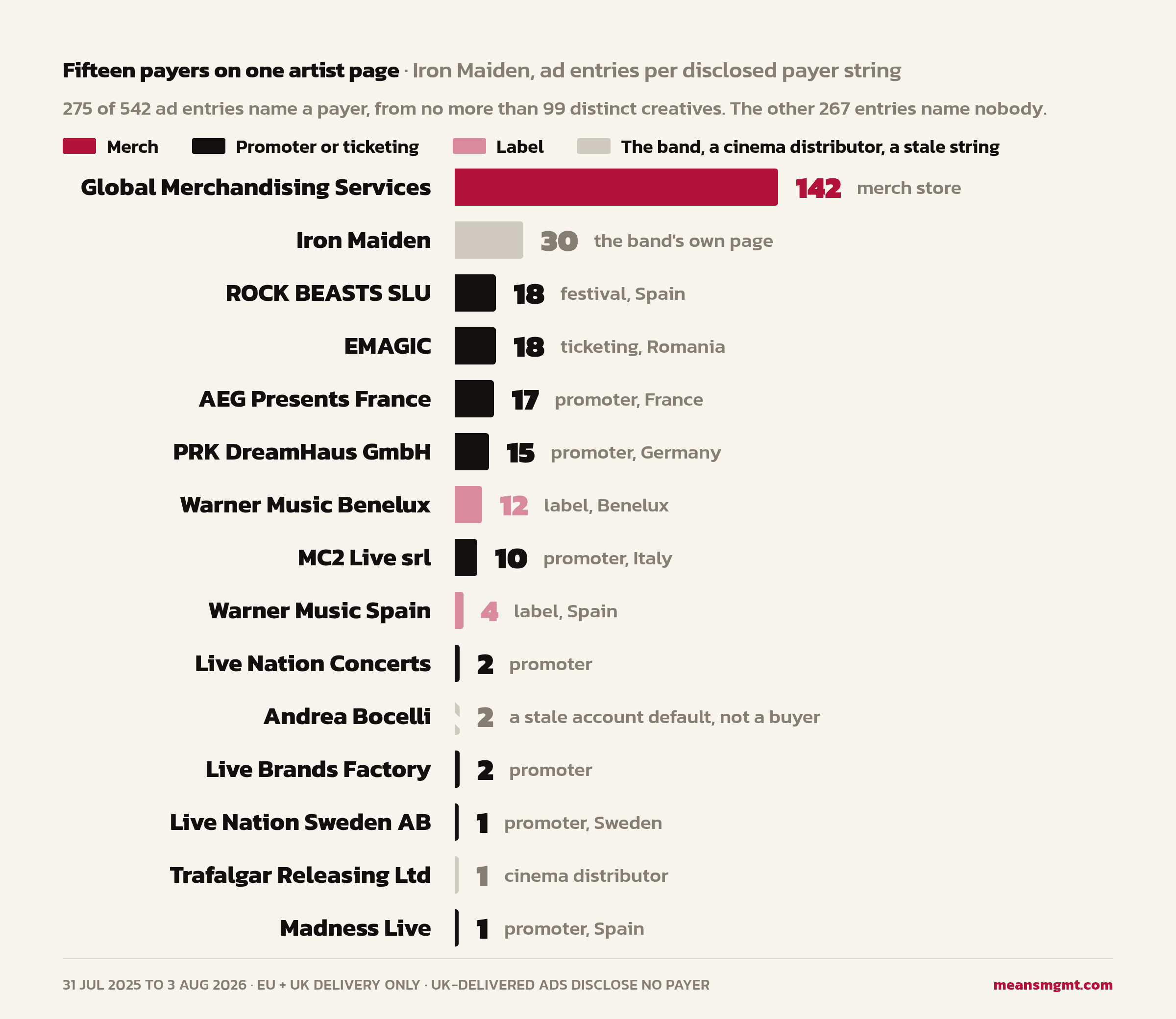
Iron Maiden's official page ran 542 ad entries across the EU and UK in twelve months, from no more than 99 distinct creatives. Under the EU's Digital Services Act, advertisers running in EU countries have to name a payer. 275 entries on that page do. They name fifteen different ones.
Global Merchandising Services, on 142 entries. The band itself, on 30. Nine promoters and ticketing outfits across six countries. Two Warner territorial labels. A cinema distributor. And Andrea Bocelli, whose name is in that settings field because someone typed it during another campaign and nobody changed it back. He has no connection to the band.
The other 267 entries name nobody, because they ran in the UK where the disclosure rule doesn't apply. Fifteen is a floor.
Nothing on that list is strange. The merch partner buys merch ads. The Spanish promoter buys ads for the Spanish show. Warner Benelux buys in Benelux. They are not looking at the same dashboard, and nobody above them is either.
Bruce Springsteen's page names nine Sony strings on 61 of its 70 disclosing entries. Germany appears twice under two registered names, alongside Italy, Ireland, Belgium, Austria, France, Spain, and Legacy Recordings. Miles Davis's page splits three ways across Concord, RHINO, and Sony, each marketing its own era of the same dead man. Fifteen payers is fifteen media plans, fifteen audiences, fifteen sets of pixel data. The person who owns the rights generally sees the least of it. The ads run out of accounts that aren't theirs, under company names they'd have to work to recognize.
The machine runs on dates
I matched 3,340 Spotify release dates against 1,044 distinct ad-start days and ran a null model to see what chance alone would produce. Exact-date matches: 44 against 12 expected. Within a week: 293 against 127. Anniversaries performed at chance, slightly worse than the random baseline.
Labels do not advertise on anniversaries. They advertise dated products. Zappa's Bongo Fury 50th on 20 March, Elton John's Captain Fantastic 50th on 24 October, Metallica's ReLoad remaster on 26 June. A fifty-year-old record cannot be new, so the label manufactures a date and the media plan follows it.
Six kinds of business buy media on a legacy name: film distributors, streaming platforms, label catalog divisions, merch operators, playlist brands, and the artists or estates themselves. The last group is the rarest. Across 1,842 estate ad entries, the payer field carries the artist's own name exactly 19 times, across four strings.
Being dead barely changes the machine. Control for the touring bias in my sample and the two groups converge. Estates and living acts run at 16.8 and 16.5 percent on "out now" language, 15.7 and 16.1 on buy CTAs, 10.2 and 10.7 on pre-order. Merch is at parity: estates send 22.3 percent of campaigns to a store, touring acts 23.3.
Death closes the live route. 7.6 percent of estate campaigns go to ticketing against 26.2 for the touring acts, and that gap is real. Estates still buy for tribute shows and cinema screenings, reaching for a live route without a living artist. The rest of the rates land within two points of each other.
Label Panthéon, Universal Music France's reissue imprint, is the widest buyer in the data. Named as payer on ads for fifteen artists, eight dead and seven living. One catalog division with a media budget, not sorting the roster by whether the artist is breathing.
Leonard Cohen's page is the one case my rules couldn't catch. 73 ad entries, all one creative filed 73 times, for the 55th anniversary of Songs of Love and Hate. No 2026 release sat behind it, so it misses the exact-date and within-a-week rules. The copy carried the date itself: "Songs of Love And Hate turns 55 this week, listen now on Apple Music." Somebody built a campaign around a number that exists nowhere except in the catalog.
Where the audience goes
Take every classified creative on an official page in this corpus, 5,898 of them, and ask whether the ad points somewhere the advertiser controls. 1,296 do. That is 22 percent.
Owned means an official store or site, or anything that captures fan data directly. Rented means a DSP, ticketing platform, social feed, or third-party retail, where the platform keeps the customer record.
Smart links complicate the number. They sit on about 42 percent of these creatives. A Linkfire page belongs to the label and carries its pixel, but the fan on the far side lands on Spotify as Spotify's user. Count smart links as owned and the corpus reads about 64 percent. I counted them as rented.
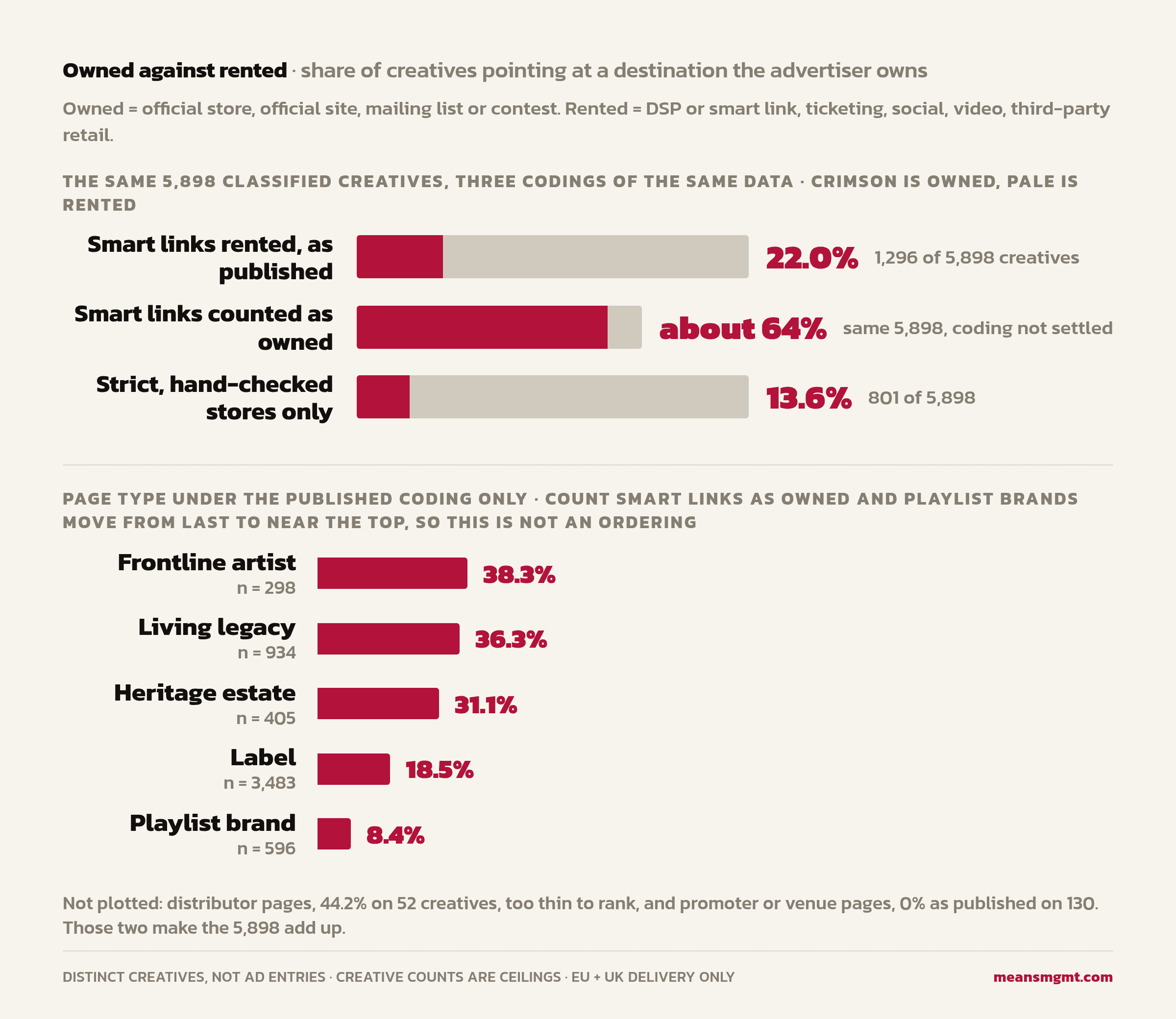
Follow every campaign to its end and the same thing happens. Warner keeps the Topsify playlist followers. Amazon keeps the subscriber it pulled onto its app from Michael Jackson's page. The cinema distributor keeps the ticket buyer. The merch operator keeps the customer record. The artist gets royalties (hopefully) and a credit line. The catalog gets streams it cannot attribute to anything.
The destination belongs to somebody else, so the audience belongs to whoever paid. It stays there when the campaign ends.
When nobody with rights is buying
EsDeeKid is a Liverpool rapper, debut mixtape out, touring Europe. He has no advertising presence in this archive. No page running ads, no smart link.
Search his name and at least 240 ad entries come back across 69 pages. Every one bought by somebody else. Promoters selling their own shows, correctly disclosed. Merch operations running through link shorteners. Sample-pack sellers renting the sound. Every ad in that probe accrued to a ticket agency, a bootlegger, or a beat seller. Meta curates the archive and removes ads flagged through enforcement, so probe counts on merch and bootleg material are floors.
Bonnie Tyler died on 8 July 2026. On 12 August a near-total eclipse crossed the UK. "Total Eclipse of the Heart" was up 94 percent for the week. The Ad Library carried at least 420 entries across 124 pages buying her name. Zero from Sony, Columbia, RCA, Legacy, any playlist brand, or anything resembling a rights holder.
What ran was tribute-show ticketing, boosted funeral coverage, and merch. One storefront's first ad under her name started 13 days after she died and was still live on the day of her funeral. The creative listed Elvis, Ozzy Osbourne, Hulk Hogan, Prince, and Bonnie Tyler.
The audience that formed around her death got monetized entirely by people who don't hold the rights. The probe's pagination reaches back only to 13 July, so the first five days after her death are unobserved. A US-only buy would be invisible here, and that constraint applies to everything in this data.
The one field that should tell you
The DSA requires platforms to name who paid for an ad. Meta has the field. It sits on every EU-delivered entry, and anyone can query it through the public API.
The field is self-declared. Meta does not verify it. On 148 entries for Dua Lipa it says Madonna. On 541 entries for Universal Music Portugal, across fourteen months, it says Karol G, and none of those ads sold a Karol G product. On a Warner playlist page, a Romanian singer's name sat in the field for months because somebody typed it during her campaign and nobody changed it back.
That the field accepts unverified free text was already documented in DSA fraud research. What wasn't measured was the scale of it in legitimate music advertising. Across roughly 31,700 disclosing entries in a wider payer study, at least 5 percent carry an adjudicated wrong payer. That is a floor, because it counts only what somebody opened and checked by reading the actual ads.
Most of the industry gets it right. Sony Music Austria, 118 of 118 entries. Universal Music Ireland, 176 of 177. But the stale strings sit on shared multi-artist accounts, which are the accounts carrying the most volume.
X was fined 120 million euros for not carrying the field at all. Carrying it with no verification is a different failure. The full accounting of what the field actually names, the wrong strings, the junk values, and the ambiguity that makes aggregation impossible, is a separate piece. (see the companion piece on payer-field accuracy)
If you own or manage a catalog
Search the Ad Library for your artist. It takes ten minutes and it is free. It shows every page running ads under that name in the EU and UK, plus who declared themselves the payer on the European ones. The catalog owners I have shown this to had never looked.
Pages using the name that you don't recognize. Payers on your own campaigns that you can't account for. Campaigns you didn't know were running, which is more common than it sounds when a catalog is licensed across territories.
Then count how many of your own ads point somewhere you own, counting a smart link as somebody else's, because the DSP behind it keeps the listener. If you land near a fifth, you're where most of this corpus sits.
If you want somebody to run that audit properly, across every territory and every page, that is work we do. The ten-minute version costs nothing, and the search bar is at facebook.com/ads/library.
Notes
Meta's public Ad Library, pulled 16 August 2026, covering July 2025 onward. EU and UK delivery only, so a US-only campaign never appears. Motown, country, and most American hip-hop barely show up.
Payer counts are the European slice. The field is self-declared and unverified. UK-delivered ads carry none of it.
Rates count distinct campaigns rather than ad entries, because the same creative gets filed dozens of times. A campaign here is a distinct page and body-text pair. Creative counts are ceilings, because the API sometimes returns the same body concatenated to itself.
The payer field does not say who paid. It says what an ad account was registered as when that ad set was built.
FAQ
When do labels run ads for catalog artists?
Do dead artists get marketed differently from living ones?
How far back does the Meta Ad Library go?
Why count campaigns instead of ads?
This is the work we do all day.
If you have a release coming, the 3-minute intake tells us everything we need to scope your campaign. Want the numbers first? The benchmarks report is free.

