
·
Spotify
·
Bought Streams and Real Streams Look the Same Until You Check the Save Rate
Fake Spotify streams and real growth look identical on a stream counter. The save rate gives them away. Here's the litmus test you can run yourself.

MeansMGMT
If your stream count went up but your save rate didn't, what you paid for was a liability.
In March 2026, a 54-year-old from North Carolina pleaded guilty in the first US criminal case of AI-assisted streaming fraud. Michael Smith made hundreds of thousands of songs with AI and used bots to stream them billions of times. He collected more than $8 million in royalties before the Department of Justice caught up with him. He's facing prison and forfeiting every dollar.
Smith is the cartoon version. The everyday version is quieter and far more common: the $40 "playlist promo" that inflates your numbers, the agency that reports streams and never reports saves. Beatdapp, which analyzes streaming data for fraud, estimates that at least 10 percent of all streams are fake. That drains roughly $2 billion a year out of the pool that pays everyone else. A lot of it is ordinary artists buying numbers they think they need.
On a stream counter, bought streams look exactly like real growth.
The counter lies. The behavior doesn't.
Two campaigns can both show 50,000 streams. One found real listeners. The other found a bot farm. From the dashboard's headline number, you can't tell them apart. Underneath, they behave nothing alike.
Real ad-driven listeners do things. They save the track. Some follow the artist. A measurable share come back over the next 7 and 30 days. Bought streams do none of that. A bot plays the song and disappears. So the gap shows up in the ratios, not the totals: save rate, follower conversion, and retention.
This is why we treat save rate as the single most honest signal a campaign produces. It's the percentage of listeners who add the track to their library. It's hard to fake at scale, because saving takes a real person deciding they want to hear the song again.
What the numbers actually look like
We grade save rate on a simple scale. Below 8 percent, something is wrong: the wrong audience, the wrong song, or creative that isn't landing. Between 8 and 15 percent is solid. Above 15 percent is strong. Above 20 percent is exceptional, and saves like that help Spotify's algorithm pick the track up.
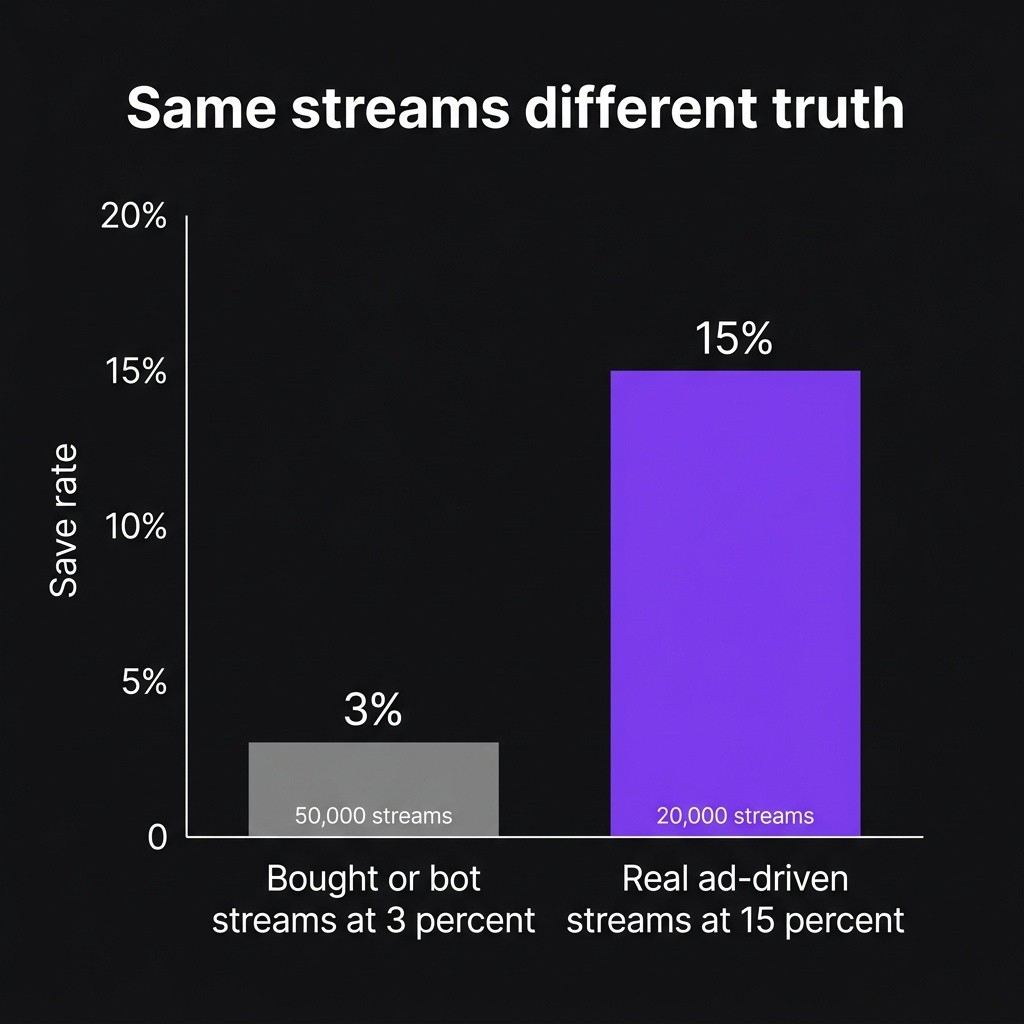
Put that against a stream count and the picture flips. A campaign with 50,000 streams and a 3 percent save rate is worse than one with 20,000 streams and a 15 percent save rate. The second campaign built an audience; the first mostly bought attention. We laid out the full case for why save rate beats raw stream count, and it's the number we report on every campaign we run.
Bought streams aren't neutral. They're a liability.
The pitch for fake streams is that they're a harmless shortcut. They aren't. Spotify's fraud detection is better than it was. When it flags artificial streaming, it can strip the streams off your track and, in some cases, the track off the platform. Distributors have started passing penalties straight to the artist. The third-party service that botted your song faces nothing. You face the strike.
And even when nothing gets caught, you've spent money building something you can't use. You can't retarget a bot. You can't sell a ticket to a bot.
The test you can run yourself
You don't need our tools to sanity-check a campaign. Pull up the song's analytics and ask three questions. Did saves and follows move with the streams, or did the streams move alone? Does the listener geography match where you actually targeted, or is it scattered across markets you never bought? Did the numbers hold for a week or two after the spend stopped, or did they fall off a cliff?
If saves stayed flat while streams spiked, you already have your answer.
It's also why we run our Meta and TikTok campaigns at MeansMGMT to real listeners, and measure them by save rate and retention rather than play count. If you want to see what real campaign data looks like, it's in our case studies, next to the playbook for how we actually promote on Spotify.
FAQ
Questions we get
If you have a release coming, start with two quick questions, about three minutes in total, and we’ll scope your campaign. Want the numbers first? The benchmarks report is free.

