
·
Paid ads
·
Increase Spotify Listens with Meta and TikTok Ads
Spotify's own ads are a small lever. The real way to promote music on Spotify is Meta and TikTok ads that drive listeners who save. Here's the playbook, with our numbers.

MeansMGMT
A stream you paid for is only worth something if the listener saves the track. That's the number we optimize, not the play count.
Most advice on how to promote music on Spotify starts and ends with Spotify's own ad tools. That's the small lever. Spotify Ads Manager (the self-serve platform formerly called Ad Studio) runs on an auction with no published CPM, so you register for free and set your own budget. It plays audio, video, display, and carousel ads to free-tier listeners. It works, in a narrow way. It puts your name in front of people who are already inside the app. What it can't do is build an audience you get to reach a second time.
The bigger lever sits outside Spotify. Across 600+ campaigns, the most reliable way we've found to grow streams and saves is paid ads on Meta and TikTok. We point them at a smart link that sends listeners into Spotify.
TL;DR
Spotify Ads Manager (formerly Ad Studio) is an auction with no published CPM or set minimum; you register free and set your own budget. It reaches free-tier listeners, but it can't build an audience you get to reach again.
The real engine for promoting music on Spotify is paid Meta and TikTok ads to a smart link, which build a retargetable audience and a measurable cost per save.
Save rate is the signal that matters, not stream count: under 8% is a problem, 8 to 15% is solid, above 15% is strong.
You don't run ads to earn stream royalties back (those run about $0.003 to $0.005 a stream); the payoff is the algorithmic flywheel and an audience you own.
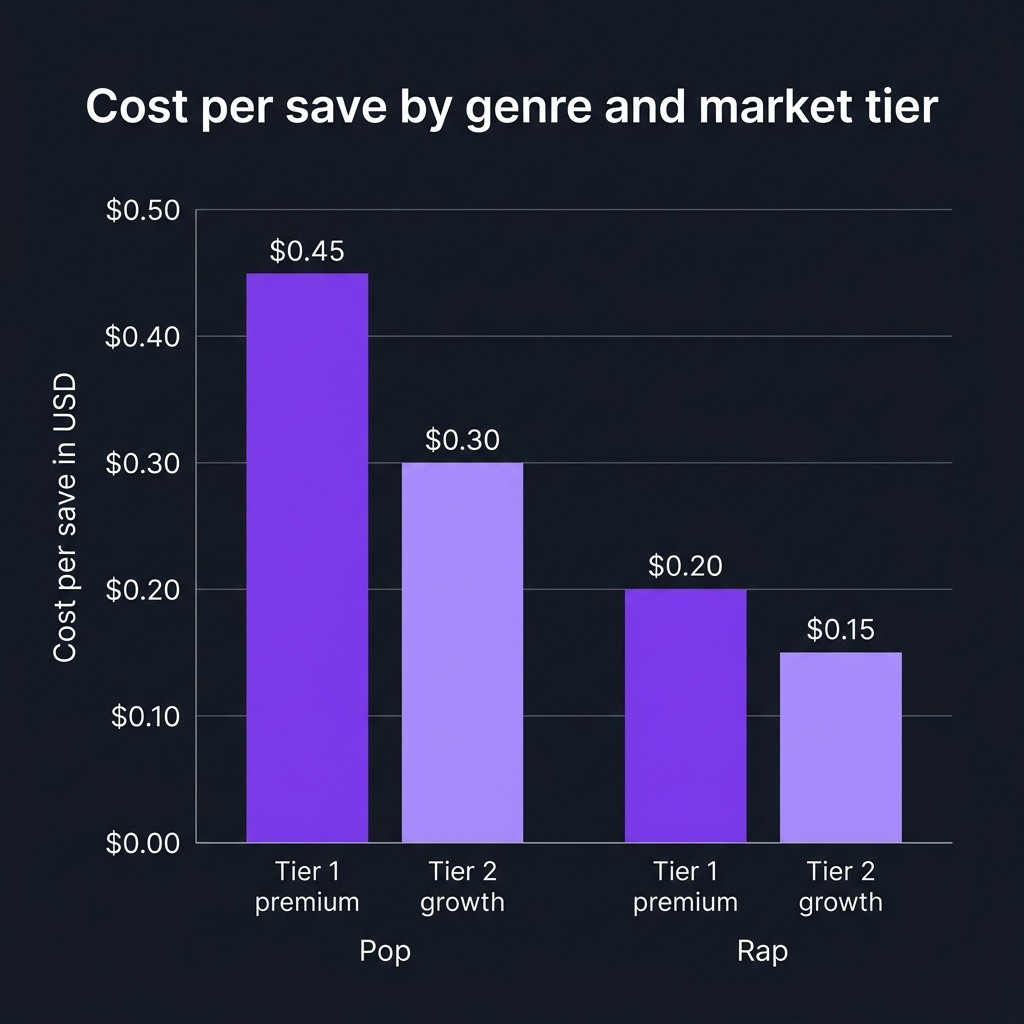
Typical cost per save runs about $0.30 to $0.45 for pop and $0.15 to $0.20 for rap, by market tier and creative quality.
What Spotify's own ads can and can't do
A Spotify ad reaches someone mid-session, then the session ends. You don't get a pixel. You can't build a retargeting pool. You can't easily tell which impressions turned into saves versus skips. It's a fine awareness tool for a release week. It's a poor foundation for sustained growth, because every dollar buys a moment of attention and then it's gone.
The real engine: Meta and TikTok ads to a smart link
Run an ad on Meta or TikTok and send the click to a landing page (we use Feature.fm) that offers every streaming service. Then track who chooses Spotify and presses play. It filters for intent, because someone who taps "Play on Spotify" actually wants to hear the song. And it gives you data: a retargetable audience, a pixel, and a clear cost per result.
TikTok puts the song into culture and works best when the sound is already moving. Meta is the workhorse for steady streaming and pre-saves, with deep retargeting. We usually run both and let the data decide. We often start cold (no targeting, letting the platform find your listeners) alongside a genre-interest set and a lookalike built from existing engagement. Our breakdown of the cost-per-save math on Meta goes deeper on the setup.
The one number that tells you it's working
Stream count is the easiest thing to inflate and the least useful thing to chase. Save rate is the signal. It's the share of listeners who add the track to their library, and it tells you whether the people your ads found actually like the music.
Our grading is simple. Below 8 percent, something needs fixing. Between 8 and 15 percent is solid. Above 15 percent is strong. Above 20 percent is exceptional, and saves at that rate help organic playlist placements follow. A campaign that drives 50,000 streams at a 3 percent save rate is worse than one that drives 20,000 at 15 percent. The second built a fanbase; the first built a number. We wrote a whole piece on why save rate beats stream count, and it pairs with the harder question of whether your streams are even real.
What it actually costs (the honest version)
Per-stream payouts sit around $0.003 to $0.005, and they shift with the listener's country and subscription tier. That math matters, because it means you don't run ads to earn stream revenue back. A campaign that drives 100,000 streams generates roughly $400 in royalties. If you spent $1,000 to get there, the direct return is negative, and that's normal.
The value compounds elsewhere. Our design target is 10,000 streams in 28 days at a 10 percent save rate. When a track gets there, Spotify's algorithm is more likely to pick it up for Discover Weekly, Release Radar, and editorial consideration. That organic lift is where campaigns turn profitable. It's a target, not a guarantee. Any agency that promises the placement is guessing.
On cost, a typical cost per save runs about $0.30 in growth markets and $0.45 in premium markets for pop, and closer to $0.15 and $0.20 for rap. These are averaged figures from real campaigns, and they move with genre and creative quality. Name your genre and your market tier before you trust any benchmark, including ours.
Where the budget should go
If you have a release week and a few hundred dollars to spend on awareness inside the app, Spotify Ads Manager is a reasonable place to put it. If you want streams, saves, and an audience you can build on, put the budget into Meta and TikTok and measure cost per save. Then let the algorithm flywheel do the compounding.
That's the work we do at MeansMGMT every day: paid campaigns on the client's own ad accounts, reported with real cost per stream and cost per save. If you want to see it on real releases, the numbers are in our case studies.
FAQ
Questions we get
If you have a release coming, start with two quick questions, about three minutes in total, and we’ll scope your campaign. Want the numbers first? The benchmarks report is free.

