
·
Paid ads
·
Meta Ads for Music: The Cost-Per-Save Math vs Playlists
Meta ads for music give you a real cost per save by genre and market tier. Here is the math, what good looks like, and when paid ads beat playlist pitching.

MeansMGMT
Meta ads for music convert at a cost per save you can name. In MeansMGMT internal campaign data, it runs roughly $0.15 to $1.10 per Spotify save, depending on genre and market tier. That number is the case for paid ads over playlist pitching. A pitch rarely tells you what each save cost, and it doesn't let you keep the audience you paid to reach.
TL;DR
Cost per save is spend divided by saves; on Meta it runs about $0.15 to $1.10 by genre and tier.
Genre and market tier move the number more than anything else: name both, always.
Premium markets cost more per save; growth markets often run about half to three quarters of that.
Meta gives you what a playlist pitch cannot: a measurable, repeatable cost per save.
Budget for a target number of saves, not a round dollar figure.
What cost per save actually measures (and what Meta does not report)
A save is a listener adding your track to their library or a playlist, which is the clearest signal that a campaign reached someone who actually liked the song. Cost per save is the spend divided by those saves. Meta never reports a save, and that trips up most people running Meta ads for music.
Meta Ads Manager, Meta's self-serve platform for Facebook and Instagram, only reports impressions, clicks, and landing-page views. The save happens one step later, on Spotify. So when you run Instagram or Facebook ads for artists, the ad sends listeners to a smart link, a single landing page that routes each person to their streaming service. The save shows up afterward in Spotify for Artists, Spotify's analytics dashboard.
We attribute it by dividing the save lift we see there by verified smart-link clicks. Which clicks count depends on the click-through window you set. That makes cost per save a typical, averaged figure, not an exact line item Meta hands you. It is still the most honest number in the funnel, and it is the one that explains why save rate beats raw streams. If you are still deciding who runs Meta ads for Spotify, this is the metric to ask them about first.
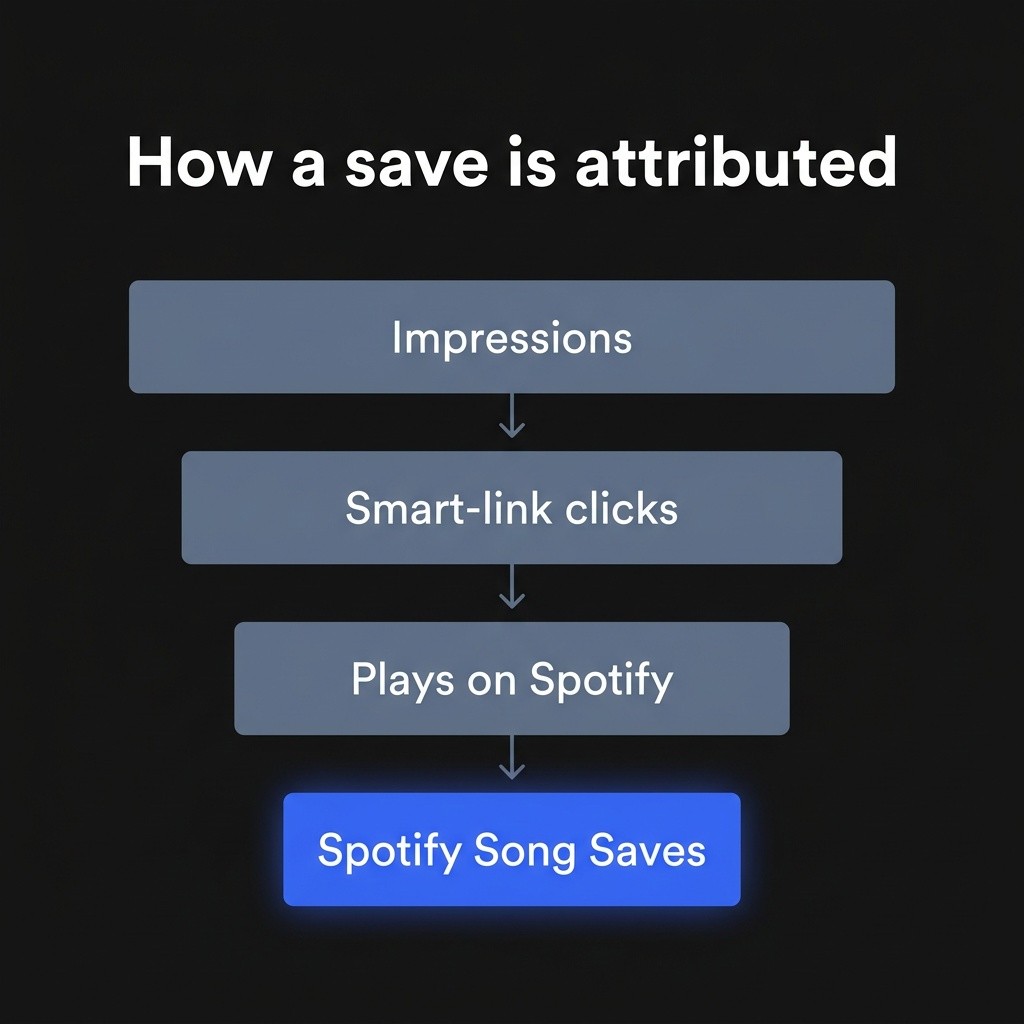
The cost-per-save math: clicks, save rate, and what you pay per save
The math is simple once you separate the two numbers that drive it. A campaign buys clicks at a cost per click, and some share of those clicks turn into saves at a save rate. Multiply clicks by save rate and you get saves; divide spend by saves and you get cost per save. The shortcut is cost per click divided by saves per click.
Take a Pop release in premium markets. Our typical cost per smart-link click is about $0.25, and Pop campaigns return about 0.51 saves per click, so each save costs roughly $0.49. (MeansMGMT internal campaign data, 9 artists, $808K+ in paid spend across Meta, Google, and TikTok, 2026 H1.) That figure is your real cost per outcome on Meta, and it is far more useful than a raw stream count.
A streaming smart-link campaign, the usual setup for Facebook ads for Spotify, gives you a cost per save you can read straight off the result. The number exists, it is stable enough to plan against, and it moves mostly with genre and market tier.
Cost per save by genre and market tier
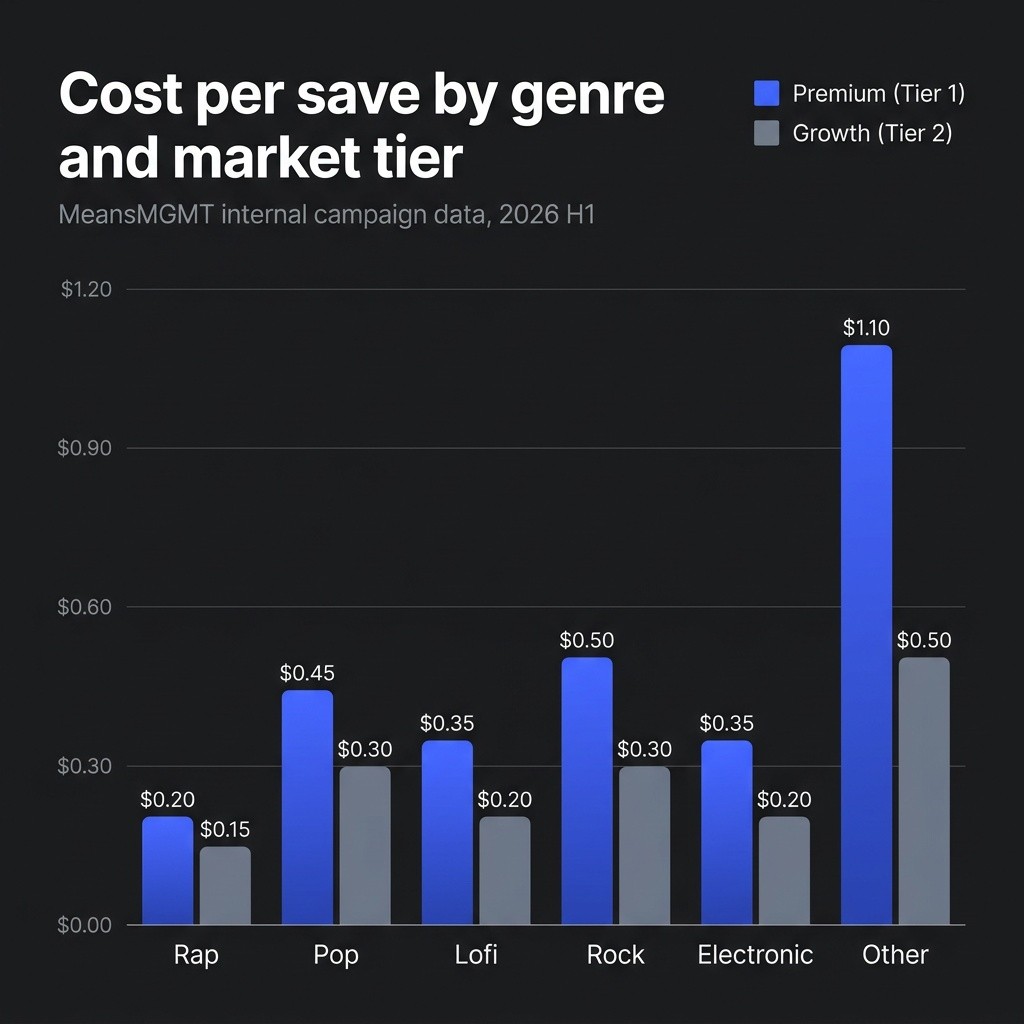
Genre and market tier move cost per save more than creative, targeting, or budget. Tier 1 covers premium markets (the US, UK, Canada, and similar), where attention is expensive. Tier 2 covers growth markets (Mexico, Brazil, India, and similar), where the same dollar buys several times more.
The table below shows typical cost per save by genre and tier, per MeansMGMT internal campaign data. Read it as a planning range, not a guarantee. Always quote genre and tier together, because a Lofi number and a Rock number differ, and averaging them hides the context that matters.
Genre | Tier 1 (premium) | Tier 2 (growth) |
|---|---|---|
Rap / Hip-Hop | $0.20 | $0.15 |
Pop / General | $0.45 | $0.30 |
Lofi / Ambient | $0.35 | $0.20 |
Rock / Alt | $0.50 | $0.30 |
Electronic | $0.35 | $0.20 |
Other / Niche | $1.10 | $0.50 |
Rap / Hip-Hop delivers the cheapest saves in our data. Niche genres are the priciest per save, and Pop sits in the middle. Cost per save tracks the save rate more than the click price. The same release usually costs less per save in growth markets, though not always by as much as the cheaper clicks suggest. The gap is widest for niche genres and narrowest for Rap.
When Meta Ads beat playlist pitching (and when they do not)
Meta beats playlist pitching on the thing a pitch cannot produce: a measurable, repeatable cost per save. Editorial playlist pitching, the free kind you submit through Spotify for Artists, is always worth doing, but it is unpredictable and gives you no per-save cost to plan against. Paid playlist-push services sit at the other end: they rarely show you what each save cost, they keep the audience data, and some carry real authenticity risk.
You get a cost per save you can name and improve. You keep the audience: the people who clicked become a retargeting pool you own, not data trapped inside someone else's service. And the listeners are real, reached through a legitimate ad platform, which is what a playlist campaign we ran on Meta Ads shows.
Pitching still earns its place for the credibility of an editorial add and the organic reach it can spark. The right move is usually both: pitch for free, and run paid ads for the saves you can actually budget. If you are weighing channels, the same logic applies to what a YouTube ad view costs, because the platforms complement each other rather than compete.
Worked example: a $1,000 Pop release in premium markets
Put $1,000 behind a Pop single in premium markets and the math reads like this. At a typical $0.25 cost per smart-link click, $1,000 buys about 4,000 clicks. Pop campaigns return roughly 0.51 saves per click and about 7 streams per click (MeansMGMT internal campaign data, 2026 H1). So the campaign produces around 2,040 saves and roughly 28,000 streams. That puts cost per save near $0.49 and cost per stream around $0.035.
We have not established how much of a campaign's streaming holds after it ends. So the readout is 2,040 listeners who told the algorithm the song was worth keeping. It also leaves a retargeting pool of 4,000 engaged clickers you can reuse on the next release.
Scaled up, the per-save cost holds steady, as a high-budget single launch we documented shows. Change the genre or tier and only the input rates change; the method does not.
Is $10 a day enough? Budget floors that move saves
Ten dollars a day will run a campaign, but it rarely produces enough signal to optimize one. Meta's delivery system needs a steady volume of optimization events to exit the learning phase, when it is still working out who to show your ad to. Starve it and the campaign stays stuck there, spending unevenly and never settling into a clean cost per save.
At a Pop premium-market cost per click of $0.25, $10 a day buys about 40 clicks and roughly 20 saves. That keeps a campaign running, but it can't test two audiences and two creatives against each other in a week. A more useful test floor is $30 to $50 a day. At $0.25 a click that is 120 to 200 clicks a day, enough to read the cost per save.
Spend less if your genre and tier are cheap (Rap or Lofi in growth markets stretch a budget further), and more if they are not. The rule is to budget toward a number of saves you want to learn from, then read the cost per save and decide whether to scale.
How MeansMGMT runs cost-per-save Meta campaigns
MeansMGMT is a Pittsburgh-based music marketing agency that runs paid campaigns on Meta, Google, and TikTok. Cost per save is one of the numbers a release campaign is held to, alongside its CPM, cost per stream, and retention curve. The campaigns run on the client's own assets. The smart link, the pixel data, and the retargeting audience belong to the artist and stay with them if the relationship ends.
The reporting is built to show its work. Every number names its genre and market tier and is given as a typical or averaged figure. A case study is attached when a performance claim needs backing.
FAQ
Questions we get
If you have a release coming, start your campaign now or book a call first, and we’ll scope it with you. Want the numbers first? The benchmarks report is free.

