
·
Paid ads
·
YouTube Ads for Musicians: What a View Actually Costs
YouTube ads for musicians cost under a cent per view in growth markets. It covers what a view costs by tier, which ad formats to run, and how to size a launch.

MeansMGMT
YouTube ads for musicians cost from a fraction of a cent per view in growth markets to about a cent in premium ones, per MeansMGMT internal campaign data. A view is about as cheap as paid attention gets, and the subscribers those views earn along the way are the durable audience you keep afterward.
TL;DR
Cost per view runs under a cent in growth markets, around a cent in premium ones.
You pay per view, not per spot: skippable ads charge after 30 seconds or an interaction.
Market tier is the biggest lever: a premium view costs about four to five times a growth-market view.
Your budget buys views; the subscribers those views earn along the way are the durable payoff.
Skippable in-stream and in-feed ads run on cost per view; bumpers run on reach.
What a YouTube view actually costs (and how you are billed)
A view on YouTube is cheap, and you only pay for the ones people actually watch. You buy YouTube ads through Google Ads, Google's ad platform. The default way to pay for a skippable in-stream ad (the one a viewer can skip after five seconds) is cost per view, or CPV. You're charged when someone watches 30 seconds, the whole ad if it's shorter, or interacts with it, whichever comes first (per Google Ads Help, About CPV bidding).
You do not pay for the skips. People who bail in the first few seconds cost you nothing, so your spend goes to listeners who actually watched.
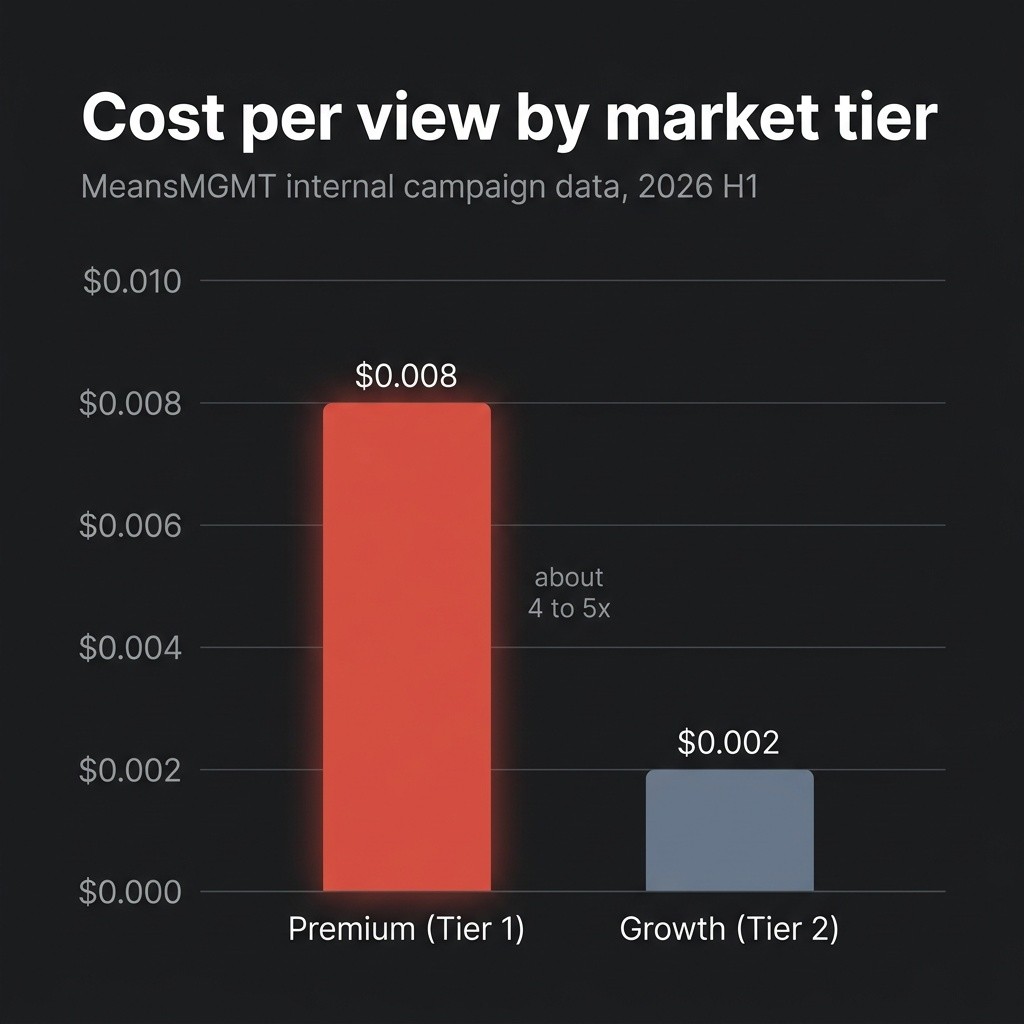
Typical cost per view in our campaigns runs about $0.008 in premium markets and around $0.002 in growth markets, so a dollar buys somewhere between roughly 125 and 500 watches. That is the cost-per-view benchmark to plan against. It's also the base for a YouTube music-video launch we ran that reached 4.3M+ views.
Cost per view by market tier
Market tier sets the price of a view more than anything else. Tier 1 means premium markets (the US, UK, Canada, and similar), where viewer attention is contested and expensive. Tier 2 means growth markets (Mexico, Brazil, India, and similar), where the same budget buys several times more watches.
The table below shows typical cost per view by tier from MeansMGMT internal campaign data. That covers 9 artists and $808K+ in spend across Meta, Google, and TikTok, including $28K+ on Google Ads (2026 H1). Quote the tier whenever you cite a number, because a premium view costs roughly four to five times a growth view. An average across both hides that.
Tier | Low | Average | High |
|---|---|---|---|
Tier 1 (premium) | $0.005 | $0.008 | $0.015 |
Tier 2 (growth) | $0.001 | $0.002 | $0.003 |
Growth markets aren't always better. A view is the cheapest unit of attention you can buy on YouTube, and tier sets its price. A view doesn't buy a returning listener on its own. Subscribers do that.
The subscribers your views earn
A view is one watch; a subscriber is a person who opts in to see more from you. You do not buy subscribers directly: they are what some share of your paid viewers choose to become, the durable byproduct of a view campaign. A view ends when the video does, and a subscriber can get notified of your next release. That's also why engagement predicts a release's longevity better than raw view counts.
Subscribers also compound across a catalog. If you release often, every subscriber a campaign earns can get notified of your next ten uploads, so one view-driven sign-up keeps paying off across all of them. A well-built view campaign leaves an audience behind after the watch you paid for.
How to weight your view budget
The budget buys views in every case; what changes is what those views are doing for you. In release week you want the video in front of as many relevant people as possible. You want watch-time to feed the algorithm and a large retargeting pool for the next drop. Views are how you buy all of that, cheaply.
A catalog is a relationship, and the subscribers those views earn are what serve it over time. The choice is how much view budget to spend and when. Spend heaviest at launch, then keep a smaller view push running once a video proves out, since more views earn more subscribers.
Paid YouTube views also build watch-time and a retargeting audience that support the wider campaign. It's the same logic behind how paid ads on other platforms feed Spotify and the cost-per-save math on Meta. YouTube rarely works best in isolation, which is the pattern across every channel we run.
The YouTube ad formats a musician should run
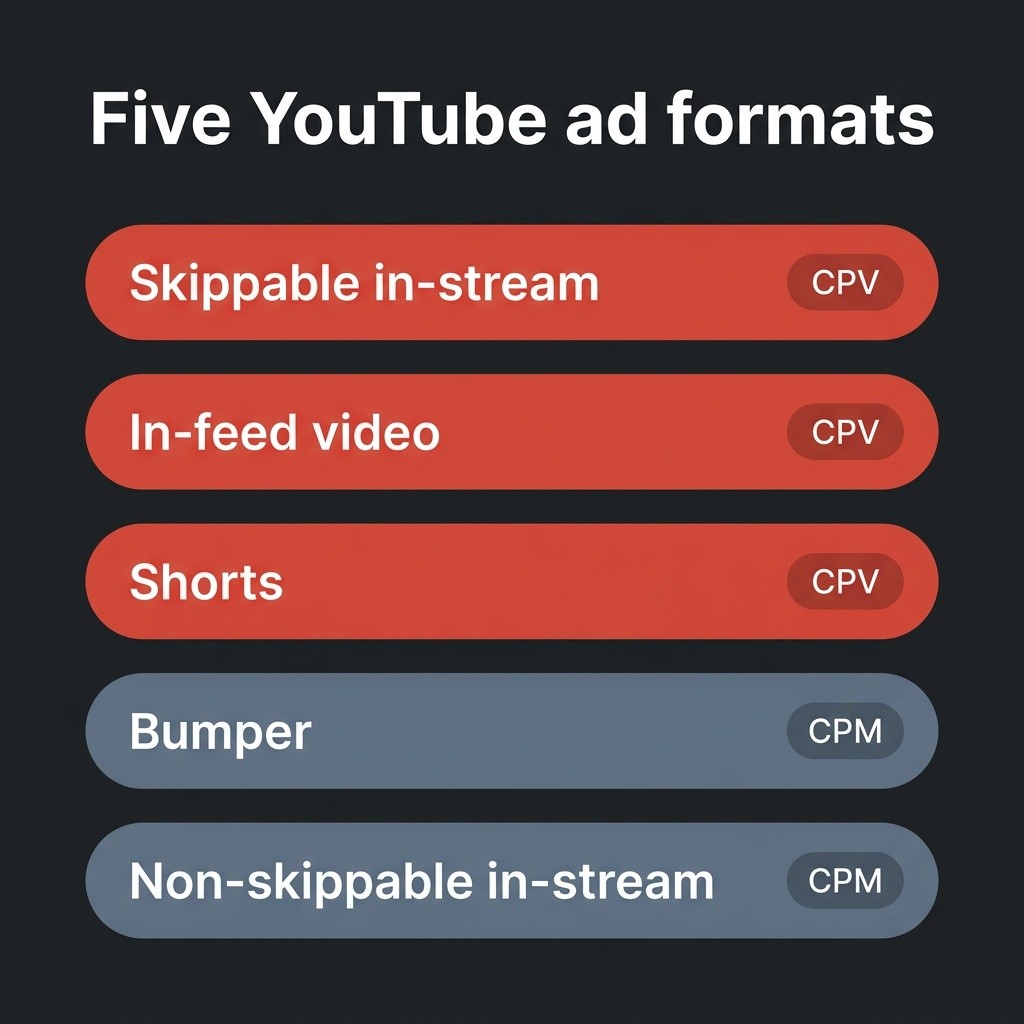
Google's ad-format page lists six video formats, but only five are ones a musician runs; the sixth, the Masthead, is a reservation-only homepage banner sold through a Google sales rep. Skippable in-stream ads play before or during another video and can be skipped after five seconds; they run on cost per view and are the workhorse for music. In-feed video ads appear in search and alongside related videos. They also bill on a view (a thumbnail click or a ten-second autoplay), which makes them strong for music discovery.
Bumper ads are six seconds, non-skippable, and sold on a cost-per-thousand-impressions reach basis, not per view. Non-skippable in-stream ads (up to 60 seconds, usually 15 to 30) are also a reach buy. Shorts ads round out the five.
For most music video campaigns, skippable in-stream plus in-feed is the cost-efficient core. You pay for watches rather than impressions (per Google Ads Help, About video ad formats). Reach formats like bumpers have their place for a short, memorable hook around a big release, but they're a branding spend.
Worked example: a $500 music video launch in growth markets
A $500 view campaign in growth markets buys about 250,000 views and earns a few thousand subscribers along the way, since some of those viewers subscribe. The subscribers aren't a second line item. They come with the reach and watch-time.
Pair that reach with the rest of the release, the way a multi-platform launch we documented for Zoe Levert used YouTube alongside streaming and social. Then the views feed the campaign.
How MeansMGMT runs YouTube ad campaigns for artists
MeansMGMT is a Pittsburgh-based music marketing agency and Google Ads Certified in Video and Search, so YouTube is a core channel we run. The cost-per-view benchmarks behind a plan come from past campaigns, not a pitch deck.
The campaigns run on the client's own Google Ads and YouTube assets, so the audience data, the retargeting pools, and the view history stay with the artist. Every campaign is reported with its real cost per view and the subscribers it earned, tied to a case study when a claim needs proof. A view that costs a fraction of a cent is only worth buying if you know what it did next. Our reports follow the spend through to subscribers and streams.
FAQ
Questions we get
If you have a release coming, start your campaign now or book a call first, and we’ll scope it with you. Want the numbers first? The benchmarks report is free.

