
·
Strategy
·
Music Catalog Marketing: Make Old Releases Earn Again
Reviving a dead catalog title with paid ads: the 1,000-stream royalty threshold, what a reactivated stream costs, and the yield math for rights owners.

MeansMGMT
The first 1,000 eligible streams are the ones that make every stream after them pay.
One of the highest-yield moves in a catalog is reviving a dead title. Run paid ads at an old release, push it back over Spotify's 1,000-stream royalty line, and watch the cost per stream against what the title actually earns. A track that streams under 1,000 times a year has crossed a hard line: below that count it earns no recording royalty at all. Paid ads are the most measurable way to fix that.
TL;DR
Catalog reactivation runs paid ads at an old title to rebuild streams at a known cost per stream.
Spotify pays only tracks with at least 1,000 streams in the prior 12 months; below that, a track earns no recording royalty.
A reactivated stream costs a few cents, depending on genre and tier, the same as any streaming campaign.
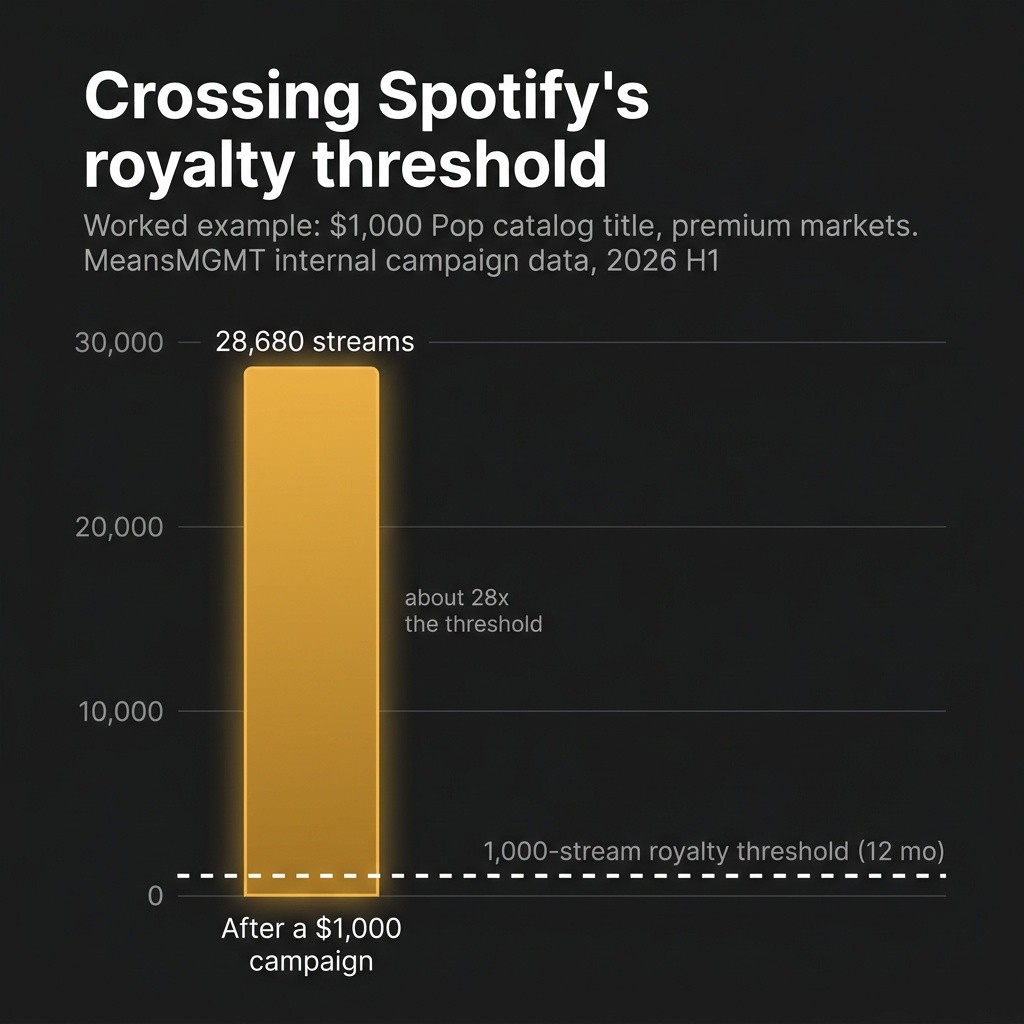
A $1,000 Pop campaign in premium markets buys about 28,680 streams, clearing the threshold many times over.
Reactivation is worth it when the per-stream cost beats the title's royalty yield and strategic value.
What back catalog reactivation actually means
Back catalog reactivation is using paid advertising to rebuild streaming demand for a release that has gone quiet, usually a title more than a few years old. For a rights owner or label, the catalog is the asset, and most of it sits dormant. It earned during its release window, then settled into a long tail that drifts toward zero. Reactivation treats that tail as a marketing problem with a measurable answer, not a fixed decline you wait out.
The mechanics match any streaming campaign. You run ads on Meta, Google, or TikTok to a smart link, a single landing page that routes a listener to Spotify, Apple Music, or YouTube. Then you measure the result in streams, saves, and cost per stream. What changes with a catalog title is the framing. This is marketing aimed at royalty yield, not a launch aimed at a debut. The same thinking behind label marketing ROI in the streaming ecosystem applies, pointed at an asset you already own.
Below 1,000 streams a year, a catalog title earns nothing
Since April 2024, a track has to reach at least 1,000 streams in the previous 12 months to earn anything from Spotify's recorded-royalty pool. Those streams also have to come from a minimum number of unique listeners (per Spotify's Track monetization eligibility documentation). A title sliding from 1,200 annual streams to 900 loses a quarter of its plays and its eligibility with it. At 900 it earns nothing on the recording side. We wrote up the mechanic in full in the Spotify 1,000-stream rule.
Reviving a dead title flips an asset from $0 back to earning, rather than buying a few incremental plays. Crossing back over that line is the first concrete goal of any campaign aimed at an old release.
What it costs to reactivate a catalog title with paid ads
A reactivated stream costs what any streaming campaign stream costs, because the delivery is identical: an ad, a click, a smart link, a play. The price is set by genre and market tier, and you should always name both. In premium (Tier 1) markets our first-party data runs from about $0.018 per stream for Lofi and Ambient up to about $0.088 for Rap and Hip-Hop. Pop sits around $0.035 (MeansMGMT internal campaign data, 9 artists, $808K+ in paid spend across Meta, Google, and TikTok, 2026 H1). Cost per stream swings roughly fivefold across genres, so the genre of the title you're reviving sets the budget as much as the spend does. The full genre-by-genre breakdown, with cost per click and streams per click for each row, lives on our Spotify ads cost page rather than repeated here.
Growth (Tier 2) markets run cheaper per stream but reach a different audience. Promoting an old song is mostly a budgeting exercise once you have the unit costs: pick the genre, pick the tier, and the cost per stream falls out. It's also why we steer owners away from opaque one-click promo, where you can't see a cost per stream at all.
The royalty-yield math: streams, retention, and the threshold
Reactivation pays when the title is worth more per stream than the stream cost to buy. A catalog owner already knows that second number from their royalty statements. The campaign supplies the first. If a Pop title costs about $0.035 a stream to reactivate in premium markets, the question is whether the recording royalty plus the title's strategic value clears that. For a catalog with sync potential or a recognizable name, it usually does.
Eligibility tilts the math toward the owner. Once the title is back over the threshold it earns on every stream again, so the campaign restores earning status on top of the streams it buys. Because the 1,000-stream count looks back 12 months, one push keeps the title eligible for about a year. For a catalog owner, durable lift is why retention matters more than a launch-week bump.
Worked example: $1,000 into a dormant Pop catalog title
Take a dormant Pop title and a $1,000 reactivation budget in premium markets. At a $0.25 cost per click, $1,000 buys about 4,000 clicks. At 7.17 streams per click for Pop, that's roughly 28,680 streams, or about $0.035 per stream. The same clicks drive around 2,040 saves at the Pop rate of 0.51 saves per click, the listeners most likely to come back.
Set that against the threshold. A title needs 1,000 eligible streams in 12 months to earn at all. This single campaign delivers roughly 28 times that in one push. Because the count looks back 12 months, those streams keep the title eligible for about a year.
Run your own genre and tier and the result is similar. A modest budget turns a dead title into an earning one, and you can see exactly what each stream cost.
When catalog reactivation is worth it (and when it's not)
Reactivation is worth it when a title has latent value the streams can realize. That means sync or placement potential, a recognizable name, a past chart run, or a catalog deep enough to reactivate several titles at once. In those cases the per-stream cost is small against the asset's earning life, and crossing the eligibility threshold is pure upside.
It's not worth it for every dormant track. A title with no sync angle, no name recognition, and a royalty rate below its cost per stream will lose money on reactivation, and no campaign fixes weak underlying demand. We apply the same filter to a new release: if the measurable yield doesn't beat the measurable cost, don't spend. TikTok is often the cheapest way to test whether latent demand exists, since paid TikTok views can reintroduce an old track before you commit a full streaming budget. It also helps to know how to tell a reactivated real stream from a bought one, because catalog owners are exactly who the cheap-promo services pitch. You can pressure-test any plan against our case studies.
How MeansMGMT runs catalog reactivation campaigns
MeansMGMT is a Pittsburgh-based music marketing agency that runs paid campaigns for rights owners, labels, and artists across Meta, Google, TikTok, and Spotify Ads. Every campaign reports a real cost per stream, a save rate, and a retention figure. A catalog owner can compare the spend against royalty yield instead of taking a promise on faith.
Campaigns run on the client's own ad accounts and smart-link assets, so the audience data and retargeting pools stay with the owner if the relationship ever ends. Performance claims tie to a specific case study, like a streaming-growth campaign we ran, so the numbers behind a reactivation plan are auditable, not aspirational.
FAQ
Questions we get
If you have a release coming, start your campaign now or book a call first, and we’ll scope it with you. Want the numbers first? The benchmarks report is free.

