·
Paid ads
·
TikTok Ads for Musicians: Cost Per View by Market Tier
TikTok ads for musicians cost a fraction of a cent per view in growth markets. It covers what a view costs by tier, which formats to run, and how it feeds streaming.

MeansMGMT
TikTok ads for musicians cost a fraction of a cent per view, roughly $0.001 in growth markets and $0.003 in premium ones, per MeansMGMT internal campaign data. The reason to run one is the sound the view carries. A Spark Ad puts your track into circulation where listeners can reuse it, Duet it, and go looking for the full song. A YouTube or Meta view buy doesn't do that.
TL;DR
A TikTok ad seeds your sound for reuse, where other platforms just show a video.
Cost per view runs about $0.001 in growth markets and $0.003 in premium ones.
You bid cost per view and pay per view: TikTok charges at a 6-second watch or an early interaction.
Spark Ads boost a real post, so the views, the sound, and any Duets attach to your track and keep working.
TikTok buys reach and sound adoption; streams convert on a paired channel, not from views alone.
What a TikTok ad actually buys: a sound, not just a view
Most ad platforms sell you attention. TikTok sells you attention with a sound stapled to it. When someone watches your ad, the track is playing, and TikTok treats it as a reusable object. A viewer can tap the sound, save it, and make their own video with it. You are seeding a piece of audio that can travel on its own after the spend stops, rather than renting a few seconds in front of a listener.
That is why you run these campaigns through TikTok Ads Manager, TikTok's self-serve ad platform, with the sound front and center rather than a polished brand film. The rest of this piece is about buying that reach cheaply and turning it into streams, but the sound is the reason TikTok belongs in a release plan at all. It's also why treating TikTok Ads Manager like a cheaper YouTube doesn't work.
Spark Ads: how a paid post keeps working organically
Spark Ads are the format that makes the sound mechanic real. A Spark Ad boosts an existing organic TikTok post, so the views, likes, follows, and sound all attach to your real account and track. Viewers can reuse that sound or make a Duet or Stitch (per TikTok Ads Manager Help, About Spark Ads). The paid reach seeds organic behavior you keep: the follows stay, the sound page fills with other people's videos, and none of it resets when the campaign ends.
The other formats have narrower jobs. Auction In-Feed ads are the standard in-feed placement and can carry a call-to-action button to a landing page. That's how you push a warmed-up viewer toward a save or a stream. TopView is the full-screen, sound-on placement shown when someone opens the app. It's a high-impact reach buy that can link to a Music Page, but you reserve it rather than scale it daily. For most musician campaigns on TikTok, Spark Ads are the core and an in-feed traffic ad is the conversion layer. Save the big reach placements for a launch moment.
What a TikTok view costs by market tier
You buy reach on cost per view (CPV). With CPV bidding you're charged per view. A view counts when someone watches 6 seconds or interacts within the first 6 seconds, whichever comes first (per TikTok Ads Manager Help, Available bidding methods). Since 2022, TikTok has reported this as the cost of a single 6-second view instead of a cost per thousand. You don't pay for the thumb that scrolls past in a second. That keeps TikTok ad costs low, because your spend lands on people who actually stopped.
Market tier sets that price more than any creative choice. Tier 1 means premium markets (the US, UK, Canada, and similar); Tier 2 means growth markets (Mexico, Brazil, India, and similar), where the same budget buys several times more views. The table below shows typical cost per view by tier from MeansMGMT internal campaign data. That covers 9 artists and $808K+ in spend across Meta, Google, and TikTok, including $8K+ on TikTok (2026 H1). Quote the tier whenever you cite a number, because a premium view and a growth view differ by roughly three times.
Tier | Low | Average | High |
|---|---|---|---|
Tier 1 (premium) | $0.002 | $0.003 | $0.005 |
Tier 2 (growth) | $0.0005 | $0.001 | $0.002 |
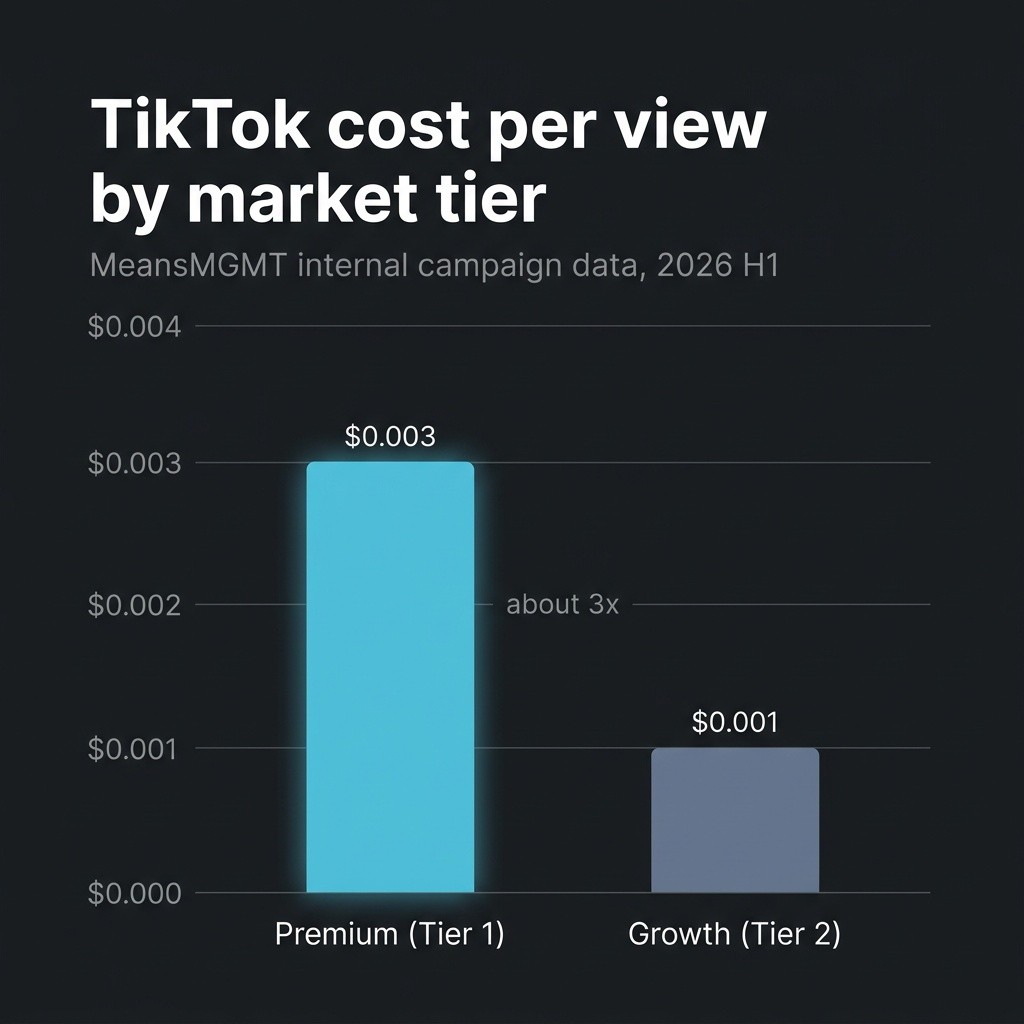
At those prices a single dollar buys somewhere between roughly 330 and 1,000 six-second views, so the markets you choose set the cost floor.
Turning TikTok views into streams
A TikTok view is reach and sound adoption, not a stream, and the platform does not hand you a clean ad-click-to-stream number. It's good at putting your track in front of a lot of relevant people cheaply and getting the sound circulating. That drives profile visits, follows, and organic sound usage that sends listeners looking for the full song. That demand is real, but it is unconverted until you capture it.
The conversion happens on a paired channel. Point the in-feed CTA and a parallel traffic campaign at a smart link, a single landing page that routes a listener to Spotify, Apple Music, or YouTube. That's where the save and the stream get counted. TikTok buys the reach and the sound, and a conversion channel banks the result (more on who runs the ads that convert that attention). TikTok drives a lot of old-song revivals, where a sound catching on pulls a years-old track back up the charts. That's why it pairs well with reviving an old release with paid ads.
Worked example: a $500 Spark Ads campaign in growth markets
Take $500 on a Spark Ad in growth markets at a typical $0.001 per view. That buys roughly 500,000 six-second views of your track, plus the sound exposure that comes with them. The same $500 in premium markets at $0.003 per view buys closer to 167,000 views, fewer watches but in higher-value markets where listeners pay for subscriptions. Neither number is a stream count; it is the reach you bought and the sound you put in motion.
What turns that into outcomes is the hand-off. Run the Spark Ad to seed the sound, and keep an in-feed traffic ad on your smart link to catch the listeners it warms up. Report saves and streams on the conversion channel, the way a multi-platform launch in our case studies used TikTok alongside streaming and social. Half a million cheap views is only worth buying if something downstream is built to convert them.
Is TikTok worth it for a musician?
For most artists, yes, but only with the right expectation. TikTok is worth it when you want a sound circulating and cheap, relevant reach behind it, and when you have a conversion channel ready to bank the attention it creates. A few hundred thousand views and a sound strangers start using, for a few hundred dollars, is a good top-of-funnel buy. The sound adoption can outlast the spend.
It isn't worth it if you expect views to equal streams, or if there's no smart link or traffic ad to convert the reach. It also fails when the budget can't fund the channel that does the converting. Judge TikTok like any reach buy: on cost per view, the sound usage it sparks, and what the paired channel did with the audience. You can sanity-check any plan against our campaign case studies before committing budget.
How MeansMGMT runs TikTok ad campaigns for artists
MeansMGMT is a Pittsburgh-based music marketing agency, and TikTok is one of the core paid channels we run alongside Meta, Google, and Spotify Ads. The cost-per-view benchmarks behind a plan come from past campaigns, reported by genre and market tier.
The campaigns run on the client's own TikTok Ads Manager and smart links. The audience data, retargeting pools, and view history stay with the artist if the relationship ends. We report every campaign's real cost per view and what the paired conversion channel did with the reach. When a performance claim needs proof, we tie it to a case study. A view that costs a fraction of a cent is only worth buying if you know what it did next. Our reports follow the spend to the smart link and the stream.
FAQ
Questions we get
If you have a release coming, start your campaign now or book a call first, and we’ll scope it with you. Want the numbers first? The benchmarks report is free.