·
Playlists
·
Spotify Ad Campaigns vs Playlist Promotion: Worth It?
Paid Spotify ad campaigns give you a cost per save and per stream you can verify. Playlist-push gives a promise. How the two compare, and what each costs.

MeansMGMT
A dollar you can trace is worth more than a dollar you can't, because only the traceable one tells you what to do next time.
Paid Spotify ad campaigns give you a cost per stream and a cost per save you can verify. The playlist-push approach gives you a placement and a promise. A campaign routes paid traffic to your release and reports what every dollar bought, so you can read the streams, the saves, and whether listeners stuck around. A push service pitches your track for playlist slots and hands you a stream count you can't independently check.
TL;DR
Paid Spotify campaigns report a verifiable cost per stream and per save; playlist-push does not.
For a Pop release, paid campaigns average about $0.035 per stream in premium markets (first-party data).
Cost per save runs about $0.45 for a Pop release in premium markets, $0.30 in growth markets.
The campaign runs on your own ad accounts and smart links, so the audience data stays yours.
Playlist-push has a narrow use, but you can't measure what it buys.
The short answer
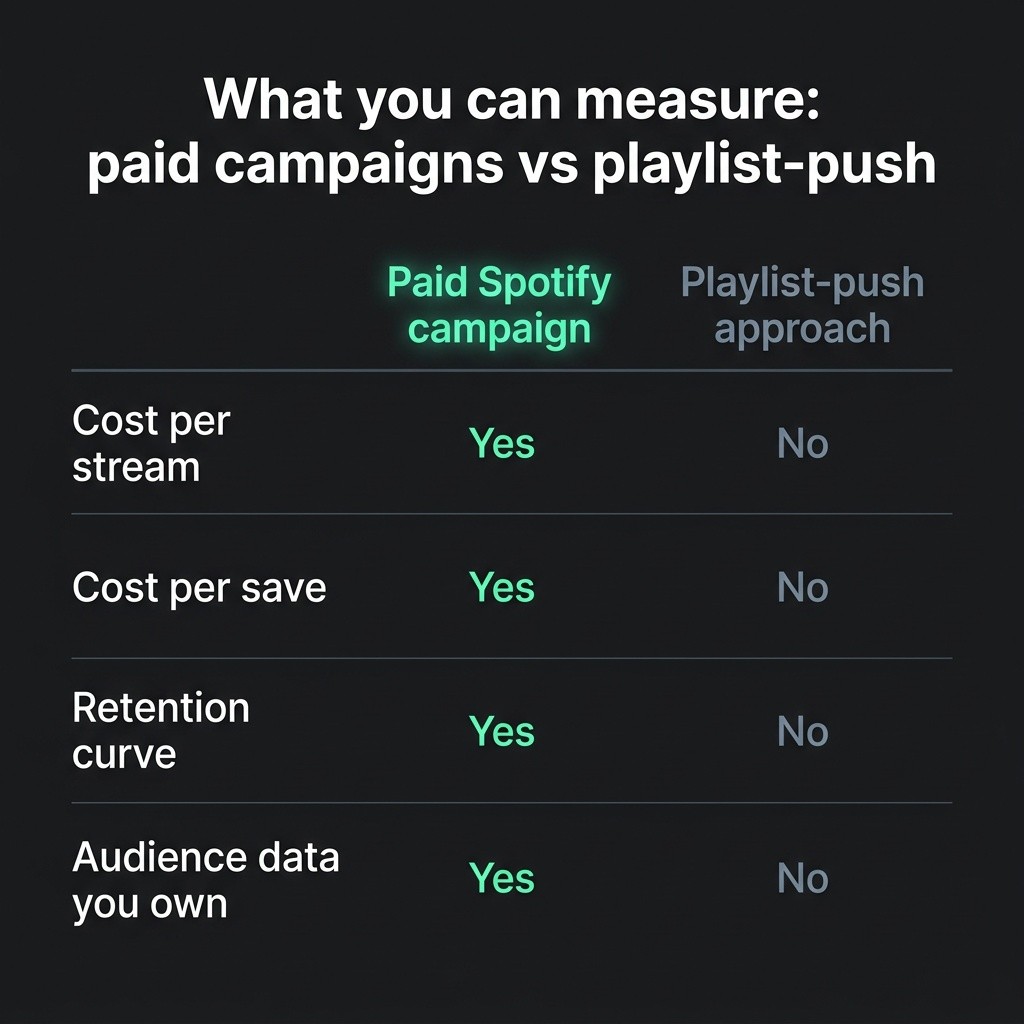
If you only have budget for one, run the paid campaign, because it's the option you can measure and own. A Spotify ad campaign gives you a cost per click, a cost per stream, a cost per save, and a retention curve. You read them in Spotify for Artists, the platform's free analytics dashboard. The playlist-push approach, paying a service to pitch your song for placement, gives you a set of placements and a reported stream number with no per-unit cost you can verify.
Playlist-push isn't worthless, and it still has a narrow use (covered below). But the question most artists are really asking, whether Spotify advertising is worth it, comes down to measurement. A dollar you can trace is worth more than a dollar you can't, because only the traceable one tells you what to do next time.
How each approach actually works
A paid campaign sends targeted ads to a smart link, a single landing page that routes a listener to your track on Spotify. The platform reports every click, and Spotify for Artists shows the resulting stream lift. You can run these as audio, video, or display ads inside Spotify Ads Manager, Spotify's self-serve ad platform at ads.spotify.com. Or run Meta, Google, and TikTok ads pointed at the same smart link. Either way, the spend, the clicks, and the downstream streams are yours to read. If you want the full map of what "advertising on Spotify" actually means, we laid out the three paths in our Spotify advertising guide.
The playlist-push approach works through relationships instead of ad accounts. You pay a service, or buy a submission tool, and it pitches your track to playlist curators in the hope of a placement. When it lands, your song sits on a playlist and collects whatever streams that playlist's listeners give it. There's no ad account, no click data, and no audience you can retarget later, which is exactly the gap between cheap one-click promo and a managed campaign. It also helps to know what a playlist placement actually buys you before you pay for one.
What you can measure with each
A paid campaign produces cost per click, cost per stream, cost per save, and save rate. It also gives you a retention curve showing whether the listeners you bought kept playing after the budget stopped. Every one is attributable to the spend and averaged across real campaigns rather than guessed, so you can compare creatives, markets, and budgets and put money behind what worked. That feedback loop is the real product of a paid campaign.
The playlist-push approach hands you far less. At best you get a placement confirmation and a stream count, with no way to verify how many plays came from real, engaged listeners. There's no cost per save and no retention curve. You keep none of the audience data, so nothing carries into the next release. Avoiding that blind spend is the thread running through most common Spotify ad campaign mistakes: if you can't measure it, you can't improve it.
What a paid Spotify campaign costs per save
Because a paid campaign is measurable, we can state its real costs, and the only rule is to read the genre and the market tier every time. Tier 1 means premium markets (the US, UK, Canada, and similar). Tier 2 means growth markets (Mexico, Brazil, India, and similar), where the same budget stretches further. For a Pop release, cost per save averages about $0.45 in Tier 1 and $0.30 in Tier 2. A Rap or Hip-Hop release averages about $0.20 in Tier 1 and $0.15 in Tier 2 (MeansMGMT internal campaign data).
Genre and tier | Cost per save |
|---|---|
Pop, Tier 1 (premium) | $0.45 |
Pop, Tier 2 (growth) | $0.30 |
Rap / Hip-Hop, Tier 1 (premium) | $0.20 |
Rap / Hip-Hop, Tier 2 (growth) | $0.15 |
Cost per stream follows the same rule: around $0.035 for a Pop release in Tier 1 and about $0.020 in Tier 2. The full genre-by-genre breakdown on our Spotify ads cost page has the rest. Each of these is a known, attributable number you can hold a campaign to. The playlist-push approach has no equivalent, because it never reports a per-save cost at all.
Where the playlist-push approach can still fit
If your track already has momentum and you want a short burst of placement around release week, a reputable push can add reach faster. Some genres also lean on editorial and curator culture more than others. For an artist with no ad experience and no time to learn, paying for placement is at least a way to get the song in front of listeners.
You're still buying reach you can't measure, so it stays a gamble rather than a strategy. If you use a playlist-push at all, pay for it with spare money on top of a measurable campaign. Never use it instead of one, or with budget you'd need to account for. If a service can't show you what a placement costs per real listener, treat it as a reach buy with no scoreboard.
The same $1,000, two different scoreboards
Put $1,000 into a paid streaming campaign for a Pop release in premium markets and you get the whole trail. That means a cost per click, roughly $0.035 per stream, about 0.51 saves per click, and retention around 5.6x baseline daily streams (MeansMGMT internal campaign data, 2026 H1). The exact stream math for that budget is worked out on the cost page. You can pull up and check every one of those numbers, and use them to brief the next campaign. That's the way a streaming-growth campaign we ran was measured, and so was another Spotify campaign we documented.
Hand the same $1,000 to a playlist-push service and you get a set of placements and a reported stream total. There's no verifiable cost per stream, no save rate, no retention curve, and no audience to keep. The two spends might even return a similar headline stream count. Only one of them tells you what it cost, what stuck, and what to do again.
How MeansMGMT runs paid Spotify campaigns
MeansMGMT, a Pittsburgh-based music marketing agency founded in 2017, is not a playlist-push service. We run measurable paid campaigns on Meta, Google, and TikTok that point listeners to a smart link. They run on your own ad accounts, so the audience and retargeting data stay with you if we part ways. Every campaign reports its real cost per click, cost per stream, cost per save, and retention curve, backed by a case study or our music advertising report.
Choosing between a measurable campaign and a placement promise is a budget call, usually defended by the manager who oversees that spend.
FAQ
Questions we get
If you have a release coming, start with two quick questions, about three minutes in total, and we’ll scope your campaign. Want the numbers first? The benchmarks report is free.