·
Industry
·
What a Hip-Hop Artist Manager Does (and What It Costs)
What does a hip-hop artist manager do, and what does one cost? A plain breakdown of the role, the standard 15-20% commission, and when a rapper needs one.

MeansMGMT
A hip-hop artist manager runs the business of your career so you can focus on the music. They set strategy, chase and negotiate deals, coordinate your label, agent, and publicist, and handle the day-to-day so opportunities don't slip. In exchange they take a commission, usually 15% to 20% of what you earn, not a flat fee. That single fact, that a manager only makes money when you make money, shapes everything about when one is worth it.
TL;DR
A manager runs the whole career: strategy, deals, team coordination, and daily decisions.
They take a commission, usually 15% to 20% of your income, not a flat upfront fee.
A manager is separate from your label, booking agent, and publicist, who each own one slice.
Get a manager when momentum outgrows what you can run solo, not before you have traction.
Vet for roster fit, a clear written agreement, and proof they grow artists rather than only sign them.
What a hip-hop artist manager actually does
A manager is the person who holds the whole picture of your career while you make records. In hip-hop that means steering the release calendar, deciding which singles lead, and lining up features and producers. It also means fielding offers for shows and brand deals and keeping your label, booking agent, and publicist pulling the same way. The job is part strategist, part filter: they decide what gets your attention and what gets a polite no. Day to day, a manager is the one taking the calls you do not have time for and turning a scattered set of opportunities into a plan.
The good ones are judged on momentum. A manager who books a session, lands a placement, and times a release so the paid marketing and the press hit the same week is doing the job. Their value shows up as faster decisions and less money left on the table. That's why a manager has a big say in how marketing money turns into ROI.
What an artist manager does not do (label, agent, publicist)
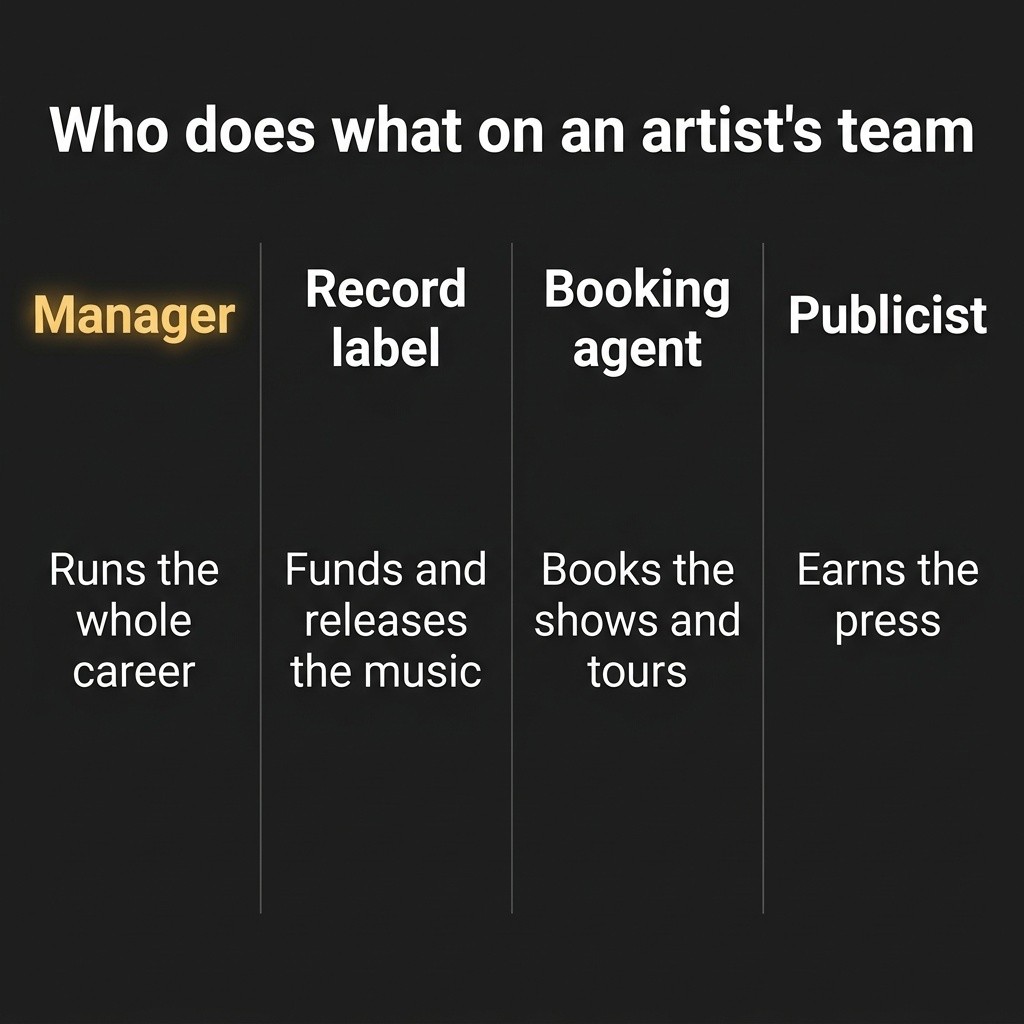
A manager coordinates your team, but they aren't the whole team. A record label, the company that funds, markets, and distributes your recordings, owns the money and rights side of releases. A booking agent, the person who books your live shows and tours, owns the calendar of gigs and the fees. A publicist, the person who earns you press and media coverage, owns your story in the outside world. A&R, the label-side talent and creative function, still exists at labels and is sometimes confused with management, but it works for the label, not for you.
Your manager sits above all of them as your representative, hiring, briefing, and holding each one accountable on your behalf. Knowing those lines matters because a manager cannot replace a label's marketing budget or an agent's venue relationships. When someone offers to be all four at once, that's a flag.
How artist managers get paid: the commission model
Almost every music manager works on commission, which means they take an agreed percentage of the income you generate during the term of your agreement. The long-standing industry range is 15% to 20% (per Hypebot). Some deals run as wide as 10% to 25%, depending on the manager's experience and how much they handle. The percentage is the whole compensation in most cases, so a manager who earns you nothing earns nothing themselves.
The rate often scales: a common structure is a higher cut on the first slice of income and a lower one above a threshold, or the reverse. So the number on the contract is rarely the number on every dollar. Second, the agreement spells out which income streams are commissionable: recorded music, touring, merch, publishing, and brand deals can each be in or out. Read that list closely, because a 15% rate on everything can cost more than 20% on a narrower base.
What hip-hop artist management actually costs
Because the model is commission, the cost of rap artist management is a share of your upside rather than a bill you pay whether or not anything works. On a 15% to 20% deal, every $10,000 you earn sends $1,500 to $2,000 to your manager. That feels like a lot until you weigh it against the income a good manager drives that you wouldn't have reached alone. A manager who takes 20% of a career they help double is cheaper than a free one who lets opportunities rot.
The rate you can expect tracks your stage. An emerging rapper with little revenue is often asked for 20%, because the manager is grinding to build something from a small base. An established artist with several income streams and a full team can usually negotiate closer to 15%. Beware anyone asking for an upfront fee on top of commission, or for your masters as part of a management deal. Those terms belong in other kinds of agreements, and bundling them into management is how artists lose more than the percentage.
When a rapper actually needs a manager (and when they don't)
Many artists reach for a manager too early. A manager multiplies momentum you already have, taking real interest, real shows, and real revenue and turning them into more. They are far worse at manufacturing momentum from a standing start, which is the job an artist often hopes a manager will do. If you have no audience, no streaming traction, and no inbound interest, a manager has little to coordinate, and the best ones will say so.
You're ready when managing yourself starts costing you the music. That's when offers come in faster than you can answer, a label or agent wants a single point of contact, or the marketing outgrows what you can run between sessions. Until then, build the audience and the data yourself, the same way you would when turning followers into real fans. Then a manager has something to multiply.
How to vet an artist manager before you sign
Treat hiring a manager like the business decision it is, because you are handing someone a percentage of your career. Start with roster fit. Who do they manage now, and are those artists at a level you respect? Can they give a new signing time, or will they park you behind their biggest name? Ask what they'd actually do in your first 90 days and listen for specifics. Ask for the plan, the calendar, and the numbers.
Then get it in writing. A real agreement names the term, the commission rate, exactly which income streams are commissionable, and what happens to deals signed during the term after you part ways. Be wary of anyone offering full artist management services who also wants upfront fees, your publishing, or your masters folded into the same contract. Ask for proof of growth: examples where they grew an artist's audience and revenue, and how they measured it. It's the same evidence you'd ask of any partner spending against your name.
How MeansMGMT thinks about management and paid growth
MeansMGMT is a Pittsburgh-based music marketing agency founded in 2017. It started as an artist-management company in the lo-fi, electronic, and indie world, where our strategies drove more than 200 million streams. In 2024 we opened our data-driven paid advertising and release strategy services to the public. So when we talk about management, it is from both sides of the table.
That history is why we are not a traditional 15% to 20% commission manager today, and we are clear about the difference. We run measurable paid campaigns on Meta, Google, TikTok, and Spotify, on your own ad accounts and assets. The audience and the data stay yours if we part ways. Across our work we've managed more than $2 million in ad spend and run 600+ campaigns. We've driven 550 million-plus streams and 800,000-plus playlist saves, each tied back to a real number. A manager coordinates the whole career; we are the specialists a manager (or an independent artist) brings in to make the growth side auditable. See our campaign case studies for the math, along with the gap between cheap promo and a managed campaign. When a manager weighs a marketing budget, the choice comes down to running paid Spotify campaigns the measurable way.
FAQ
Questions we get
If you have a release coming, start with two quick questions, about three minutes in total, and we’ll scope your campaign. Want the numbers first? The benchmarks report is free.