

Catalog ads open on exact release dates at more than three times the rate chance predicts. Labels advertise dated products, not anniversaries.
On 24 October 2025, three campaigns opened on Meta.
Elton John's Captain Fantastic 50th Anniversary Edition.
Bruce Springsteen's Nebraska '82 Expanded Edition.
And twelve Depeche Mode ad entries selling cinema tickets for the film DEPECHE MODE: M.
Twelve entries is two ads, a German one filed eleven times and a Polish one filed once. The archive counts deliveries, not decisions, and that gap runs through everything below.
A Depeche Mode single from the Memento Mori sessions came out that same day. Neither ad mentions it, and the film they do sell opened four days later.
So on one October date, two record companies and a cinema distributor all opened campaigns, and each one hangs off a dated product.
We went through a year of Meta ads for 51 legacy artists, living and dead. Catalog marketing turns out to be a machine that runs on dates, and whether the artist is alive barely changes how it runs.
The machine, measured
Before I looked at any results, I wrote down three rules for what counts as a release driving an ad. Rule one, the ad starts on the exact day a release comes out. Rule two, within a week. Rule three, any-year anniversary, same month and day.
The rules look at dates and nothing else, never at what the ad is selling. A rule fires when a campaign opens on a release day whether or not that campaign is selling the release. That is what the Depeche Mode ads at the top were doing. Read the numbers below as calendar proximity rather than proof of intent.
Then we matched every Spotify release date those catalogs have against every day a campaign opened. A null model that shuffles release years gives chance a fair shot.
Rule one held. Campaigns opened on an exact release date on 44 days, against 12 expected by chance. Within a week, 293 against 127. The anniversary rule found nothing at all, 133 against 164, slightly worse than chance.

So labels mostly do not advertise on anniversaries, they advertise dated products, and the ad follows the date.
What opens on the day
Anniversary editions, Zappa's Bongo Fury 50th on 2026-03-20 and Elton John's Captain Fantastic 50th.
Remastered box sets, Metallica's ReLoad on 2026-06-26, Queen's Queen II (2026 Mix), Cream's Wheels of Fire expanded deluxe.
Archive releases, the Beatles' Anthology titles on 2025-11-21, Dylan's Bootleg Series Vol. 18, Lennon's Power to the People ultimate mixes.
Every one of those is a product somebody chose to give a release date to. A fifty-year-old record cannot be new, so the label manufactures a date and the media plan hangs off it.
Three campaigns linked to a specific page rather than just a domain. Two of the three link to the release itself, Paul McCartney's The Boys of Dungeon Lane and the Rolling Stones' Foreign Tongues, and both opened on the release day.
Dead or alive barely changes the machine
We pulled a control group of 19 living legacy acts the same way. Once you match for size, the two groups run nearly identically. On the exact-date rule, estates had 23 matches, living acts 21. Both groups ran the same platforms and the same age brackets, over about the same number of launch days a year.
Death does change the destination mix, but less than I first thought, and not for the reason I first gave.
That control group was the Stones, Iron Maiden, Deep Purple, Metallica and Depeche Mode, almost all British rock. They were in the set because they had a smart-link subdomain we could find, and nobody picked them for balance. Against that lot, estates looked streaming-heavy and living acts looked ticketing-heavy, and the easy explanation was that dead artists cannot tour.
So we widened it, twelve more living acts from outside that group. Snoop Dogg, Wu-Tang Clan, ABBA, Shania Twain, Marc Anthony, Alejandro Sanz, Laura Pausini, Scorpions, Grönemeyer, Lindenberg, Die Toten Hosen, Rammstein.
Those twelve send 34.7% of their campaigns to streaming links. Estates send 36.1%. The British rock group at 22.5% was the outlier, because those acts tour constantly and buy ticket ads to match.
What moves the mix is what a rights holder has to sell that isn't a stream. Touring is the loudest of those here, mostly because ticket links are easy to spot in the data. It is one route among several, and the one that takes the most work to build.
Merch sits in the same column, and death doesn't remove it. Estates send 22.3% of campaigns to a store, the touring British acts 23.3%. Physical, licensing and whatever direct-to-fan product a catalog has are in there too, and none of them needs a living artist.
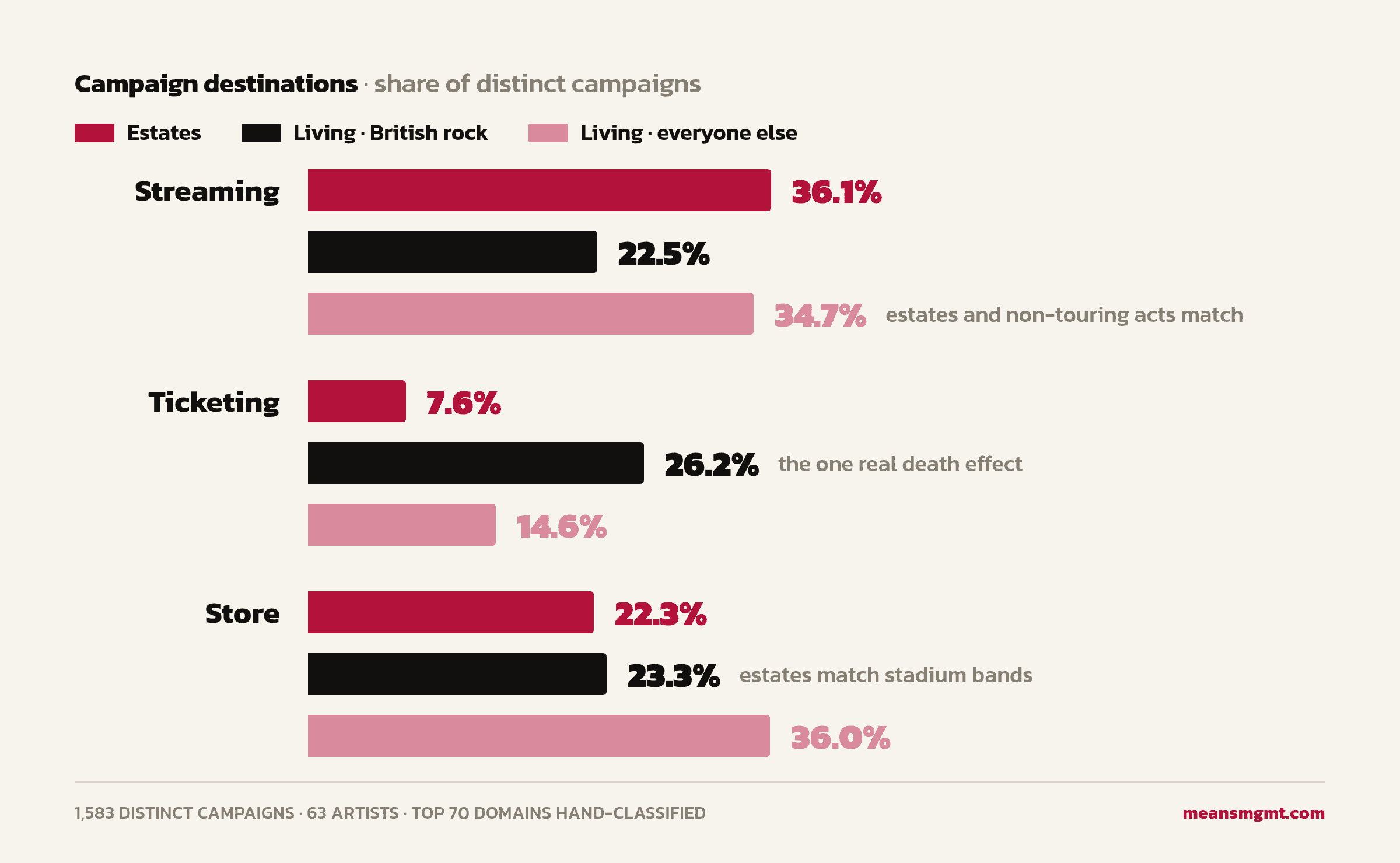
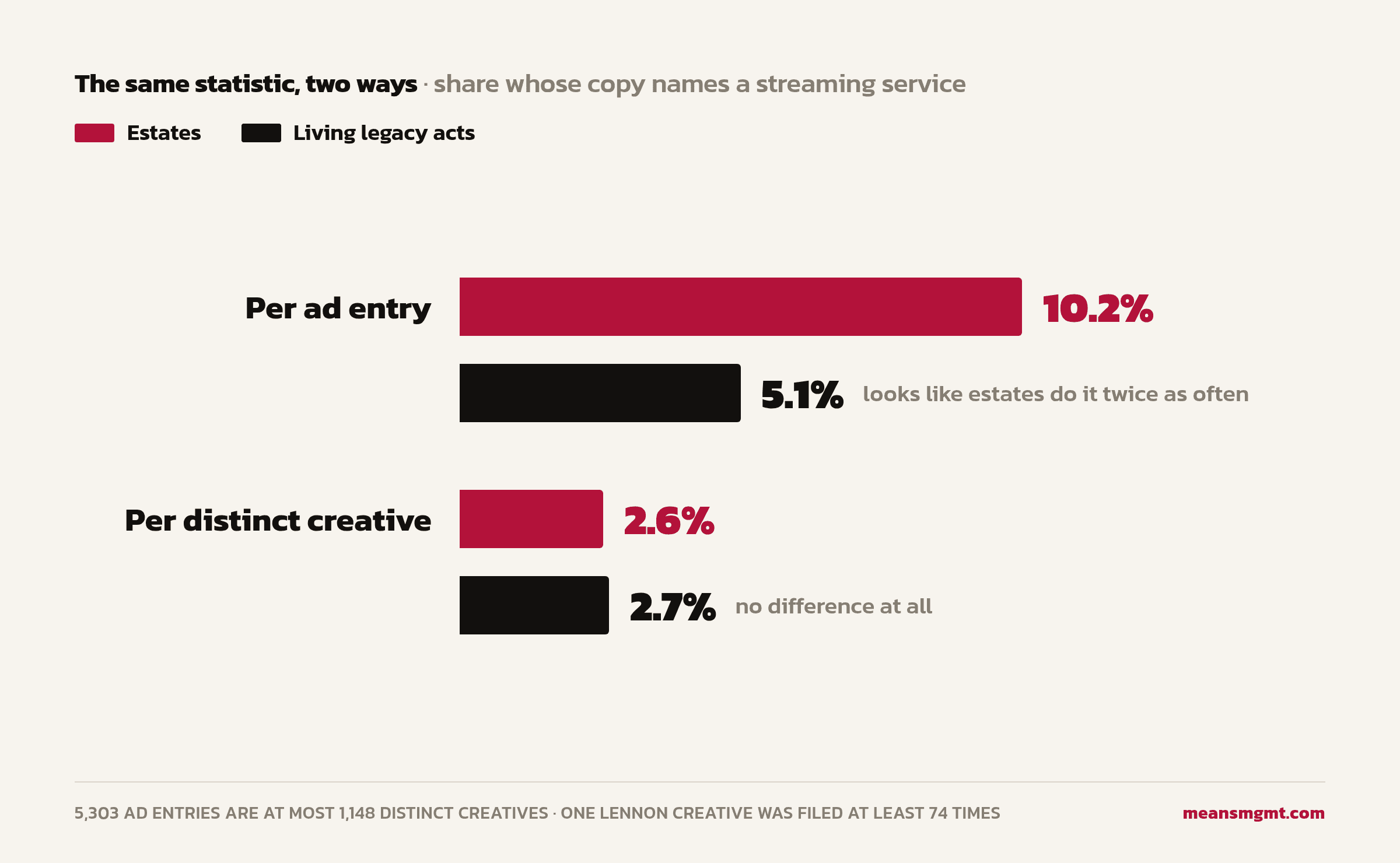
Live is the one route death actually closes, and by more than I originally reported. 7.6% of estate campaigns go to ticketing against 26.2% for the touring British acts. An earlier version of this post said estates ran ticketing on a quarter of their ads. That number counted ad entries rather than campaigns, and it was almost entirely one John Lennon film campaign. 407 ad entries, 37 distinct creatives, and the most-filed of those creatives accounts for at least 74 entries on its own.
Even that gap is not total. Estates still buy ticketing for tribute shows, stage musicals and cinema screenings, which is the catalog reaching for a live route without a living artist.
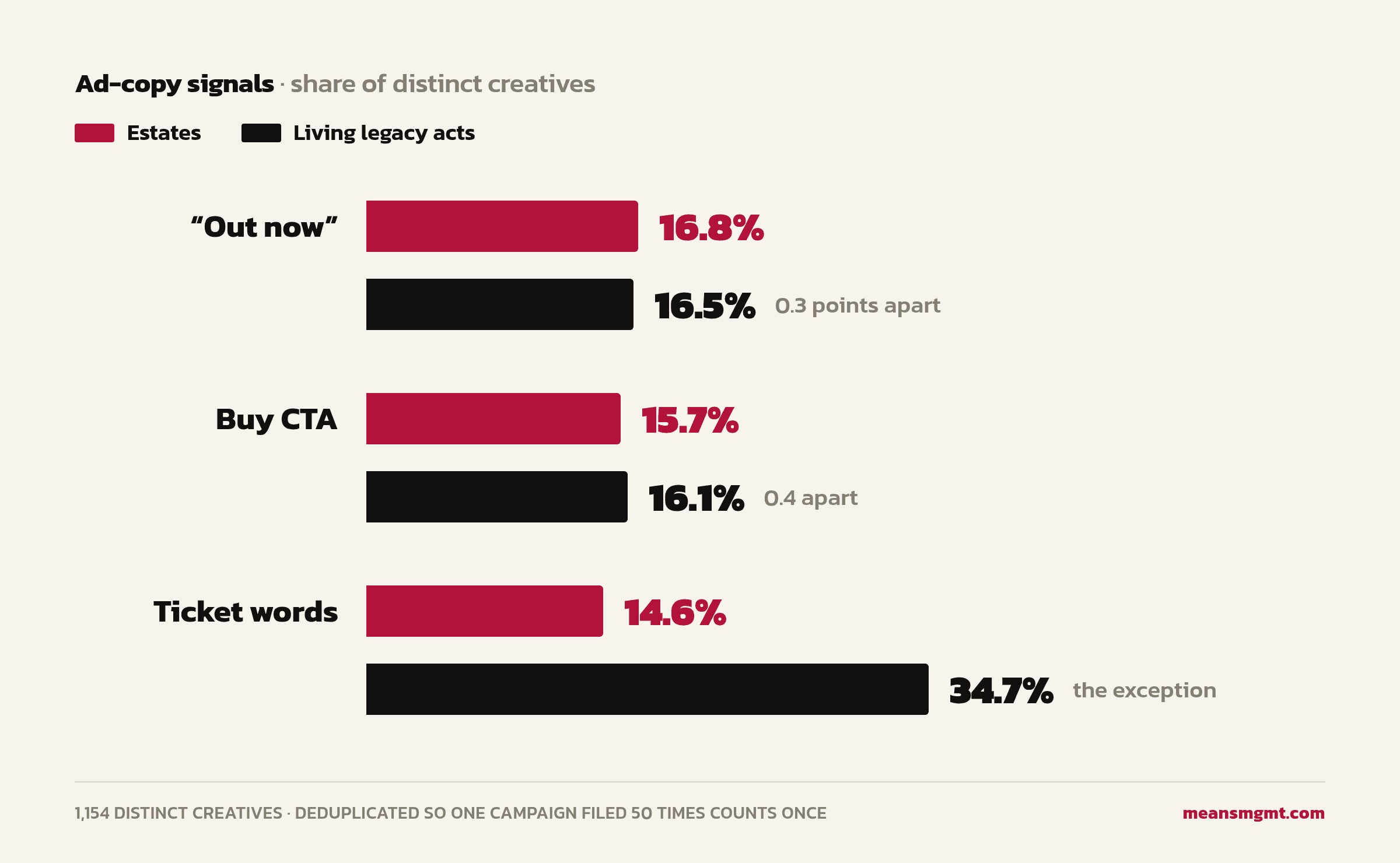
In the ad text itself, dead and living artists use "out now" language at 16.8% and 16.5%, buy CTAs at 15.7% and 16.1%, pre-order language at 10.2% and 10.7%. All three sit within half a point.
Living acts use ticketing language at 34.7% against 14.6% for estates. Estates lean on the title in quotes and the format words, vinyl and box set and remaster.
One imprint, fifteen artists
No buyer in the data touches more artists than Label Panthéon, Universal Music France's reissue imprint. It is named as payer on ads for fifteen of them, eight dead and seven living. The dead are Bob Marley, Charles Aznavour, Freddie Mercury, Johnny Hallyday, Serge Gainsbourg, the Beatles, Thin Lizzy and Henri Salvador. The living are McCartney, Queen, the Rolling Stones, Elton John, Metallica, ABBA and Peter Gabriel.
Fifteen artists did not each go out and hire an agency. One catalog division has a media budget and a roster, and it does not sort that roster by whether the artist is alive.
On the estate half of the pull, Universal Music GmbH is named on 217 ad entries and Trafalgar Releasing on 214, against Label Panthéon's 40. Count every page rather than just the estates and Label Panthéon runs 79 entries and 48 creatives across all fifteen artists. The widest roster in this data files the fewest entries of any of them.
That field records how an ad account was registered when the ad set was built, which is not the same as a bill. Meta doesn't verify it, and UK-delivered ads carry no payer at all. Every count in this section is the European half of the archive.
Concord's Craft Recordings, RHINO and Sony Music Germany all show up as payer on Miles Davis' page. Each one markets its own slice of the same catalog, Warner-era albums against the Columbia years.
Where the clicks land
When a smart link resolves, artist pages point mostly at albums. About half of classified estate links land on an album, box set or compilation, singles are second, and playlists are rare on artist pages in both groups. The playlist economy generally lives on playlist-brand pages rather than artist pages, which is part two's territory.
The exception
Leonard Cohen is the campaign my rules were built to catch and could not. 73 ad entries, three days, March 19 to 21 2026, split across Germany, France and the UK. All 73 are one creative filed 73 times. There was no 2026 release behind it, so it misses the exact-date rule and the within-a-week rule entirely. It matches only the anniversary rule, the one that performs at chance.
The ad copy reads "Songs of Love And Hate turns 55 this week, listen now on Apple Music." The album came out 1971-03-19, which makes the first day of the burst the exact 55th anniversary. Somebody built a campaign around a date that exists nowhere except in the catalog, named it in the creative, and pointed it at Apple. Of the 77 ad entries in this pull whose copy names Apple Music, 73 are his.
Naming a service in the copy at all is rare, under 3% of distinct creatives in both groups. Why this one anniversary campaign ran across three countries when anniversary proximity performs at chance across the whole set, the archive does not say.
What to do with this
If you own or manage a catalog, the thing to schedule against is the release date, not the anniversary. Anniversary proximity on its own performed at chance in this data and a dated product did not. Every reissue, box set and expanded edition is a date you can hang a media plan on. The ones the rules caught had a Spotify release date attached, not just a round number of years. What any of them delivered is not in this archive.
If the only thing you have to sell is a stream, the ads point at a stream, and streams pay the least of anything on the list. Everything else here, merch, physical, a screening, a stage show, exists because somebody built it first. That work is not free, and touring is the most expensive version of it. This is not a "go on tour" post.
The practical side of working an older catalog, formats, budgets, where to point the ads, is covered in music catalog marketing for old releases.
Both groups here run near-continuously, six to eight months active, twenty to thirty launch days a year. That is always-on catalog advertising rather than the occasional anniversary burst. Somebody is funding it every month, and the archive never says how much.
Somebody bought every one of those launch days. Part two is who.
Notes
Meta's public Ad Library API, pulled 16 August 2026, against Spotify's own release dates. The pull covers 5,303 ad entries for 51 legacy artists, 32 deceased and 19 living, July 2025 through August 2026. The widened control group adds 1,496 entries from twelve more living acts. The archive only covers ads delivered in the EU and UK, so US-market catalog is largely missing. Motown, country and most American hip-hop barely appear at all.
The three rules were written down before I looked at any results, and they measure calendar proximity and nothing else. They match an ad's start day against a release date, never what the ad is selling. The matching put 3,340 Spotify release dates against 1,044 distinct ad-start days. Matches are counted as days rather than ads, which is the unit the null model was built on. A reissue drives both the ads and whatever the streams do, so nothing here says the ads caused anything.
Percentages count distinct campaigns rather than ad entries, because the same creative gets filed dozens of times and counting entries lets one duplicated campaign swing a whole category.
A campaign here is a distinct page and body-text pair. That key is itself slightly inflated, because the API sometimes returns the same body concatenated to itself, so one ad can read as two or three. 5,303 ad entries are at most 1,148 distinct creatives and really nearer a thousand. Every absolute creative count in this series is a ceiling. Rates are unaffected, because the split hits the numerator and the denominator together.
FAQ
When do labels run ads for catalog artists?
Do dead artists get marketed differently from living ones?
How far back does the Meta Ad Library go?
Why count campaigns instead of ads?
This is the work we do all day.
If you have a release coming, the 3-minute intake tells us everything we need to scope your campaign. Want the numbers first? The benchmarks report is free.

