·
Industry
·
Touring and ROI · Part 3 of 3
Breaking a Band: 1976 vs 2026
About 106,000 tracks hit streaming every day. The music industry then vs now, and why the odds of breaking a band are better in 2026 than in 1976.

MeansMGMT
Getting in got cheap, but breaking through still costs money. The walls moved from geography and connections to money.
This is part three, the last in the series, after part one on where the money comes from and part two on turning streams into ticket sales.
I read that Bob Seger played about 250 nights a year for seven years before "Night Moves" broke him nationally in 1976.
"I played too many nights and I really didn't have enough time to write" (Ultimate Classic Rock, 2025).
That really was the discovery engine of the era, geographic and physical, and it meant an act could be a regional star and a national nobody at once. That's much rarer now. Back then, for most acts, that gap ended the career before it started.
Breaking a band in the 1970s ran on a bank and a gate
The 1976 machine ran on two gatekeepers, capital and radio.
Capital meant the label, because the label was the only bank.
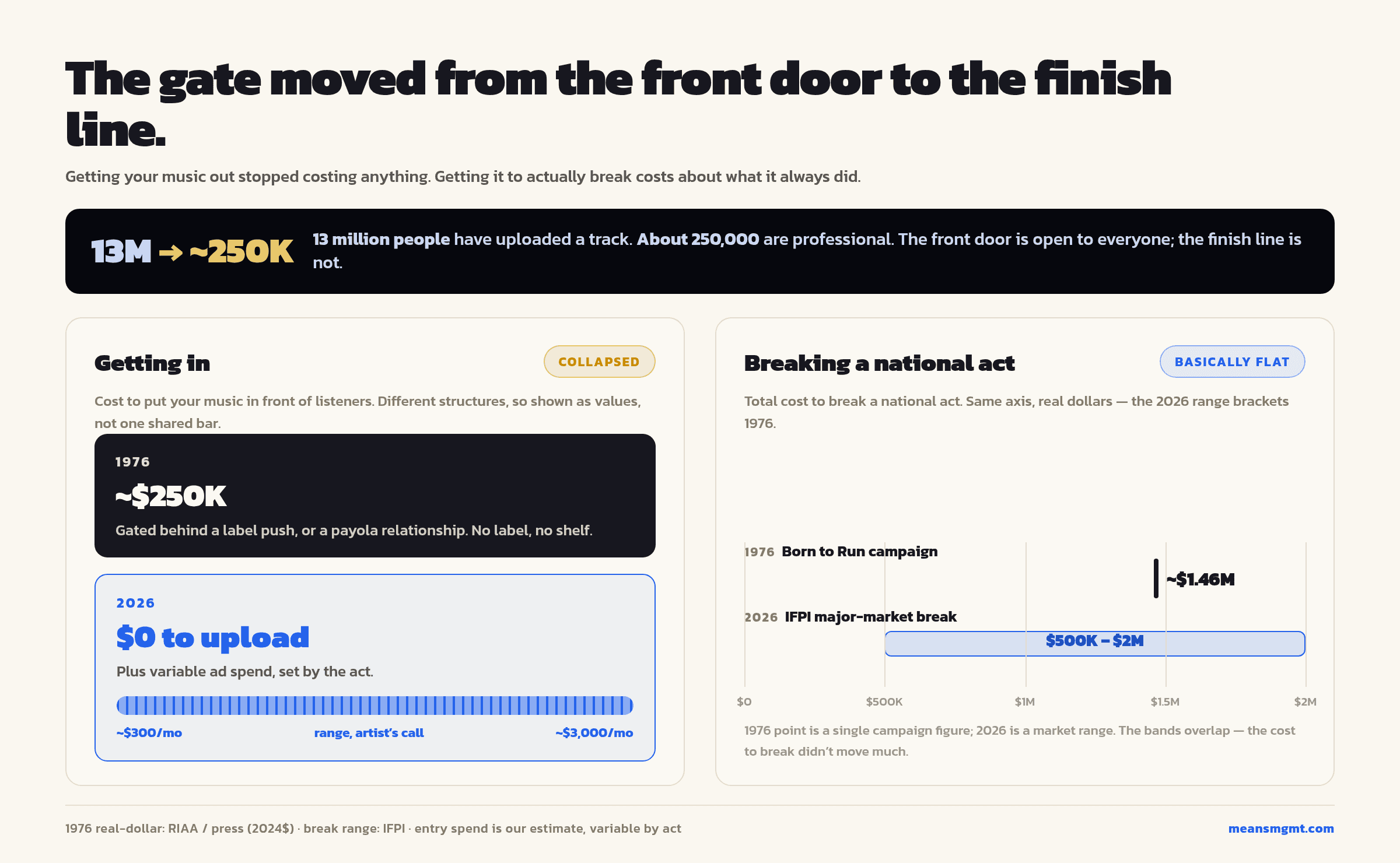
Columbia reportedly spent about $250,000 promoting Springsteen's Born to Run in 1975 (Grammy.com), roughly $1.46 million in 2024 dollars, on one album by one artist. KISS is the other side of that coin.
With Casablanca Records near bankruptcy, manager Bill Aucoin reportedly put more than a quarter million dollars on his own credit. That funded the band's touring and the recording of Alive! in 1975 (Quillette, 2025).
Somebody basically always fronted the risk money.
The DIY route existed and cost real money too.
Buzzcocks recorded Spiral Scratch in Manchester in December 1976 for about £500 borrowed from friends and family, about £3,700 today. That covered recording and pressing 1,000 copies (Louder Than War).
Free upload didn't exist, and distribution meant a thousand physical objects assembled by hand.
Radio was the second gate, and it was the one you couldn't get past honestly. One spin on one FM station reached a whole city, and getting that spin ran on relationships, favors, and cash.
The radio gate had a rate card
The polite word for that cash was independent promotion.
The blunt word is payola, from "pay" plus "Victrola," and paying for airplay without disclosing it has been a federal crime since 1960. That never really stopped it, the money just moved off the books.
By the mid-1980s the majors were spending an estimated $60 to $80 million a year on independent radio promotion. CBS Records alone spent $12.8 million in 1985, close to 10% of its pretax profits, as documented in Fredric Dannen's Hit Men (1990).
Those are 1980s figures for a machine that ran quieter, on relationships, in Seger's day. Even those numbers are estimates, because the system was built to leave no paper trail.
Then in 2005 the paper trail leaked.
New York Attorney General Eliot Spitzer's investigation pulled internal label emails into the public record, and they read like invoices.
One Epic staffer chasing a spin for Audioslave wrote to a programmer at station WKSS, "WHAT DO I HAVE TO DO TO GET AUDIOSLAVE ON WKSS THIS WEEK?!!? Whatever you can dream up, I can make it happen."
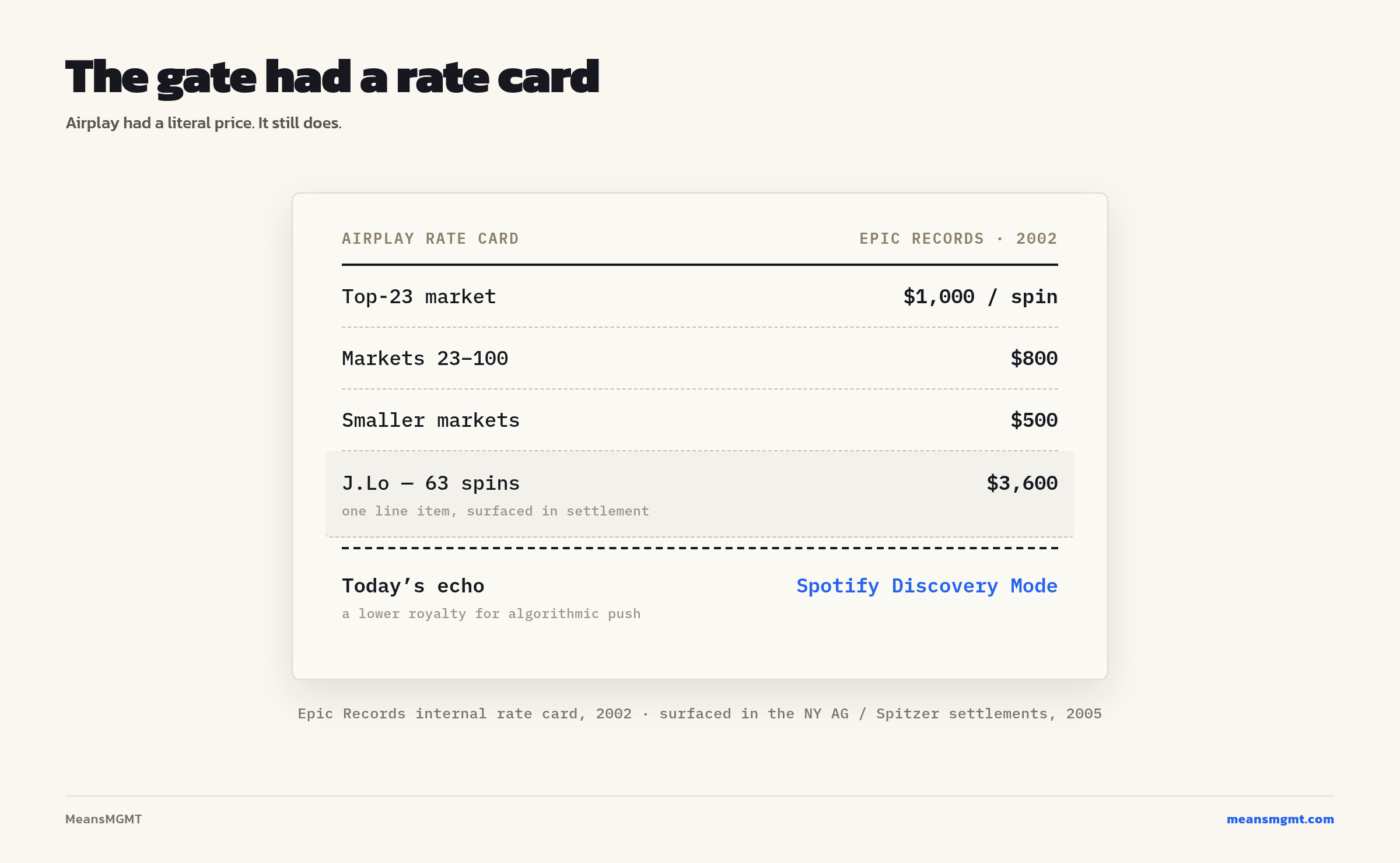
Another email did the math out loud on a Jennifer Lopez single. It read, "in this week's Jennifer Lopez Top 40 Spin Increase of 236 we bought 63 spins at a cost of $3,600."
Epic even kept a rate card, $1,000 a spin in the top markets on a 2002 internal sheet (Fox News, 2005).
The gifts were itemized too: laptops, plasma TVs, and PlayStation 2 consoles. One email included a request to "buy a walkman for Toya Beasley" at station WRKS in New York (CBS News / AP, 2005).
Sony BMG settled with the state for $10 million that July, and Warner and Universal settled their own cases over the next year.
Fifteen years on, the format changed and the mechanism didn't.
In 2020 Rolling Stone published more than 2,500 leaked text messages tied to independent radio promoter Steve Zap (Rolling Stone, 2020).
One asked to move Ellie Goulding and X Ambassadors into heavier rotation because "we need beach swag."
Another, requesting overnight spins for a track, put the incentive plainly, "This is how I will get the bills paid."
A third asked a programmer to pull one act off the chart to clear room, "Help Marshmello go 1."
Zap denied any wrongdoing and blamed a disgruntled former employee, and the texts were never tested in court. Read them as a leaked snapshot of how the game allegedly still works, not a legal finding.
The gate always had a price.
It just moved from Victrola to plasma TV to iMessage.
Today the same gate is out in the open, a product you can buy.
A November 2025 class action calls Spotify's Discovery Mode "modern payola" (Billboard, 2025). Discovery Mode boosts a track in the algorithm in exchange for a lower royalty rate. Spotify denies the claim, and the case was pushed to arbitration in 2026.
That closes the loop from part two straight into the machine we work inside now. With UGC and clipping, nearly everyone is a promo man these days, often without knowing it.
The promo man that matters now, the target every campaign is actually aimed at, is the platform algorithm, and ads, playlisting, and clipping are the money aimed at moving its decision.
Music industry history keeps proving the money was in the room
Peter Grant, Led Zeppelin's manager, is where the modern concert business starts. When the usual take left promoters around 40% of the gate, Grant held out for a 90/10 split in the band's favor by the early 1970s (WBUR, 2018). Ten percent of Led Zeppelin beat 100% of nothing.
Tom Petty fought the other end of the same math. In 1981 MCA wanted to price Hard Promises at a new "superstar" $9.98, up from $8.98. Petty refused and won it back at $8.98 (CNBC, 2018). He put it as a warning. "If we don't take a stand, one of these days, records are going to be $20."
It didn't get better. Decades later, the legends said so themselves.
David Crosby said in 2020 that streaming had "taken away half my income" (GQ, March 2020). He called touring "the only thing that we can do to make any money," and repeated it when selling his catalog that December (Music Business Worldwide, Dec 2020).
Roger Daltrey, in 2023, priced the room itself. Assembling a US run puts The Who "upwards $600,000 to a million in the hole" before show one (American Songwriter, 2023).
The music industry then vs now, in real dollars
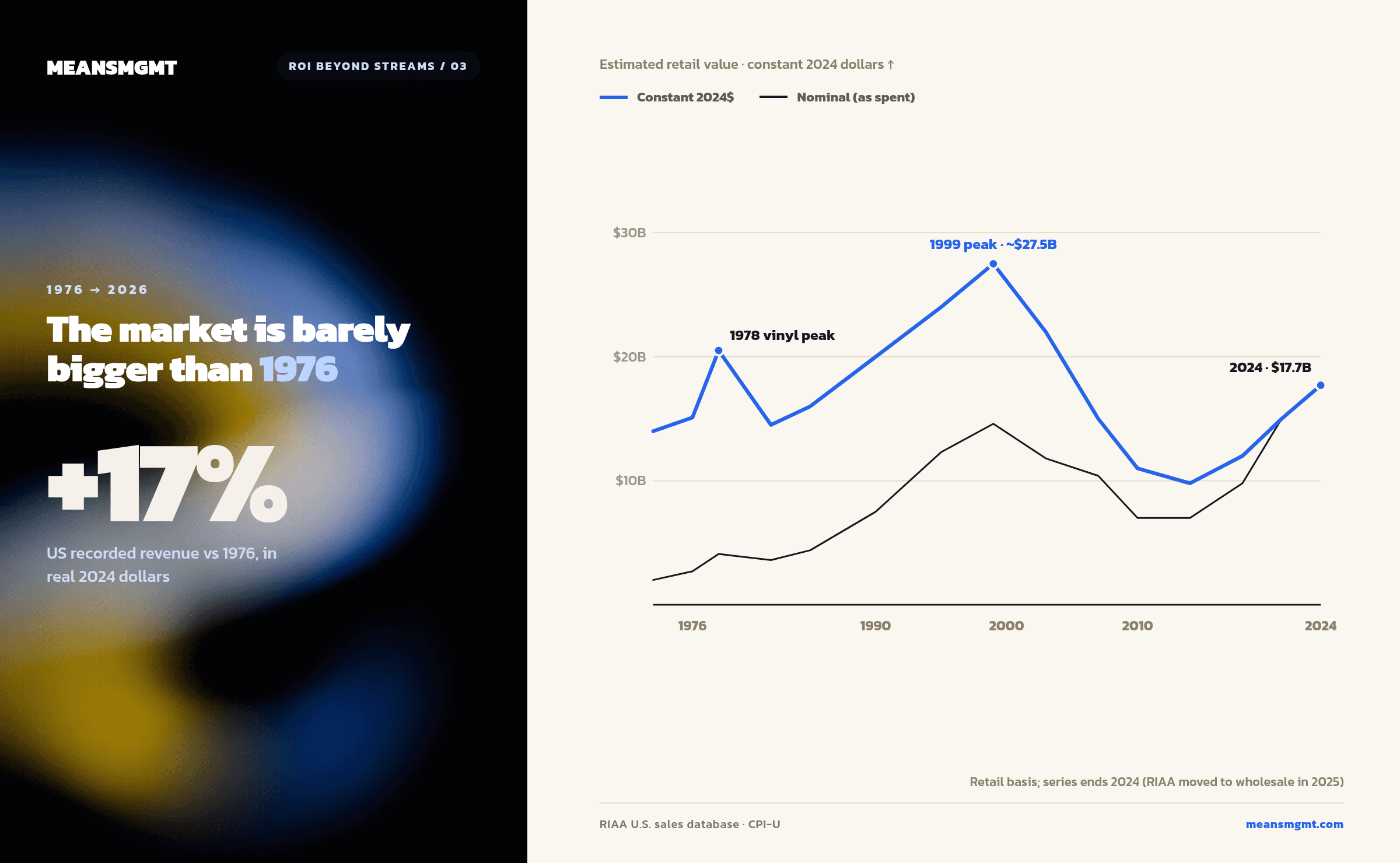
Adjusted for inflation, the US recorded-music market has barely grown in fifty years.
In 1976, US recorded music took in about $2.7 billion, roughly $15.1 billion in 2024 dollars (RIAA, CPI-U adjustment).
In 2024 it took in $17.7 billion at retail, a nominal record and still about 36% below the real 1999 peak of ~$27.5 billion (RIAA). So the market 2026's artists fight over is only about 17% bigger, in real terms, than the one Seger and Springsteen fought over.
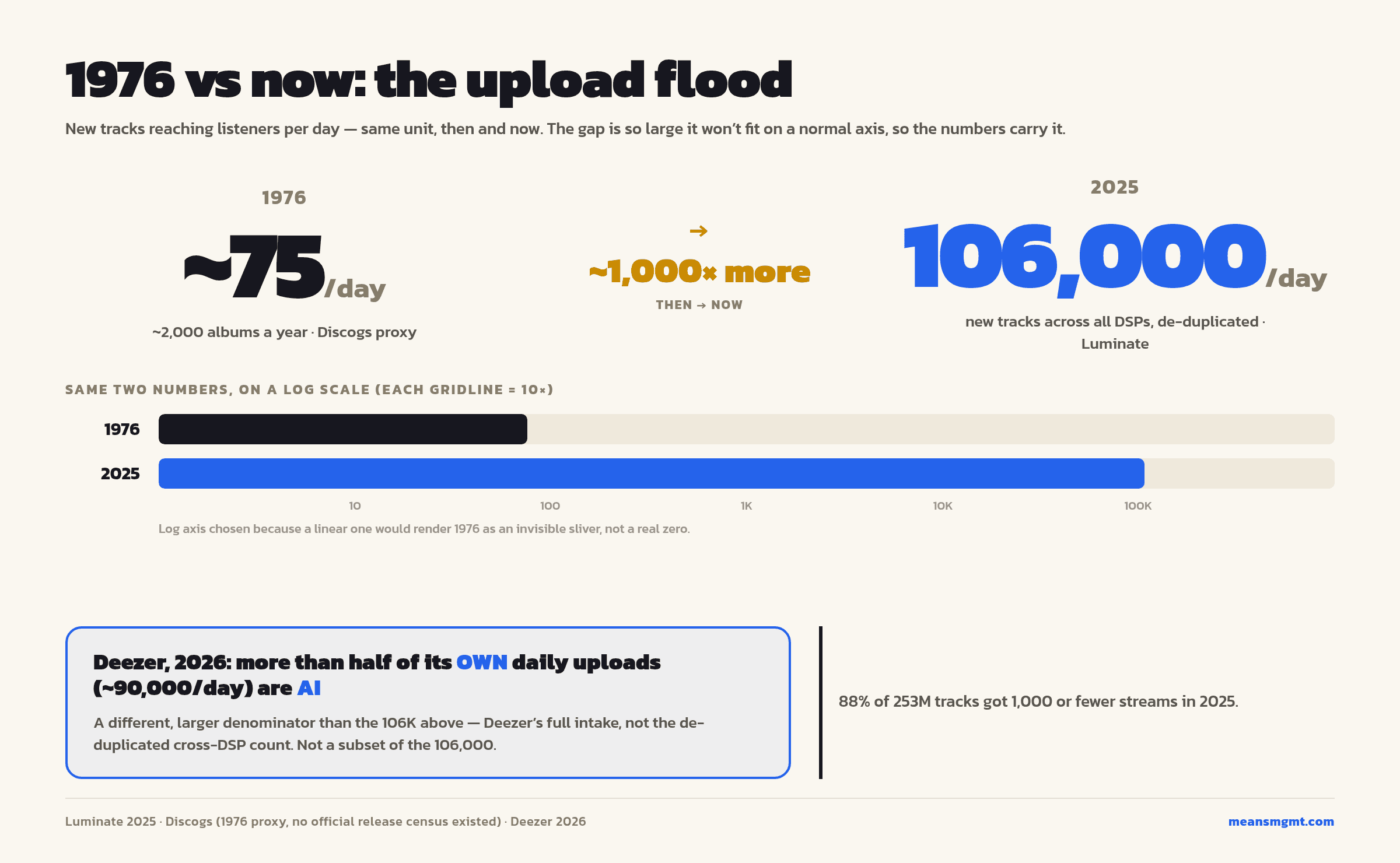
What multiplied is the crowd at the table. Part one counted that flood: about 106,000 new tracks a day in 2025. And 88% of the 253 million tracks on streaming drew 1,000 or fewer streams all year (Luminate, via Hypebot, 2026).
Put that against the era Seger broke in. The mid-1970s saw on the order of 2,000 albums a year, a few dozen new tracks a day (Discogs release counts as a proxy; no official 1976 release census exists).
Today's 106,000 new tracks a day is at least a thousand times more.
RIAA switched its headline reporting to a wholesale basis with the 2025 report, so the clean retail series stops at 2024. I wouldn't plot the 2025 wholesale figure ($11.5 billion) next to the retail years, because on a different basis it reads as a crash that never happened.
What got easier
The walls that used to decide everything got lower.
The £500 Buzzcocks borrowed to press a thousand records is now an upload that costs nothing and reaches every country at once. Fans are yours to keep, too. Instead of a relationship mediated by a label, a station, and a store, you capture an email and phone number directly. That makes the next release and tour cheaper to launch (the loop behind where artist money actually comes from).
You can measure demand before you spend a dollar on it. Streaming geography tells you which cities will fill a room before you book the van, the whole subject of how streams turn into ticket sales.
Seger found his 250 rooms by driving to them. You get a rough look at yours across your dashboards, usually several of them.
Getting in front of the right listeners used to take a $250,000 label campaign or a payola relationship.
Now getting in costs almost nothing.
Uploading a track can cost nothing. Paid reach scales with the act, from a few hundred to a few thousand a month depending on the artist and the goal, so far more acts get a shot.
That's the split behind the numbers: about 13 million people have uploaded a track, while only around 250,000 are what Spotify counts as professional (Loud & Clear, 2026).
Breaking a national act still costs real money, mid-five to seven figures. The IFPI puts a major-market break at $500,000 to $2 million (IFPI, Investing in Music), a number that hasn't fallen. What the cheap end buys is speed on a song that's already working, not the break itself.
So basically the gate moved from the front door to the finish line.
What got harder
None of that makes 2026 easy. The walls got lower and the crowd got enormous. It's the same 106,000-a-day flood from part one, now with more than half of Deezer's daily uploads AI.
In July 2026, Deezer reported that AI-generated tracks crossed 50% of its daily intake at their June peak, around 90,000 tracks a day (Deezer, July 2026).
Spotify said it removed over 75 million "spammy" tracks in the twelve months before September 2025, a period it tied to generative AI (Spotify, September 2025). It did another batch of removals in July 2026.
Spotify's word was "spammy," not "AI."
Add the fake-promo sellers, stream farms, and playlist scams that take an artist's money and return bots, a tax on attention 1976 didn't levy.
This is where I part ways with most of the artists I talk to. They're stuck in 2020, chasing digital numbers (monthly listeners, playlist adds, follower counts). Sometimes there's no distribution or licensing plan behind any of it, because they've absorbed the idea that the numbers are the goal. They aren't.
You don't need huge streaming numbers to sell out shows and make a living, but you do need an audience somewhere. Streaming is one meter of that audience, not the only one. The flood makes that read truer, because when most of the catalog is filler, what cuts through is a real audience in a real room.
Low-effort content and content made with the newest tools are not the same thing.
Ten years ago, people downloaded Splice or Vengeance loops, looped them, and posted that as music. Low-effort then, low-effort now.
The tools just made the volume far bigger.
There's a difference between using a good modern tool well and posting filler because a platform rewards volume. The flood is mostly the second kind.
The artists worth joining build whole worlds
The move is to build something bigger than a song.
The acts breaking now, and the ones who broke biggest before them, don't ship tracks into the void. They build a world and spread it across media, so there's a reason to stay.
Gorillaz is the archetype. Damon Albarn and Jamie Hewlett launched it in 1998 as a virtual band with four animated members. They told its story through videos, comics, cartoons, and gallery-scale exhibitions, with the music one piece of a much bigger canvas. Granted, Damon was already a rock star from Blur by 26. Not to discredit him, but you can imagine that came in handy for funding the elaborate multimedia projects Gorillaz create.
Donald Glover did something similar as Childish Gambino. He paired his 2018 PHAROS shows and their AR companion app with a surprise 2019 film, Guava Island, dropped on Amazon over his Coachella weekend (Variety, 2019).
Tyler, the Creator is the clearest model of the mix that actually holds a fanbase. He runs his own festival, Camp Flog Gnaw, which grew from a parking-lot carnival into a two-day event at Dodger Stadium drawing tens of thousands. Add his Golf Wang clothing line and a footwear and fragrance label, all feeding one identity fans want to live inside (Forbes, 2018).
Ghost, a rock band, has run a years-long narrative in which frontman Tobias Forge plays a succession of characters (Papa Emeritus I through IV, then Papa V Perpetua). He's backed by anonymous Nameless Ghouls, and the lore advances every album.
Chappell Roan built her 2024 breakout on an explicit drag-inspired persona and a "Midwest Princess" world her fans dress into. Tour stops are themed so the crowd shows up in costume (Salon, 2024).
aespa runs the most systematized version, a fictional universe called KWANGYA with per-member AI avatars, treating world-building as a production line rather than a one-off (Korea Times, 2023).
The goal is to give people somewhere to belong instead of one more playlist add or a streaming app.
The cost of doing this is what changed. Building a world used to take a team, and a team took money, which is exactly the wall 1976 gated on.
That wall is dropping.
In 2023 Grimes released her own AI voice model, GrimesAI-1, and let anyone make songs in her voice through Elf.tech in exchange for a 50% master-royalty split (Forbes, 2023).
That's a licensing department, a vocal-session pipeline, and a distribution deal, run by one artist and some software. I won't put a number on how much smaller the team gets, because no honest one exists yet.
The direction is clear enough. LLMs and creative tools shrink the crew you need to build and run a world. Team size was always one of the things that separated big artists from small ones.
The wall is still there, and using AI to get over it is highly controversial right now.
But, it's lower than it has ever been for the people with the drive.
My prediction, for fun: in the future it won't be odd to watch a movie directed and produced by your favorite artist.
You might be at home playing the video game that same artist just released. The game ties into the movie, and the movie used the album as its soundtrack.
Oh, and I forgot, all of these will contain themes and mentions that are from the book that came out first.
And all of it comes from "one" artist.
The old model was always broken, just differently
Ask me what the old model got right that we lost, and the answer is almost nothing.
To be 100% honest, in my opinion it was kind of always broken and unfair. It just gated on different things.
1976 gated on where you were, who you knew, and how much money you had.
2026 mostly gates on money & content. Money is more portable than a zip code or a rolodex.
The one piece of the 1976 machine worth keeping is the regional circuit. Seger was right about rooms. He was just slow, driving to find them.
You rebuild that circuit now with streaming geography and geo-targeted ads instead of a station wagon and a radio-promo man. Getting your song recommended to new listeners is how the algorithm turns into fanbase growth.
Today you can be a nobody from Ohio with no connections. If you have good content and some money behind it, the two missing pieces, who you know and where you are, fill in fast.
Popular acts and influencers start following you, your network grows, and it carries you to the central cities if you weren't already there.
The 1976 version of that nobody was a flight to New York or LA, walking the streets and hanging outside the record-label buildings hoping to meet someone inside. Both paths cost money and nerve.
The difference now is that one of them can start from almost anywhere and become profitable enough to sustain the artist, their team, and sometimes even their fans.
Sources
Ultimate Classic Rock, "Bob Seger at 80" (2025), ~250 nights/year for seven years, "too many nights" quote: ultimateclassicrock.com
Grammy.com, Born to Run 45th-anniversary feature (Columbia's ~$250,000 campaign, 1975): grammy.com
Quillette, "Fifty Years of KISS: ALIVE!" (Oct 2025), Aucoin bankrolling the band on personal credit, Casablanca near bankruptcy: quillette.com
Louder Than War, Buzzcocks interview on Spiral Scratch (~£500 total, Dec 1976, first thousand pressed and sold): louderthanwar.com
Billboard, "'Hit Men' 25 Years Later" on Fredric Dannen's Hit Men (1990): majors spending $60-80M/yr on independent radio promotion; CBS $12.8M in 1985, ~10% of pretax profits; figures are early-to-mid-1980s: billboard.com
Fox News, "Payola Shocker: J.Lo Hits, Others Were Bought by Sony" (July 2005), internal Sony BMG/Epic emails from the NY AG investigation: the Audioslave/WKSS line, the J.Lo "63 spins at $3,600" math, and the 2002 Epic rate card ($1,000/spin top markets): foxnews.com
CBS News / AP, "$10M Payola Settlement" (July 25, 2005), Sony BMG's settlement with the NY AG; itemized gifts (laptops, plasma TVs, PlayStation 2 consoles) and the "walkman for Toya Beasley" email: https://www.cbsnews.com/news/10m-payola-settlement/
Rolling Stone, Elias Leight, "Pay-for-Play Was Banned From Radio, But Texts Reveal It May Still Be Thriving" (Oct 2020), 2,500+ leaked texts tied to promoter Steve Zap ("we need beach swag," "this is how I will get the bills paid," "Help Marshmello go 1"). Allegations supported by a leak; Zap denied wrongdoing and the texts were never adjudicated: rollingstone.com
Billboard, "Spotify Lawsuit Says 'Discovery Mode' Is Just 'Modern Payola'" (Nov 2025), proposed class action (Capolongo v. Spotify, SDNY, filed Nov 5, 2025) alleging Discovery Mode is modern payola. Spotify denies the claim; the case was compelled to arbitration in May 2026 (Digital Music News): billboard.com
WBUR, Here & Now, "How 'Rock's Greatest Manager' Shaped Led Zeppelin's Success" (2018), Peter Grant's 90/10 promoter split: wbur.org
CNBC, "Why Tom Petty once battled his record label over $1" (2018), Hard Promises $8.98 vs $9.98, "records are going to be $20": cnbc.com
Music Business Worldwide, David Crosby on selling his catalog / "streaming stole my record money" (2020, citing his 2020 GQ remarks that touring was "the only thing that we can do to make any money"): musicbusinessworldwide.com
American Songwriter, Roger Daltrey on The Who's US touring costs (2023), "$600,000 to a million in the hole": americansongwriter.com
RIAA US Sales Database (retail-value series 1973-2024; 1976 ~$2.7B nominal / ~$15.1B in 2024$, 2024 $17.7B retail, 1999 real peak ~$27.5B; the 2025 report switched to a wholesale reporting basis, so the retail series ends at 2024): https://www.riaa.com/u-s-sales-database/
Luminate 2025 Year-End Report, as reported by Hypebot (Jan 2026): ~106,000 new tracks/day; 88% of 253M tracks under 1,000 streams/year: hypebot.com
Deezer Newsroom (July 2026): more than 50% of daily uploads AI-generated, ~90,000 tracks/day: newsroom-deezer.com
Spotify Newsroom, "Spotify Strengthens AI Protections" (Sept 25, 2025): over 75 million "spammy" tracks removed in the prior 12 months: newsroom.spotify.com
Variety (2019), Childish Gambino/Donald Glover: "Guava Island" surprise release on Amazon and the PHAROS AR app: variety.com and variety.com
Forbes, "Camp Flog Gnaw: The Business Behind Tyler, the Creator's... Carnival" (Nov 2018), Camp Flog Gnaw at Dodger Stadium, Golf Wang / Golf le Fleur: forbes.com
Forbes, "Grimes Helps Artists Distribute Songs Using Her AI Voice, If They Split Royalties" (June 2023), GrimesAI-1 / Elf.tech, 50% master-royalty split: forbes.com
World-building examples reported in public coverage: Gorillaz (virtual band, launched 1998 by Damon Albarn and Jamie Hewlett); Ghost's evolving Papa Emeritus / Papa V Perpetua characters and Nameless Ghouls; Chappell Roan's drag-inspired persona and "Midwest Princess" fan world (Salon, 2024); aespa's KWANGYA universe and per-member AI avatars (Korea Times, 2023).
Inflation adjustment: BLS CPI-U annual averages (2024 = 313.689; 1975 = 53.8; 1976 = 56.9). Method and RIAA sourcing tiers in the series master source notes.
IFPI, Investing in Music (label development spend to break an artist in a major market commonly cited at $500,000-$2,000,000): https://www.ifpi.org/
Discogs release database, used as a proxy for mid-1970s output (on the order of ~2,000 albums released per year, a few dozen new tracks a day; no official 1976 release census exists, so this is an order-of-magnitude proxy, not a hard count): https://www.discogs.com/
Spotify, Loud & Clear FAQ, updated March 2026 (~250,000 artists Spotify considers professional; 13 million people have ever uploaded a track): https://loudandclear.byspotify.com/faq/
FAQ
Questions we get
If you have a release coming, start with two quick questions, about three minutes in total, and we’ll scope your campaign. Want the numbers first? The benchmarks report is free.