
·
Industry
·
Touring and ROI · Part 2 of 3
Tour Math: How Streams Turn Into Ticket Sales
A sold-out tour can still lose money on tickets. How streaming geography and real ad numbers make tour marketing for independent artists pay off.

MeansMGMT
A sold-out tour can still lose money on tickets. Merch and the fans you keep are where the margin lives.
This is part two of the series; part one showed why streaming is the storefront, not the paycheck.
So, it's June 2024, and Los Campesinos! just sold out almost every date of an 11-show North American run, ten US cities plus Toronto. Pretty good.
Then they published the books.
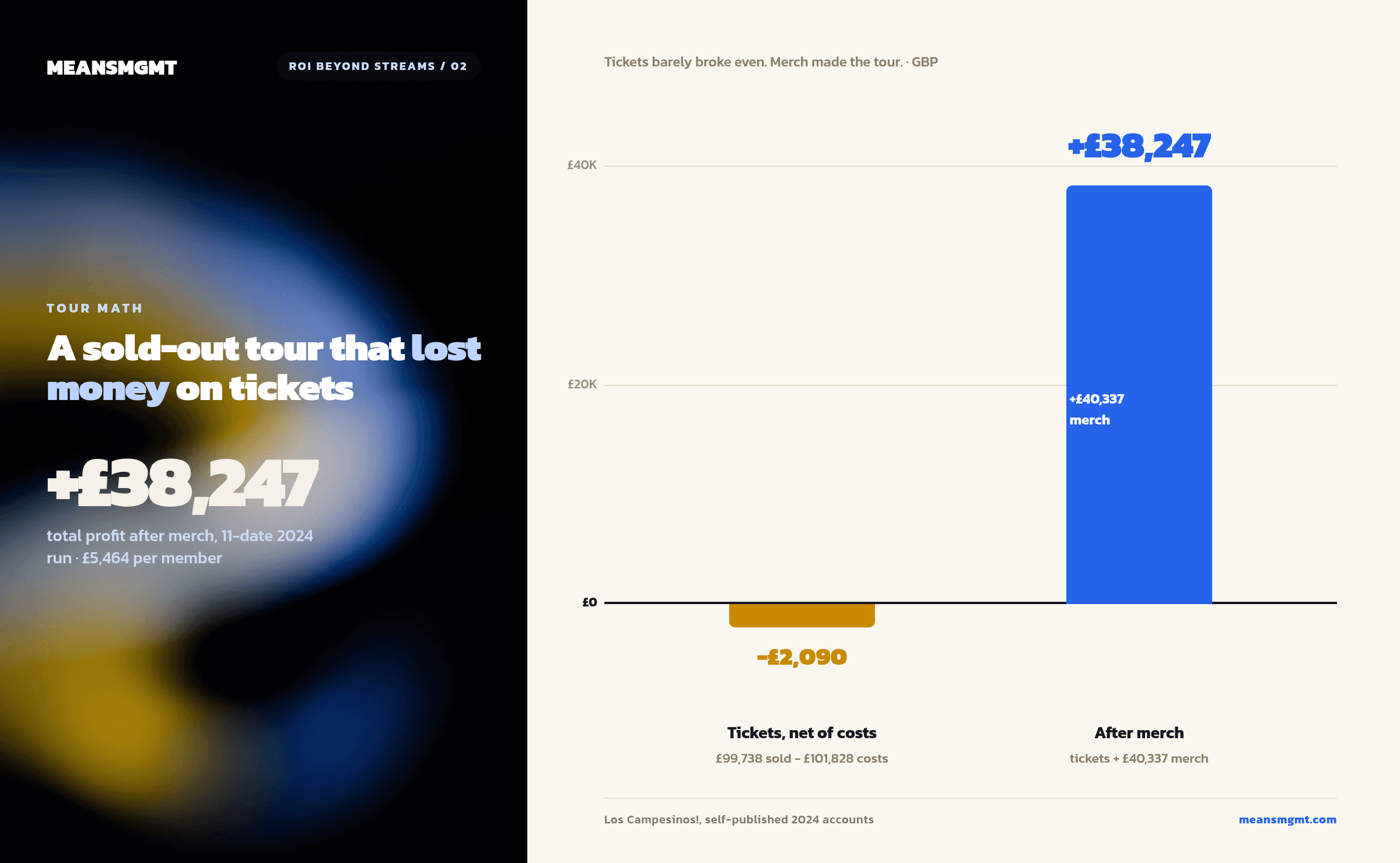
Ticket income came to £99,738. Tour costs (visas, travel, hotels, gear, crew, per diems, the van) came to £101,828. The tour lost £2,090 on tickets, sold out (Los Campesinos!, 2024 tour accounts; coverage via Rolling Stone).
This is the center of tour marketing for independent artists.
The ticket rarely carries the tour, merch does.
Net of manufacturing, Los Campesinos! cleared £40,337 on merchandise, which turned a break-even run into £38,247 of profit. That's about £5,464 per member across the seven-piece, and the band said it goes straight into funding the next tour.
The show barely clears break-even, top to bottom
The same shape runs the whole live business. Live Nation, the largest concert promoter on earth, reported a 3.3% operating margin for its concerts segment in 2025, its best ever. Its Ticketmaster segment ran 37% (Live Nation FY2025 results, Feb 2026).
Those are adjusted operating income margins, the company's own non-GAAP measure, not net profit. Putting on the show barely turns a profit at global scale, and the money lives in the ticketing fee and everything around the event.
Down where most artists play, the room itself often loses. NIVA, the trade group for US independent venues, found 64% of independent stages were unprofitable in 2024 (NIVA State of Live, June 2025).
NIVA is an advocacy organization, so I'd lean on its unprofitability number over its economic-impact figures.
In the UK, the Music Venue Trust put grassroots venues at an average 2.5% profit margin, with 53% making no profit at all in 2025. Regular touring shows left 175 towns and cities (Music Venue Trust Annual Report 2025, Jan 2026). "We have reached the limits of what venues can absorb on margins of 2.5%," MVT's Mark Davyd said.
None of this is new. Pomplamoose's 24-show 2014 run grossed $135,983, spent $147,802, and lost $11,819 in 2014 dollars, floated on the duo's personal credit cards (Jack Conte, 2014).
Selling tickets and making money have long been two different jobs.
Streaming geography is tour routing data
Streaming geography answers the routing question better than instinct does.
Luminate published the clearest example of this in 2026.
Beyoncé's Cowboy Carter run pulled $306M from US dates alone across just 23 shows in six markets, and those residency cities were her top streaming cities.
Luminate noted she "could likely have booked an extra day or two in Washington, D.C., given its similar streaming volume to Chicago and Atlanta" (Luminate, Live Music 2026).
Streaming data found an underbooked ticket market.
We wanted to know whether that pattern holds below the superstar tier, so we ran our own check. From the 5,000-artist dataset behind our Tier 2 targeting analysis, we sampled 200 artists, all above 200,000 Spotify monthly listeners. We matched each one's top streaming cities against upcoming shows listed on Bandsintown (MeansMGMT internal analysis, Aug 2026).
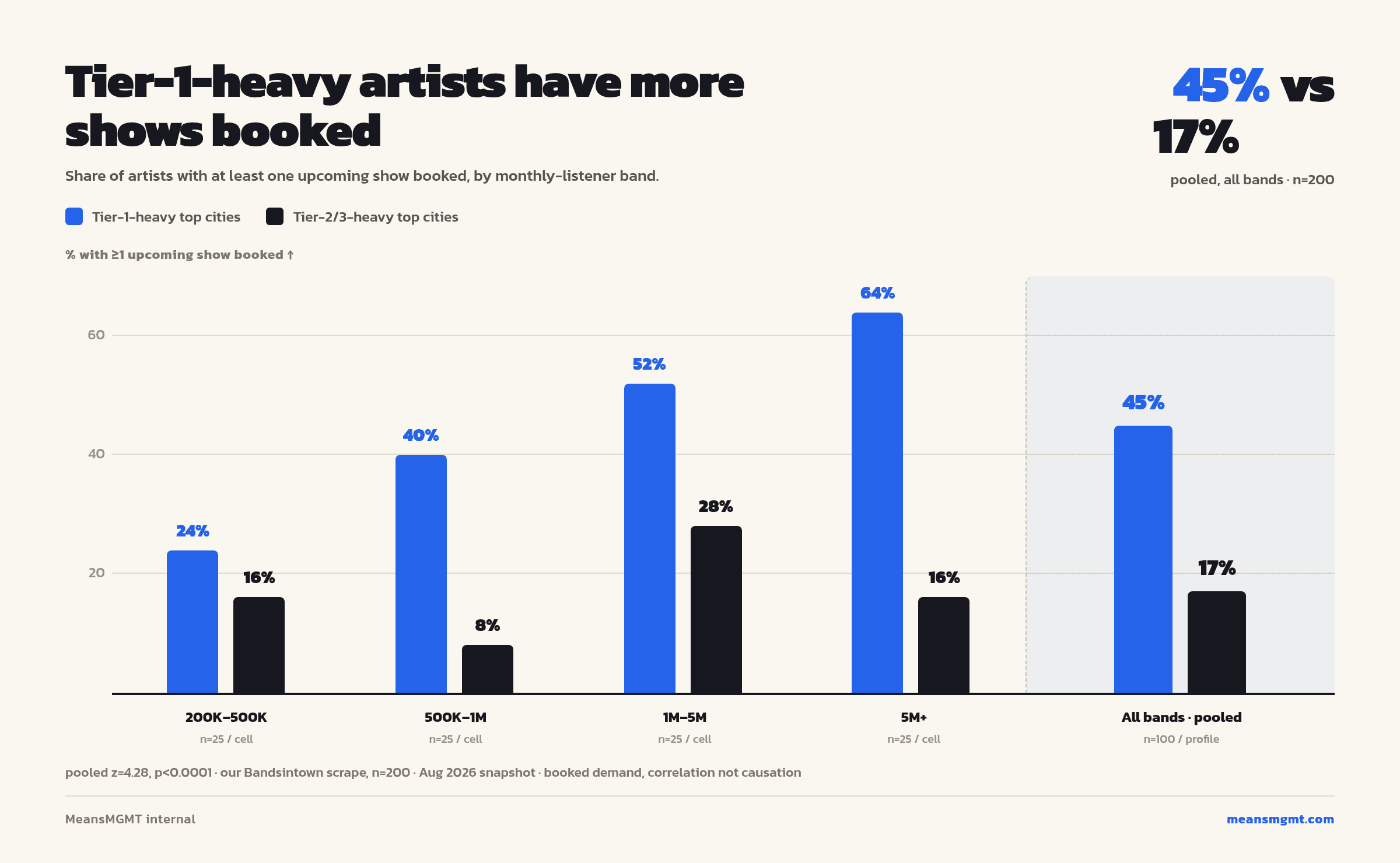
Artists whose top five streaming cities skew toward Tier 1 metros like New York, LA, and Chicago were far more likely to have a show on the calendar.
45% had at least one upcoming date booked, against 17% for artists whose top cities sit in Tier 2 or Tier 3 markets (z=4.28, p<0.0001).
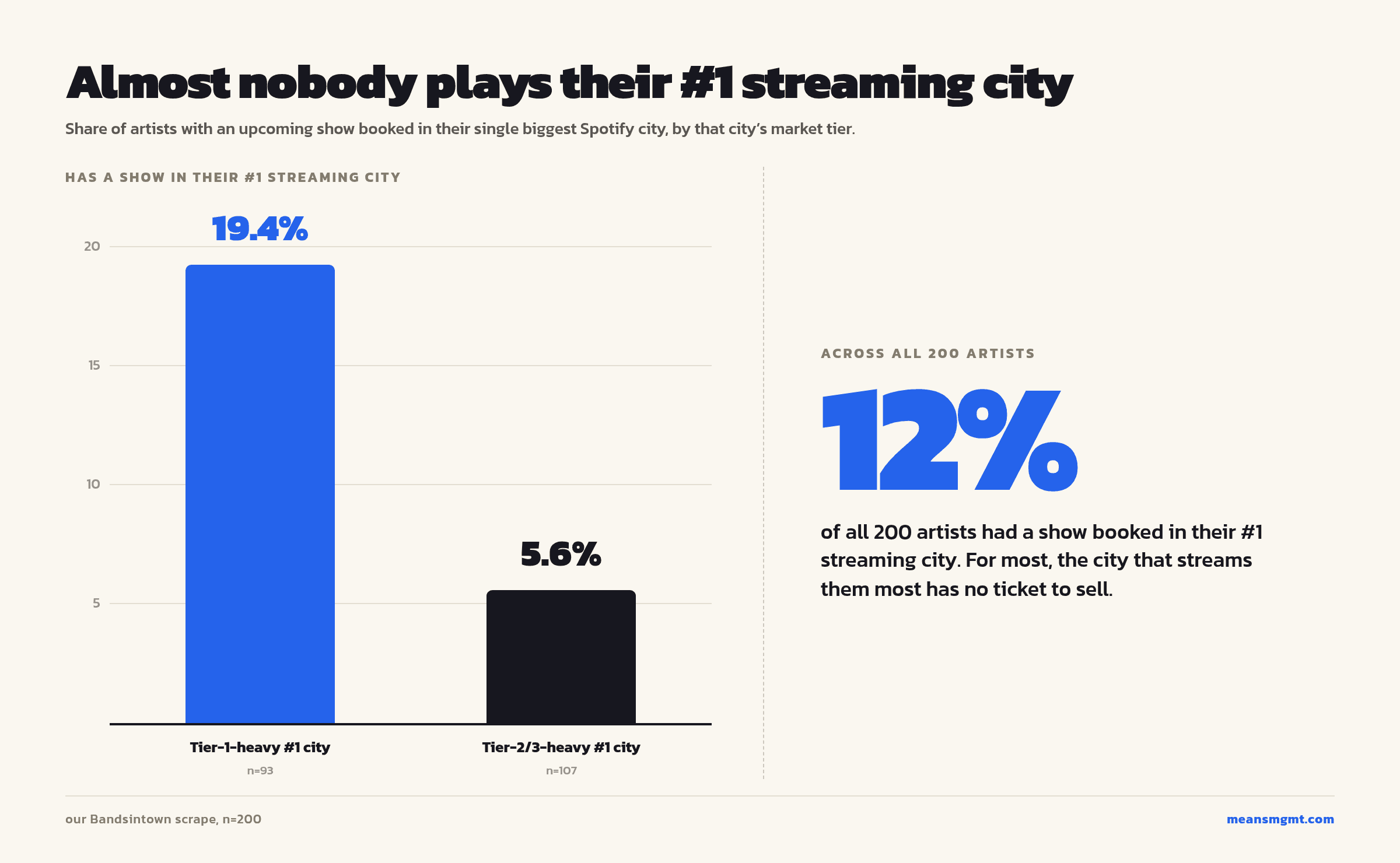
Take the narrower question of whether your biggest streaming city can even sell you a ticket. Among Tier 1 number-one cities, 19% had a booked show in that metro, against 6% for Tier 2/3. Across all 200 artists, only 12% had a show booked in their number-one streaming city.
It's consistent with the geography-to-touring idea, not proof of it.
It's a convenience sample of 200 artists, all above 200K listeners, so it says nothing about smaller acts, and the z-score is suggestive rather than clean inference. Bandsintown listings are team-maintained and under-count DIY and non-Western artists, a bias that points the same way as the finding. This is booked demand, not tickets sold, and correlation rather than causation, with routing, genre, and home market all entangled.
It's a single snapshot from August 2026, weighted toward the fall announce cycle, so acts between tour cycles read as zero. It lines up with the Tier 2 piece's closing point: a streaming map is a demand signal, and touring is one of the clearest places to act on it.
What a small room actually earns
At the club level the deal is usually a guarantee or a percentage, whichever comes out higher. Los Campesinos! walked through their own version with numbers.
The standard is a guaranteed minimum, and if ticket income after the show's costs beats that minimum, the band takes roughly 80% of the show's profit instead.
Their 2024 guarantees ran from $5,500 on the low end to $17,100 on the high end, and on the sold-out nights the percentage won, paying out $10,853.68 and $21,743.80. The booking agent takes a standard 10% off the top of whatever lands (Los Campesinos! via Stereogum, May 2026).
The bar sits outside that math. Drink sales generally stay with the venue.
The 443 Social Club laid it out from the venue side. With no cover charge, the venue says "the money to pay Joe Songwriter has to be made in drink sales at the bar" (The 443 Social Club, 2018). Even at a roughly 75% drink margin, the room has to move about $370 in drinks to net a single $250 fee. That's before its own rent, payroll, insurance, liquor license, and PRO dues.
The bar covers the building. That is why the door, or the guarantee the door funds, goes to the act. Acts almost never get a cut of the bar.
Merch is where the venue reaches back in.
Club merch cuts commonly run 10% to 25%, usually on apparel, and Los Campesinos! call the practice predatory (Stereogum, 2026).
It is not universal. Live Nation dropped merch fees at about 77 of its US club-size rooms in September 2023 under its "On the Road Again" program. Artists keep 100% and get a $1,500 travel stipend, where prior cuts generally ran 15% to 30% (Rolling Stone, Sept 2023).
atVenu's point-of-sale data puts merch at $10.24 per attendee across the shows it tracks, with about 21% of the room buying (atVenu Year in Review, 2025, 2024 data).
That $10.24 spreads across everyone through the door. Among the one in five who actually buy, the average sale runs closer to $49.
A full 300-cap night implies roughly $3,000 in merch gross, maybe half of it surviving manufacturing and the venue's cut.
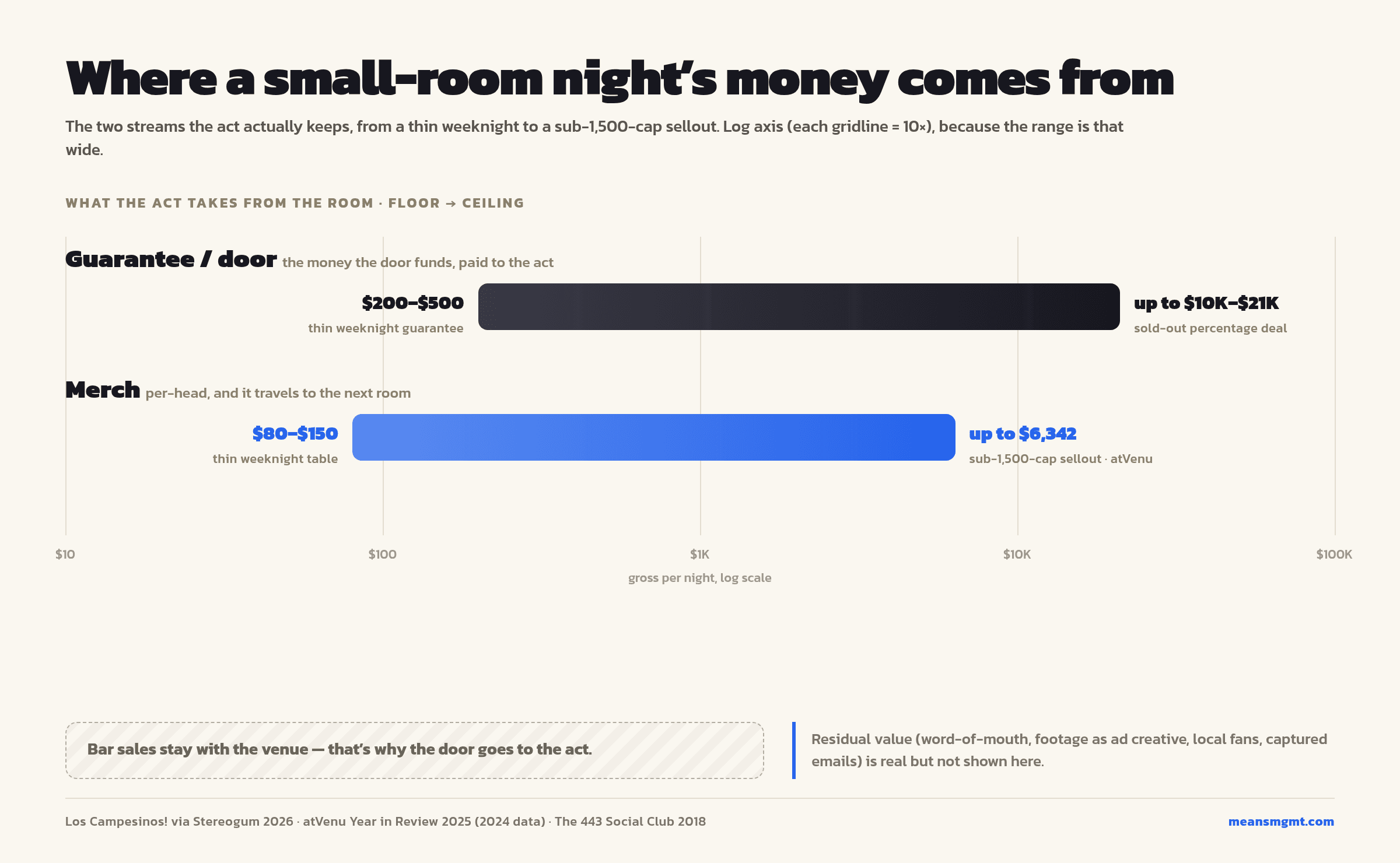
atVenu's average sub-1,500-cap show does $6,342 in a night.
Now scale that down to where most artists actually start.
Picture a Wednesday in a 150-cap room that's half full. The guarantee, if there is one, runs $200 to $500. You put maybe $20 to $30 a day behind the local ad for a few weeks, call it $400 into promotion.
The merch table does $80 to $150 on the night, because a thin weeknight crowd buys less than a packed Friday. On paper that show doesn't clear its own costs. It puts forty or fifty new people in a room with your name on it. A handful leave an email at the table and stream you on the drive home.
The night pays off only if you count the emails and new listeners. This is an illustrative floor, not a real settlement, but it's the math a lot of first tours actually run.
Even sold-out, acclaimed tours often lose money.
Little Simz canceled a 2022 US run because self-financing it "would leave me in a huge deficit" (NME, April 2022).
Santigold pulled a tour the same year, saying flatly "I can't make it work" (Music Ally, Sept 2022).
Animal Collective scrapped a UK and EU run in 2022 (Consequence, Oct 2022). The band said "we simply could not make a budget for this tour that did not lose money even if everything went as well as it could."
A 2024 Pirate Studios survey found 72% of touring artists made no profit (Pirate Studios via DJ Mag, 2024).
This is basically the same lesson part one landed on. The ticket is not where the return lives. The merch table and the "owned" audience are.
A tour marketing playbook for independent artists
No single channel wins tour ticket sales for everyone. Which platform performs depends on where the artist or label already has an audience and puts out work.
In practice Meta or TikTok usually move tickets best. YouTube view campaigns paired with ticket retargeting work well too. And don't write off flyers and street teams just because they don't report back a pixel. Pick the platform you're already active on, then run the mechanic below on it.
Connect Google Analytics (GA4) to your Google Ads account. Put the same GA4 measurement ID on the landing page behind your Meta traffic so both systems see the same visitors. Then run a video-views or subscriber campaign for at least a month in the cities you expect to tour. Location matters more here than in almost any streaming campaign; you're building an audience in specific metros.
That month of spend builds the segments that matter.
In GA4, group the people who engaged. That means landing-page clickers, viewers who watched most of the video, and new subscribers. With the property linked to Google Ads and personalized advertising, auto-tagging, and Google Signals on, those audiences export automatically and populate in a day or two (Google Analytics Help).
Google dropped the minimum audience size to 100 active users across Search, Display, and YouTube in December 2025, which makes this workable on small local audiences (Search Engine Land, 2025).
Then retarget those warm segments with the ticket link once the show is announced.
Start 3 to 4 months before the date. One month is the floor, and more lead time reliably means more sales; if you're touring next month, your ticket campaigns should have been live for the past two. A tour campaign is far more timing- and location-specific than a streaming campaign.
If you have $1,000 total, that's about $30 a day across a month, and you should expect modest outcomes at that level. Put it on the tour dates and general awareness rather than streaming. A ticket sale has a real chance of returning more than it cost, and you can feed that profit into streaming growth later.
For bigger budgets we model spend against our live StreamSpend benchmarks, not a rule of thumb, since hand-derived per-click math tends to be wrong.
This is one approach that has worked for us, not the only path. The channel version of that math is in our music marketing channel ROI comparison.
Tracking ticket sales back to the ad
The hard part of tour attribution is that the biggest ticketers don't hand you the data. Ticketmaster isn't a total black box, but the access sits behind TM1, the account promoters and venues hold, not artists.
A team with TM1 can place pixels on the event and purchase pages and read a post-show report on a five-day last-click window.
Without it, you get whatever your promoter chooses to share, and either way the buyer email list stays with Ticketmaster and the promoter, never the artist. AXS is thinner and effectively closed to independent artists.
Other platforms hand the result back.
Eventbrite and Tixr both fire real Meta CAPI purchase events, value and currency attached. Bandsintown Pro carries Meta, TikTok, and X pixels with retargeting audiences built in.
Laylo routes ticket buyers straight into the artist's CRM and pulls in DICE and Seated sales.
Music gatekeeps this harder than most, and that read is ours, not a neutral fact. Spotify won't let you put a Meta pixel on your profile or your tracks (Spotify Ad Analytics, About Attribution). So you can't see or optimize toward the person who came from your ad and then streamed.
That single limitation is why Feature.fm, Linkfire, and smart-link landers exist to some degree. The pixel fires on the landing page, one step before the handoff to Spotify (Feature.fm, May 2026).
ToneDen collapsed in March 2024 when Eventbrite let its fanlink.to domain expire and broke every link built on it. A wave of replacements rushed in to fill the gap (Music Ally, March 2024).
And Spotify has reason to keep its box closed.
It blocks the outside pixel, sells you native promotion to move the same needle (Marquee, and Discovery Mode, which a November 2025 Manhattan class action calls "modern payola," and I don't disagree). It now runs its own Spotify Pixel and Conversions API, so the conversion signal stays inside its ad system instead of going out to Meta or Google (Billboard, 2025).
None of that serves the artists, labels, distributors, or listeners.
Walled gardens gatekeep everywhere, though.
Meta, Google, and Amazon don't hand out user-level data either. E-commerce is the clean contrast, where a Shopify store owner fires pixels freely and sees every purchase attributed.
The closest analog to music is the movie theater, where studios largely don't know who showed up. Roughly three-quarters of tickets are bought offline, and there's no unified moviegoer record (Epsilon).
What makes music its own case is who pays for it.
The artist or label spends its own money to drive traffic into a box that hides the result, and then the platform sells them ads to recover it.
Damon Krukowski has made a related case about Discovery Mode (Dada Drummer Almanach). He argues Spotify promotes its own content using privileged access, then asks artists to pay for advantage they used to get for nothing.
Track a real pixel-fired purchase event, never Meta's native "click," or you'll optimize toward the wrong action, the same trap that quietly wrecks streaming campaigns.
And treat the owned email and SMS list as the one durable, portable, measurable win.
Ticketers come and go, but the community you build, and the way you talk to it, stays yours.
That was part two. If you want the full picture, read part three.
Sources
Los Campesinos!, "Los Camp! Present: Their Tour Accounts" (11 dates, June 2024). Ticket income £99,738.05, tour expenses £101,827.95, ticket-side loss £2,089.90, merch profit £40,336.54, total tour profit £38,246.64, or £5,463.81 per member. loscampesinos.substack.com; coverage via Rolling Stone (rollingstone.com) and Exclaim! (exclaim.ca).
Los Campesinos! (Gareth David) via Stereogum, May 5, 2026. Deal structure "guarantee vs ~80% of the show's profit, whichever is greater"; 2024 guarantees $5,500 low to $17,100 high; sold-out nights paid $10,853.68 and $21,743.80. Booking agent standard 10%; venue merch cut called a "predatory practice". stereogum.com
The 443 Social Club, "The Economics of Live Music in a Small Venue," Dec 27, 2018. Bar and F&B stay with the venue and fund its overhead, which is why the door goes to the act. About 75% drink margin; the venue must sell about $370 in drinks to net a $250 fee before rent, payroll, insurance, and PRO dues. 443socialclub.com
Rolling Stone, Sept 26, 2023. Live Nation's "On the Road Again" dropped merch fees at ~77 US club-size rooms: artists keep 100% plus a $1,500 travel stipend. Prior venue merch cuts generally ran 15-30%. rollingstone.com
Live Nation Entertainment, Full Year and Q4 2025 Results, Feb 19, 2026 (concerts AOI margin 3.3%, "best-ever"; Ticketmaster AOI margin 37%; AOI is a non-GAAP measure, not net profit): newsroom.livenation.com
NIVA State of Live, national report, June 2025 (64% of US independent stages unprofitable in 2024): https://www.nivassoc.org/stateoflive
Music Venue Trust Annual Report 2025, Jan 2026. UK grassroots venues average a 2.5% profit margin; 53% made no profit in 2025; 175 towns and cities lost regular touring shows; Mark Davyd quote. musicvenuetrust.com
Jack Conte, "Pomplamoose 2014 Tour Profits," Medium, Nov 2014 (24 shows / 23 cities; income $135,983, expenses $147,802, loss $11,819; 2014 dollars, historical benchmark): medium.com
Luminate, "Live Music 2026" special report, June 2026. Beyoncé's Cowboy Carter run made $306M from US dates across 23 shows in 6 markets; residency cities were top streaming cities; Washington, D.C. streaming-volume observation. Based on Luminate consumption data and Billboard Boxscore. luminatedata.com
MeansMGMT internal analysis, Aug 2026 (Bandsintown scrape; n=200 artists, all 200K+ Spotify monthly listeners, 25 per cell across 4 listener bands x 2 tier profiles). T1-heavy top cities: 45% with an upcoming booked show vs 17% for T2/3-heavy (z=4.28, p<0.0001). Metro match for each artist's #1 city: 19.4% Tier 1 vs 5.6% Tier 2/3. Of all 200, 12% had a show in their #1 streaming city.
atVenu, Year in Review 2025 ($10.24 per attendee, ~21% buy rate, $6,342 average sub-1,500-cap merch night, 2024 point-of-sale data): https://www.atvenu.com/year-in-review
Members Media, "From Spotify Streams to Gigs," July 4, 2025 (independent artist Eric Kane ran $5/day geo-targeted ads per tour town and sold 70 tickets in a room he'd previously drawn 5 to; Spotify's claim that about one in three of its listeners attends at least one concert a year): members.media
Andrew Southworth, ad-creative rights guidance (using concert or live footage in an ad requires clearing sync and master rights first): https://andrewsouthworth.com/
NME, April 19, 2022 (Little Simz canceled a US tour, self-financing "would leave me in a huge deficit"): nme.com
Variety, Sept 2022 (Santigold canceled her tour over touring costs, "I can't make it work"); see also Music Ally, Sept 28, 2022: musically.com
Consequence, Oct 10, 2022 (consequence.net). Animal Collective canceled a UK/EU run: "we simply could not make a budget for this tour that did not lose money even if everything went as well as it could."
Pirate Studios touring survey, mid-2024, via DJ Mag (72% of touring artists made no profit; ~48% broke even, 24% ran at a loss): djmag.com
Google Analytics Help, sharing GA4 audiences with linked Google Ads products (account link with edit permission, personalized advertising + auto-tagging + Google Signals, 24-48h to populate): https://support.google.com/analytics/answer/12800258
Search Engine Land, Dec 2025 (Google lowered the minimum audience size to 100 active users across Search, Display, and YouTube): searchengineland.com
Spotify Ad Analytics, "About Attribution." Attribution works only through the Spotify Pixel on the advertiser's own website plus IP and first-party cookies. There's no way to put a third-party pixel on a Spotify profile or track: https://help.adanalytics.spotify.com/about-attribution
Feature.fm blog, May 27, 2026 ("You can't install a Facebook Pixel or Conversion API on Spotify itself"). The pixel fires on the Feature.fm lander and captures the "Listen on Spotify" click before the handoff. Feature.fm added support for Spotify's own Pixel + CAPI in May 2026. blog.feature.fm
Music Ally, March 14, 2024 (ToneDen collapse: Eventbrite let the fanlink.to domain expire, breaking every link built on it; a wave of replacement tools followed): musically.com
Billboard, 2025 (Spotify Discovery Mode described as "modern payola"; a November 4, 2025 Manhattan class action makes that claim; Discovery Mode gives an algorithmic boost for a reduced royalty): billboard.com
Damon Krukowski, Dada Drummer Almanach. Argues Spotify promotes its own content using privileged access, then asks artists to pay for similar advantage through Discovery Mode: https://dadadrummer.substack.com/
Epsilon (movie-theater analog: roughly three-quarters of US tickets bought offline, studios lack a unified moviegoer record, ad outcomes measured in aggregate, not buyer-level): epsilon.com
MeansMGMT ticket-attribution platform verification, Aug 2026, per platform documentation. Ticketmaster: TM1 pixel access, five-day last-click sales window, buyer list kept by TM and the promoter. AXS: artist-level gating, effectively closed. Data-returning platforms: Eventbrite (Meta CAPI purchase events with value and currency), Tixr (native Meta CAPI), and Bandsintown Pro (Meta, TikTok, and X pixels plus retargeting). Laylo sends ticket buyers into the artist CRM, with DICE and Seated sync.
MeansMGMT StreamSpend benchmarks (internal, 2026); forward budget projections modeled in the live simulator, not hand-derived from per-click multipliers.
FAQ
Questions we get
If you have a release coming, start with two quick questions, about three minutes in total, and we’ll scope your campaign. Want the numbers first? The benchmarks report is free.

