
·
Industry
·
Touring and ROI · Part 1 of 3
Streams Don't Pay Rent: Where Artist Money Comes From
What 1,000 streams actually pays, what one merch night is worth, and how paid ads feed the music artist income streams that cover rent.

MeansMGMT
Streaming is the storefront, not the paycheck. The money lives in merch, shows, and an audience you actually "own."
This is part one. Part two takes the touring gear apart, from what streaming geography tells you about ticket demand to how we structure tour ads city by city.
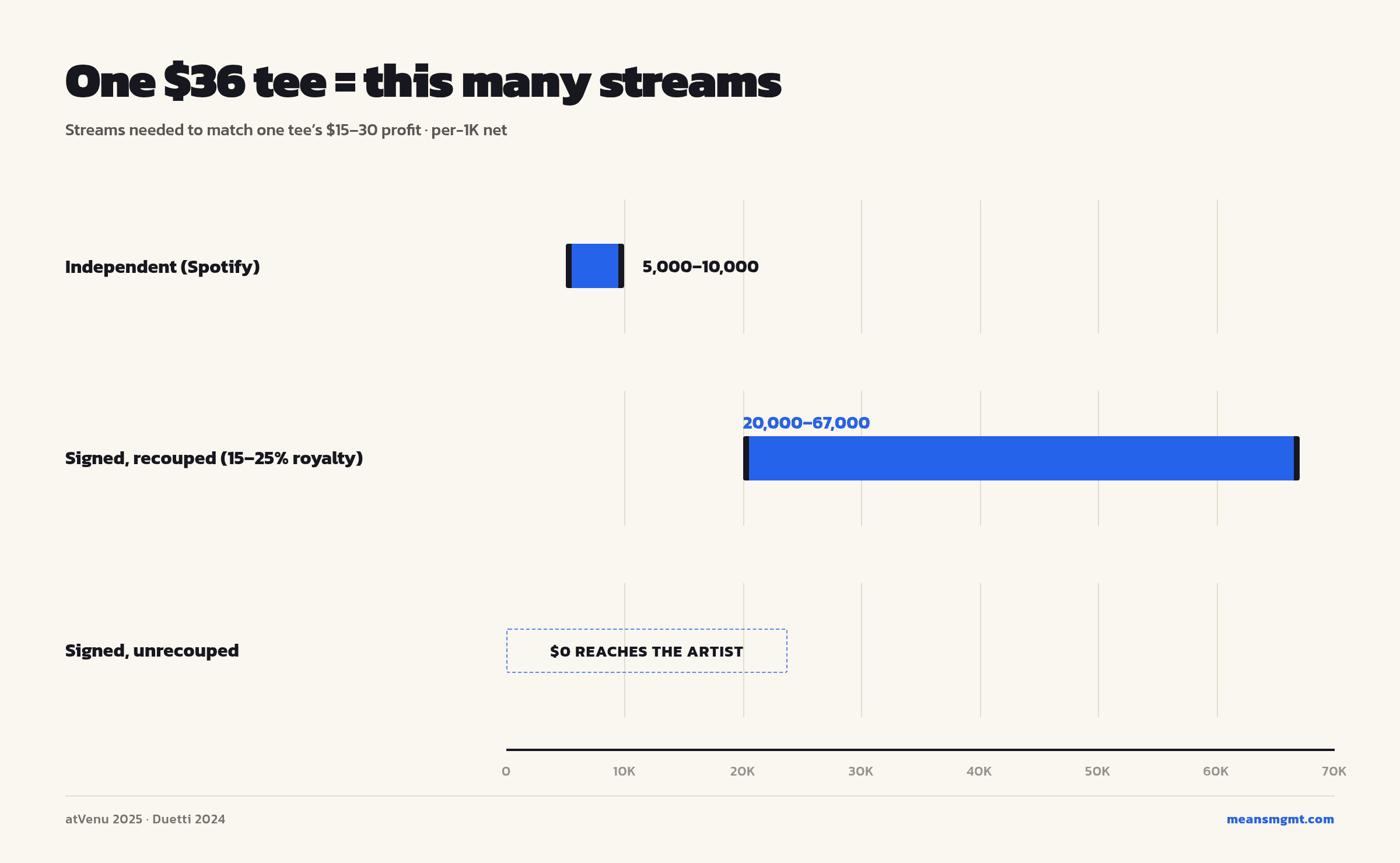
One $36 tour tee puts between $15 and $30 in an artist's pocket once printing and the venue's merch cut come out. Matching that from streaming takes roughly 5,000 to 10,000 streams for a fully independent artist.
On a typical label deal, at a 15 to 25% royalty, the same shirt is worth 18,000 to 67,000 streams. And if the deal isn't recouped, no number of streams closes the gap, because the artist's share is zero until it is recouped.
Deal structure can multiply the answer several times over. That's why music artist income streams look nothing like the play counts everyone stares at.
Those numbers assume a $36 shirt (atVenu Year in Review, 2025) and $6 to $12 print cost at tour quantities. Venue cuts run from 0% at Live Nation's US clubs (since 2023) to about 25% at typical halls.
The streaming nets sourced below vary with the platform and with the listener's account. Location matters most, along with whether the listener pays or uses the free tier.
Inside the music artist income stack
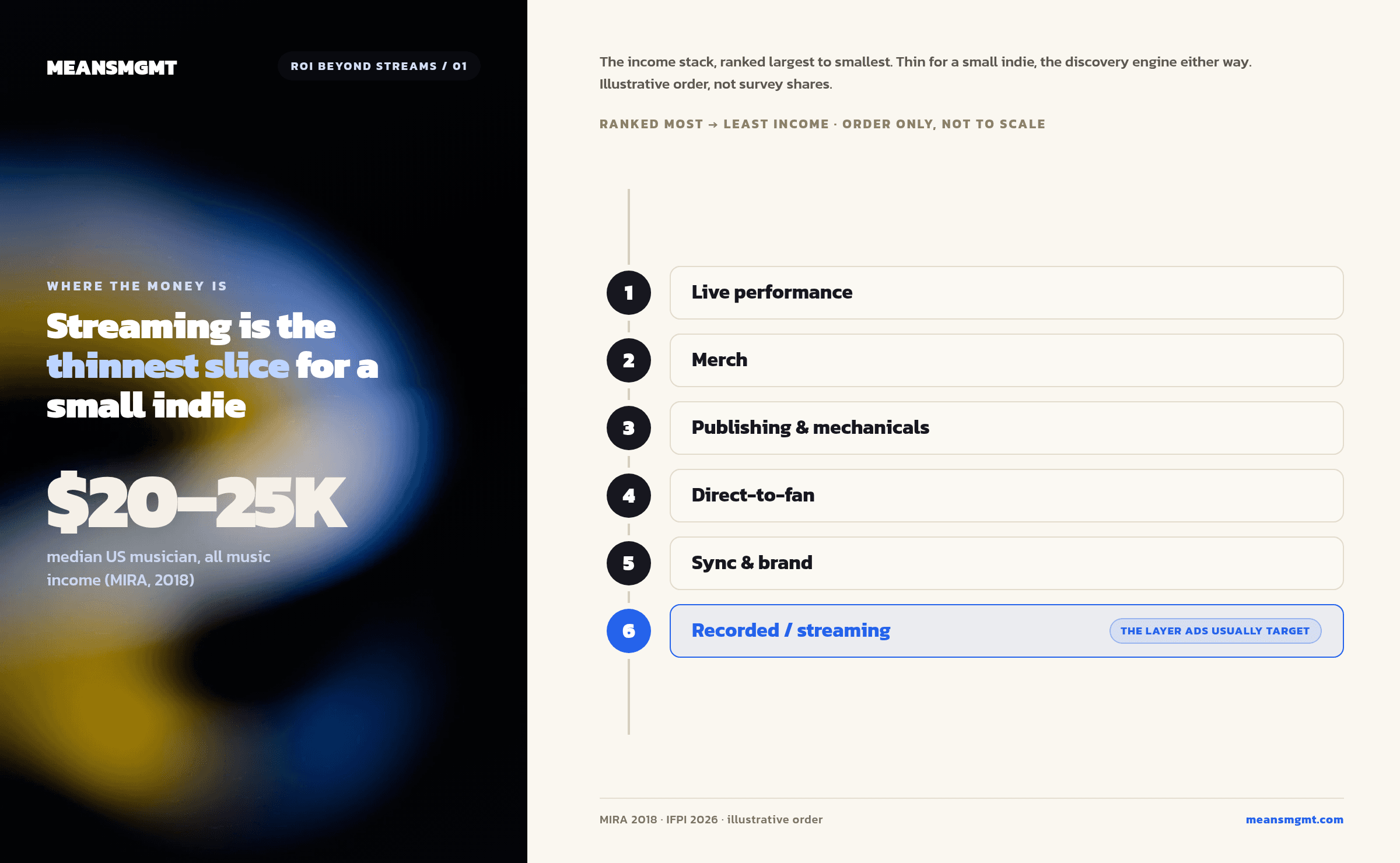
The MIRA survey (Music Industry Research Association with Princeton's Survey Research Center, 2018) found the median US musician earned $20,000 to $25,000 a year from all music activities combined. Of those surveyed, 61% said that income didn't cover living expenses. Live performance was the most common income source, and the average musician stacked 3.5 separate music activities to get there. That's 2018 data, pre-pandemic, and nothing as thorough has been run since.
Zoom out and the industry is at record revenue.
Recorded music brought in $31.7 billion globally in 2025, up 6.4%, an eleventh straight year of growth (IFPI Global Music Report, 2026).
For a small independent artist, streaming is a thin payout line, a few dollars per thousand plays.
At scale, it's the biggest and fastest-growing category in the business. Either way it's the discovery engine, the thing that finds listeners before the rest of the stack can charge them.
Spend aimed only at streams treats that discovery layer as the whole paycheck. We work on the same problem from the agency side in label marketing ROI.
One layer that often doesn't make it into these conversations is publishing. Songwriting royalties, mechanicals, and PRO payments (ASCAP, BMI, PRS) are a separate stream from the recording, and they pay the writer rather than the performer. They tend to be the most durable money in the stack, since they keep landing whenever the song is played, covered, or synced years later.
How streaming actually pays
No streaming service pays a per-stream rate. Spotify's own royalty FAQ says a per-stream rate "isn't actually how anyone gets paid," on Spotify or any major service (Loud & Clear, 2026).
Each service pools roughly two-thirds of its music revenue by market, then splits that pool by streamshare, meaning your streams as a fraction of everyone's.
Every per-stream figure you've seen is after-the-fact arithmetic, payouts divided by plays, and it moves with country and subscription mix.
We took the country side apart in whether Tier 2 markets are worth targeting.
Measured after the fact, recording-side payouts run about $3 per 1,000 streams on Spotify and $4.80 on YouTube. Apple Music pays about $6.20 and Amazon Music $8.80 (Duetti Music Economics Report, 2024 data).
That's gross to the rights holder. A fully independent artist on a flat-fee distributor keeps nearly all of it. On a typical label deal, a 15 to 25% royalty on the label's receipts leaves under $1 per 1,000 Spotify streams for the artist, and $0 before recoupment.
The pool is real and growing. Spotify's payouts went from $1 billion in 2014 to $10 billion in 2024 (Spotify Newsroom, 2025) and passed $11 billion in 2025 (Loud & Clear, 2026). Those are payments to rights holders, before labels and distributors take their cut.
In Spotify's own framing of the average, capturing one in every million streams on the platform generated about $11,000 in 2025.
Streaming is the storefront
About 106,000 new tracks hit streaming services every day in 2025 (Luminate 2025 Year-End Report, as reported by Hypebot, 2026).
Of the 253 million tracks on DSPs, 88% drew 1,000 or fewer streams for the year (Luminate's cross-platform count). Since April 2024, Spotify has applied its own 1,000-stream minimum before a track earns recording royalties at all, so on Spotify most of the catalog now formally earns nothing.
Higher up, the curve stays steep. In 2025, 81,000+ artists generated $10,000 or more on Spotify and about 13,800 cleared $100,000. That is out of roughly 250,000 artists Spotify considers professional and 13 million people who have ever uploaded a track (Loud & Clear, 2026).
Streaming is window shopping, sometimes. The profile is the storefront. Someone hears a song, and if they care enough, they go to your bio, then your Instagram, your YouTube, your site.
That path is trackable, which matters if you have something to grow, sell or monetize. Streaming finds your people. It was never going to be most of the paycheck, not that artists had a say in how streaming played out.
The loop, and where it leaks
This is the loop we build campaigns against.
They build retargetable audiences across platforms, grow the profiles themselves, and nudge organic reach up along the way. That presence throws off demand data, the top cities, the saves, the followers, the fan-made clips, the stuff that tells you which rooms you can fill.
Rooms sell merch and hand you emails and phone numbers, which adds up to an owned list. That list makes the next release and the next tour cheaper to launch, which is where the loop comes back around.
The channels that look expensive per click are often the ones feeding this loop best, and we ran those numbers in a music marketing channel ROI comparison.
None of that is frictionless. Every arrow in the diagram leaks. Plenty of people who hear the song never tap the profile, most who tap never save, and most who save never buy a ticket. The drop-off compounds at each step.
The loop turns. It just loses people at every step, and the campaign's job is to plug what it can.
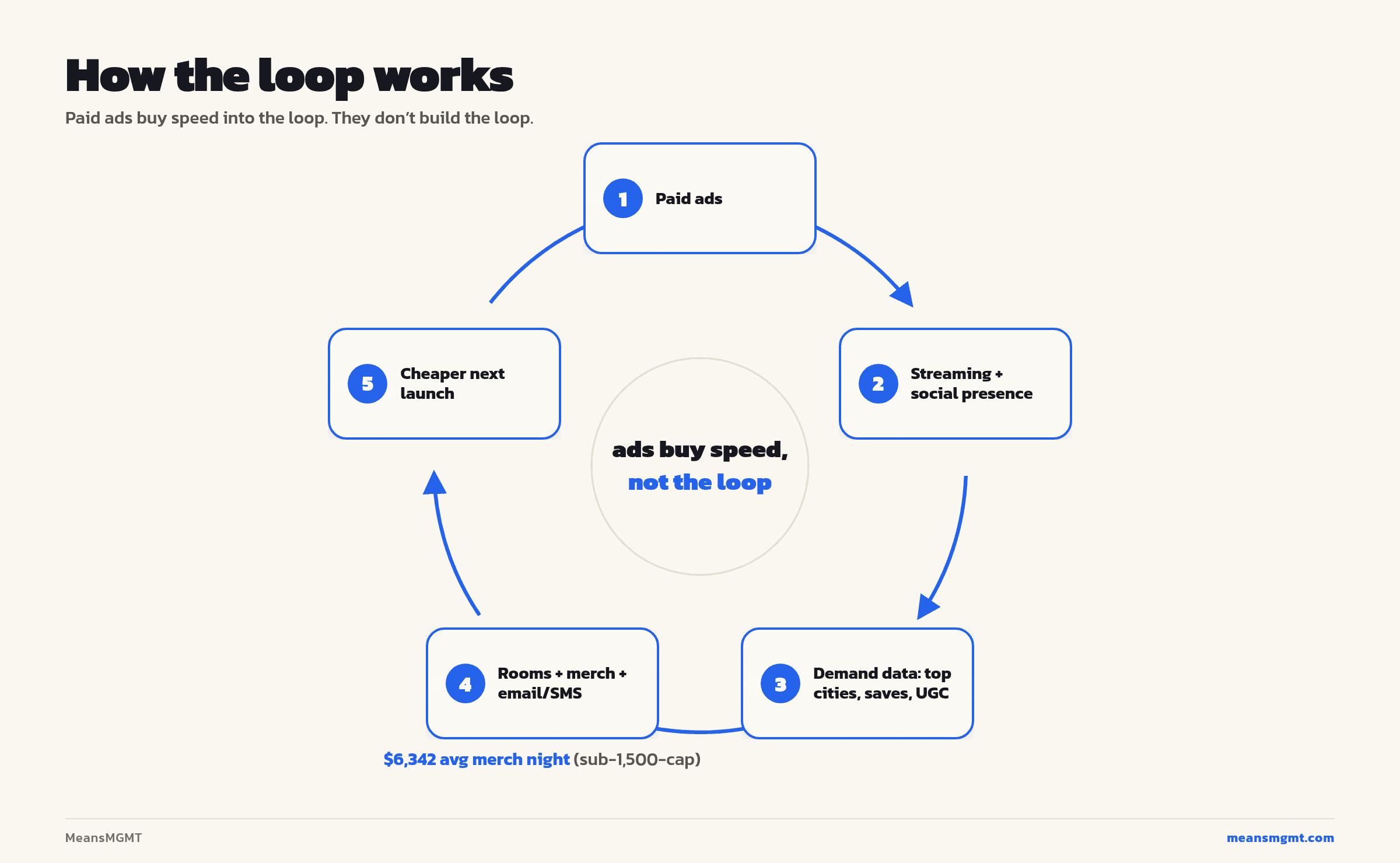
atVenu's point-of-sale data (Year in Review, 2025) puts the average merch night at a sub-1,500-capacity show around $6,342 in gross sales (2024 data).
Net that down by roughly half once printing and the venue's cut come out, and the artist keeps somewhere near $3,000 from a single night. Matching that on streaming takes about a million plays for an independent at roughly $3 net per 1,000.
Part two takes the per-head merch math apart.
A reggae act we work with shows how this plays out. They caught a viral moment when an AI remix of one of their songs took off on TikTok. Spotify streams rose 98% and peaked at 53,900 a day, saves rose 570%, and TikTok creations climbed from 7,000 to more than 50,000 a day (MeansMGMT internal data, 2026). We did not create that moment.
The AI remix did, organically, with nothing paid behind it. What we did was put $6,000 of YouTube behind the spike, roughly 407,000 views at about $0.015 per view, to turn attention into subscribers and retargetable audiences.
The streaming money from the spike itself was rounding error. The audience it left behind is what fills rooms later.
Sync and brand deals follow the numbers
Sync placements and brand partnerships belong in the stack, and they're the most misunderstood layer because they're demand-driven.
Supervisors and brand teams license what already shows measurable momentum, and the demand data the loop generates is the pitch.
Chasing sync cold, with nothing behind the song, mostly burns time. Build the numbers and these deals tend to arrive as an output.
What most artists are actually chasing
Ads aren't necessary, and never have been. What they buy is speed. The platforms' delivery systems raise the rate at which the loop turns, but the loop itself has always existed. It's just available to everyone now.
People seem tired of the internet lately, or at least of socials, and that's worth building for.
The artists reading that correctly are adding in-person experiences, limited runs, hand-made merch, small series built around the edges of their core vibe.
Push only one gear and you never find out which one actually works, or whether you need to push multiple gears to get the "machine" running.
Most artists aren't really chasing superstardom anyway. They're after stability, built around a specific gift, and that doesn't take millions of monthly listeners or a sold-out amphitheater.
People make a living on YouTube covering defunct amusement parks, cruise ships, retro tech.
The job is to use the easy-engagement platforms to find your real people. Then let each of them pick their rung: just streaming, one tee, every drop, every show, the livestream, the video series. Somewhere on that ladder a community forms around something worth paying for. Make things worth showing up for, and count what you can.
Part two takes the touring gear apart, from what streaming geography tells you about ticket demand to how we structure tour ads city by city. Our internal payback framework plans for 24% of ad value coming back in week one, 18% across weeks two through thirteen, and 58% between week fourteen and two years out.
Sources
atVenu, Year in Review 2025 (tee price, $10.24/head, 21% buy rate, $6,342 sub-1,500-cap merch night, 2024 POS data): atvenu.com
MIRA / Princeton Survey Research Center, Survey of Musicians, 2018 (median $20-25K, 61% insufficient income, 3.5 activities, live most common source): psrc.princeton.edu
IFPI Global Music Report 2026 ($31.7B, +6.4%, 11th straight growth year): ifpi.org
Spotify, Loud & Clear FAQ, updated March 2026 (streamshare quote; $11B+ 2025 payouts; one-in-a-million streams = ~$11K; 81K artists at $10K+, 13.8K at $100K+; ~250K professional artists; 13M uploaders; 1,000-stream policy): loudandclear.byspotify.com
Spotify Newsroom, Sept 25, 2025 ($1B 2014 to $10B 2024 payouts): newsroom.spotify.com
Duetti Music Economics Report, Jan 2025 (2024 data; per-1,000-stream payouts by platform): report.duetti.co
Luminate 2025 Year-End Report, as reported by Hypebot, Jan 2026 (106K tracks/day; 88% of 253M tracks at 1,000 streams or fewer): hypebot.com
Music Business Worldwide, Live Nation "On the Road Again," Sept 2023 (0% merch cut at LN US clubs): musicbusinessworldwide.com
ScreenPrinting.com, profit calculator (tee COGS at tour quantities): screenprinting.com
MeansMGMT internal campaign data, 2026 (anonymized reggae act: $6,000 YouTube flight, ~407K views at ~$0.015 CPV; organic viral context: streams +98% peaking 53.9K/day, saves +570%, TikTok creations 7K to 50K+/day).
MeansMGMT internal planning framework (24/18/58 payback curve, adapted from legacy audio ROI studies; operating heuristic, not third-party research).
FAQ
Questions we get
If you have a release coming, start with two quick questions, about three minutes in total, and we’ll scope your campaign. Want the numbers first? The benchmarks report is free.

