

At 35 listeners, a fifth city is a statistical artifact, not a finding. Almost any city on earth can show up, no fraud required.
Open Spotify for Artists, glance at your top five cities, and there's a place you've never been. Santiago at number four. Mexico City at number two. On a profile that's never toured outside its home state. The usual read, all over Reddit and the artist forums, is bots: a purchased stream campaign, a shady distributor, a fake playlist.
That worry makes sense. But your Spotify top cities can't confirm it on their own, and for a small catalog the reason is arithmetic, not fraud detection.
We pulled the top-five city lists for about 7,000 Spotify artist profiles between June 26 and July 11, 2026: 5,000 above 200,000 monthly listeners, and roughly 2,000 between 1,000 and 200,000, the band where this question comes up most. Everything below is top-five-city presence and per-city listener counts from public profiles, not audience share.
One narrow question: how many listeners does a city need before it lands in an artist's top five?
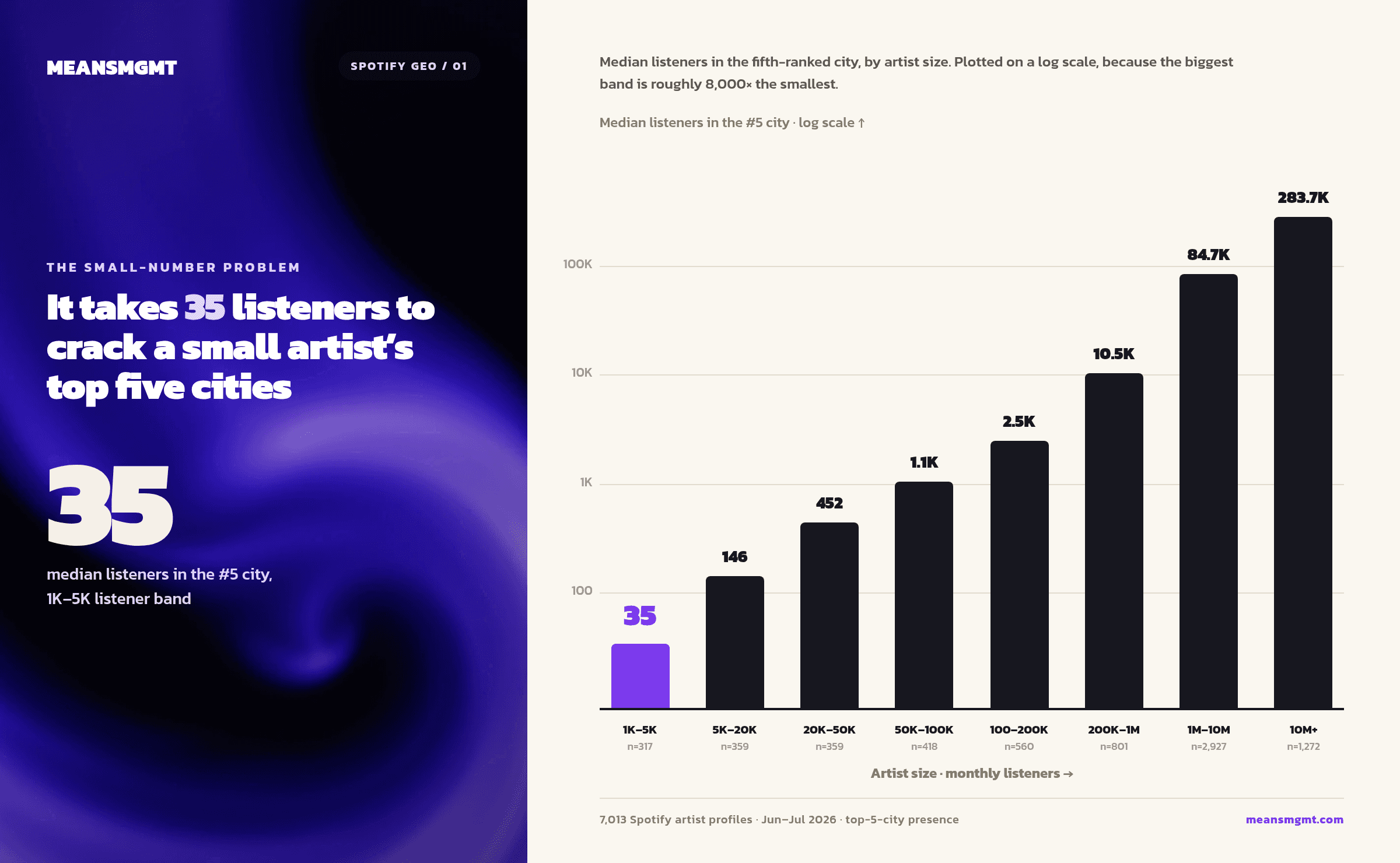
For an artist with 1,000 to 5,000 monthly listeners, the median count in the fifth city is 35 people. From there the bar climbs about an order of magnitude at a time: 146 in the 5K-20K band, 452 between 20K and 50K, 2,513 for artists nearing 200K. Above 10 million, the median fifth city holds 283,662.
So a top-five list means completely different things at different sizes. At 10 million listeners, your fifth city is a real regional audience with demographic weight. At 3,000, it's whichever 35 people happened to press play, small enough that one playlist add or one curator with a local following can put it there. At that size, almost any city on earth can show up, no fraud required.
That unfamiliar city is probably not bots
The bot theory makes a testable prediction. If a strange top city meant artificial streaming, then artists whose top city sits outside their genre's home region should show inflated listeners against their followers: lots of plays, comparatively few fans.
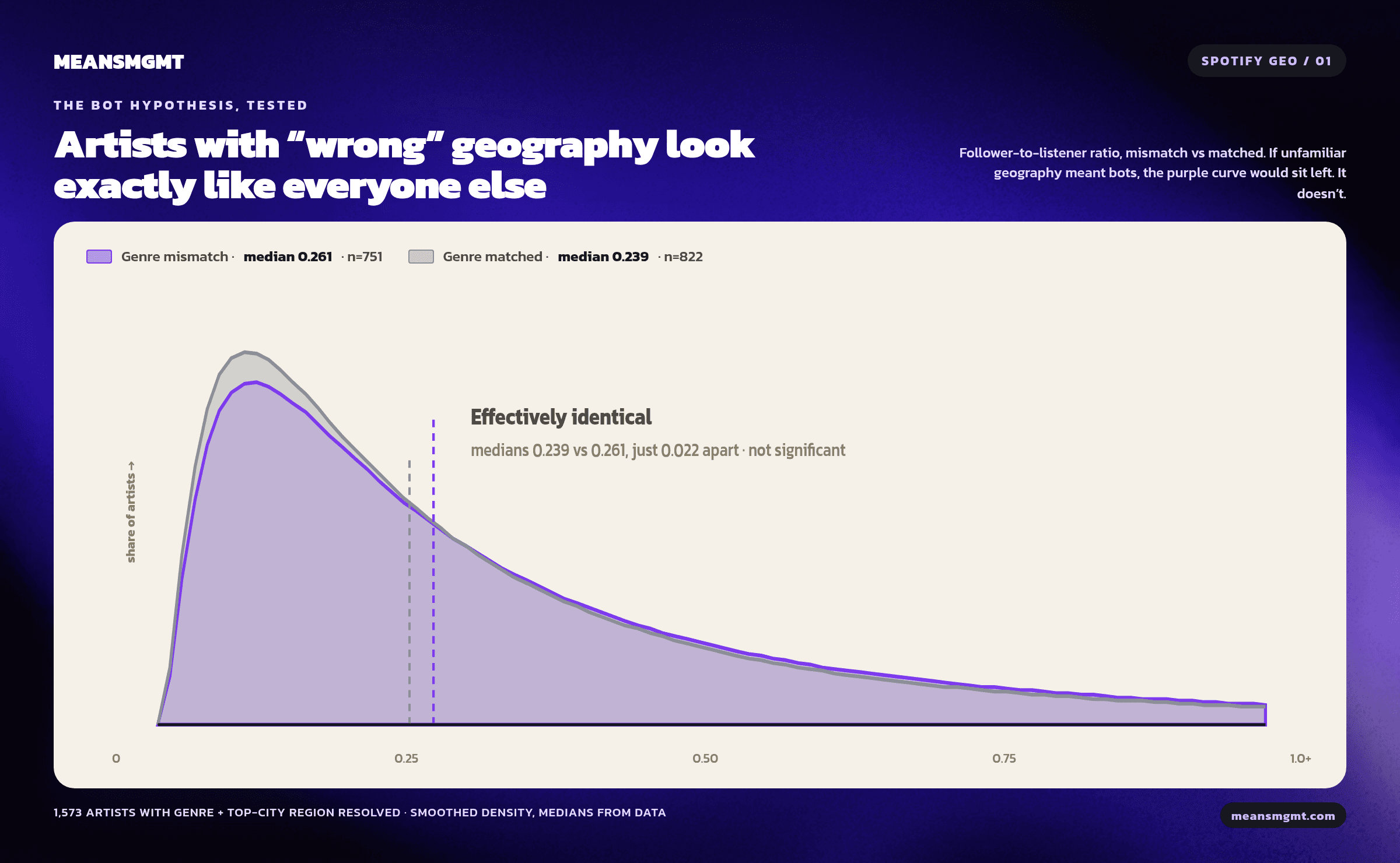
They don't. Across the 1,573 artists where we could resolve both genre and top-city region, the mismatch group (751 artists) had a median follower-to-listener ratio of 0.26, against 0.24 for the matched group (822 artists). The analysis treats that gap as statistically indistinguishable. Geography alone didn't separate them.
That lines up with how detection actually works. Spotify and third-party fraud vendors flag artificial streaming through engagement signatures, not location: skip rate, completion rate, saves and follows, and repeat plays from accounts with no other listening history. Location barely matters on its own, because streaming farms route through commercial IP in any country and real listeners can be anywhere.
The fraud is real. The geography just isn't the evidence.
None of that shrinks the fraud problem. Beatdapp puts annual losses around $2 billion in diverted royalties, a figure IFPI cites in its own reporting, and depending on methodology the estimate runs as high as $3 billion. Deezer reported in July 2026 that roughly 90,000 AI-generated tracks were landing daily, more than half of all new uploads at the June peak, with up to 85% of streams to those tracks flagged as fraudulent and demonetized.
Spotify's enforcement has scaled with it. It now charges distributors a per-track penalty when artificial streaming is detected, and its royalty model requires 1,000 streams in a trailing 12 months before a track earns anything, a threshold built partly to undercut the economics of stream fraud.
Every one of those mechanisms runs on behavioral data. None of them treats an unfamiliar city as a signal by itself.
How to read your top cities without panicking
So if you're auditing your own map, two things are worth reading. The city's name isn't one of them.
First, engagement next to geography. Listeners in a strange city who save tracks, follow you, and finish songs are an audience, wherever they sit. Streams with no saves and constant early skips deserve a look in any market, your home city included.
Second, whether the city tracks a real event. Cities that show up after a release, a playlist placement, an ad flight, or a regional social trend are just normal campaign behavior. Cities that appear with nothing behind them are the ones worth investigating, and that investigation runs on engagement data, not on the city name.
At 35 listeners, a fifth city is a statistical artifact, not a finding.
Playlist placements shape a lot of this geography before a dollar of ad spend shows up. Part two looks at what a playlist placement actually buys and the footprint a rented audience leaves behind. And if you're weighing where to actually put ad budget, part three digs into whether Tier 2 markets are worth targeting.
We publish breakdowns like this from real campaign data. If you're running streaming campaigns and want a second set of eyes on your numbers, reach out at meansmgmt.com.
Sources
MeansMGMT internal dataset: top-five Spotify city pulls for ~7,000 artists (5,000 above 200K monthly listeners, June 2026; ~2,000 between 1K and 200K, July 2026), via public artist profiles. All figures are top-5-city presence and per-city listener counts, not audience share.
Spotify for Artists, Artificial Streaming: artists.spotify.com/artificial-streaming
Spotify Support, third-party services that guarantee streams: support.spotify.com
HUMAN Security, AI-powered streaming fraud detection mechanics: humansecurity.com
Music Business Worldwide, streaming fraud costs ~$2B/year (Beatdapp, cited by IFPI): musicbusinessworldwide.com
EDM.com, Beatdapp/Beatport partnership and the up-to-$3B framing: edm.com
Deezer Newsroom, July 2026 (~90,000 AI tracks/day, more than 50% of daily uploads at the June peak, up to 85% of their streams flagged fraudulent): newsroom-deezer.com
Music Business Worldwide, Spotify's 1,000-stream royalty threshold: musicbusinessworldwide.com
Spotify for Artists, Modernizing Our Royalty System: artists.spotify.com
FUGA, Spotify's artificial streaming per-track penalty (distributor-facing): support.fuga.com
FAQ
How many listeners do you need to show up in Spotify top cities?
Why is there a random city in my Spotify for Artists?
Are my Spotify streams from bots?
How often do Spotify top cities update?
This is the work we do all day.
If you have a release coming, the 3-minute intake tells us everything we need to scope your campaign. Want the numbers first? The benchmarks report is free.

