
·
Industry
·
Who Owns Your Music Distributor in 2026?
CD Baby signed IFPI's anti-fraud standard. DistroKid, TuneCore and UnitedMasters haven't, though DistroKid backs the MFFA's. See who owns 18 distributors.

MeansMGMT

On September 14, 2026, IFPI, the recording industry's global trade body, launched an anti-fraud standard called the Streaming Integrity Initiative, with a public list of signers. CD Baby is on the list. DistroKid, TuneCore and UnitedMasters aren't, and as of October 15 that hasn't changed (endstreamingfraud.com, read October 15, 2026). DistroKid did endorse a separate set of anti-fraud recommendations, published in June.
Separately, on September 15, Universal Music Group sued DistroKid in Delaware, alleging copyright infringement and deceptive trade practices. DistroKid disputes the claims, and no court has ruled. CVC Capital Partners agreed in July to take a majority stake in DistroKid, and as of October 15 neither side had announced a closing.
We lined up the owners of 18 distributors, one of them already shut, against the two industry anti-fraud lists published this year. Both major-owned distributors in our table that still operate signed SII. The rest split, and ownership doesn't predict which way. Why anyone signed is a question the lists can't answer, so this post doesn't try.
Two anti-fraud rulebooks, three months apart
The Music Fights Fraud Alliance (MFFA) published its "Recommendations on Fraud Mitigation for the Digital Music Industry" in June 2026, version 1.0. It sets out nine voluntary recommendations, including know-your-customer checks, metadata integrity and monitoring. The alliance calls them "not binding regulations" (MFFA, 2026). DistroKid, Believe, RouteNote, Symphonic and Vydia are among the endorsers.
The alliance itself is older. TuneCore and Believe, Downtown, CD Baby, DistroKid, UnitedMasters, Symphonic, EMPIRE, Vydia, Spotify and Amazon Music co-founded it in June 2023 (TuneCore launch release, 2023). It passed 35 members after adding 12 in April 2026 (SoundExchange, 2026). Belonging to the alliance and endorsing the June recommendations are separate lists. CD Baby and UnitedMasters were founding members and aren't on the endorser list.
IFPI's Streaming Integrity Initiative (SII) followed on September 14. Signatories commit to five things (IFPI, 2026). They verify rights ownership and customer identities, and vet content for infringement, fraud and AI-related risks. They act against suspected fraud, including repeat offenders. They share intelligence where the law allows, and they keep measuring and strengthening their systems. Spotify's own AI labels and spam filter are a separate system, covered in our post on Spotify's AI Persona badge.
Launch-day coverage counted 24 companies and trade bodies (MBW, 2026). IFPI's release named 27, and the live list still named the same 27 when we read it again on October 15, 2026, including SonoSuite, WIN and Zebralution. We couldn't pin down when the count went from 24 to 27, and the page carries no update date. No streaming service is on the list (endstreamingfraud.com, read October 15, 2026; Music Ally, 2026).
MBW reported on September 14, 2026 that the SII document sets out "no audit requirement, no reporting obligation, and no penalty for a signatory that does not follow it." The MFFA calls its recommendations voluntary, and its page publishes no audit or penalty for an endorser either. Both do tell signers to sanction fraudulent customers, and SII's version ends in a ban after repeated violations (IFPI, 2026; MFFA, 2026).
Who owns each distributor, as of October 15, 2026
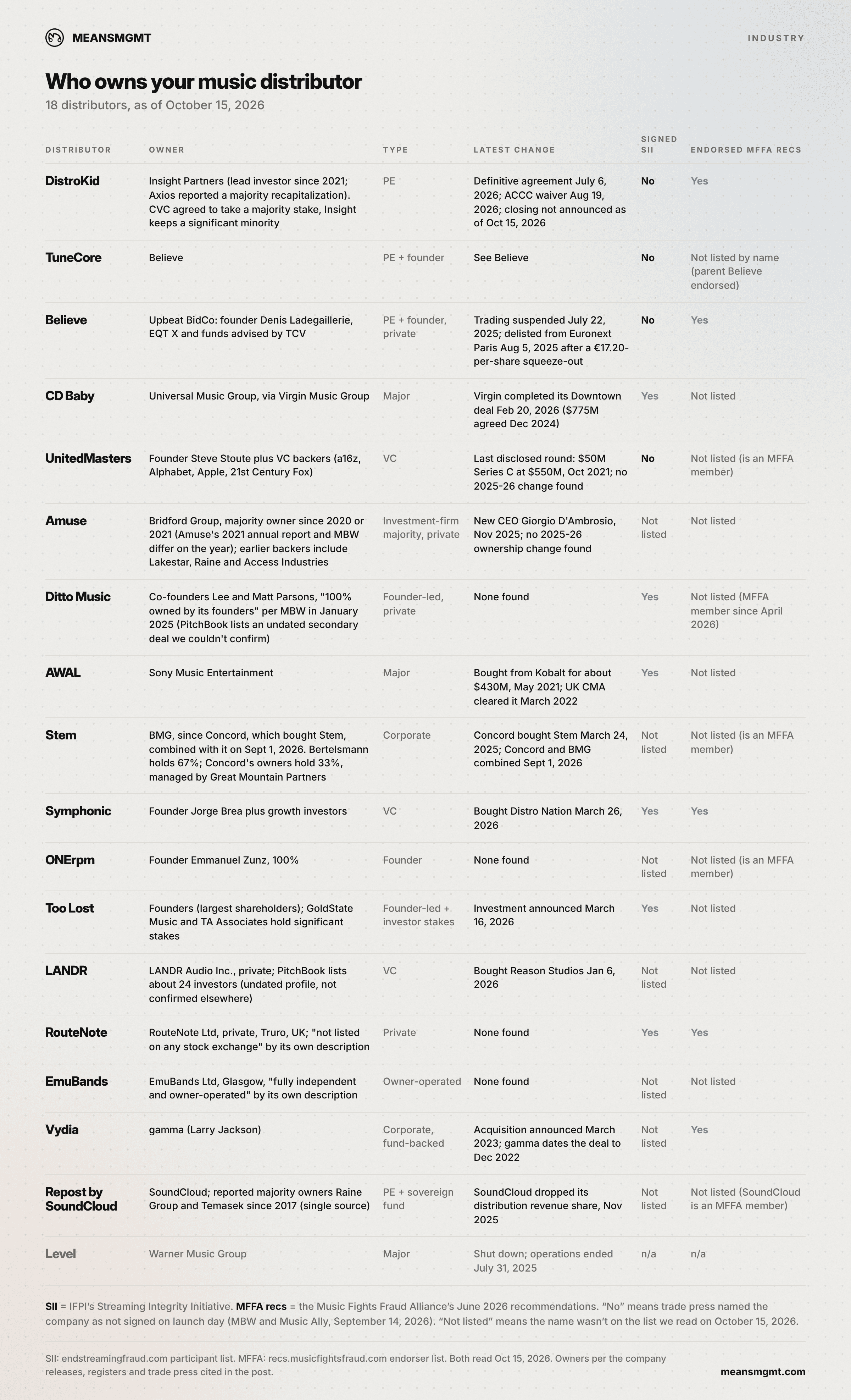
Distributor | Owner | Type | Latest change | Signed SII | Endorsed MFFA recs | Source |
|---|---|---|---|---|---|---|
DistroKid | Insight Partners (lead investor since 2021; Axios reported a majority recapitalization). CVC agreed to take a majority stake, Insight keeps a significant minority | PE | Definitive agreement July 6, 2026; ACCC waiver Aug 19, 2026; closing not announced as of Oct 15, 2026 | No | Yes | CVC, 2026; DistroKid, 2021; Axios, 2021; ACCC register via MergerLoop, 2026 |
TuneCore | Believe | PE + founder | See Believe | No | Not listed by name (parent Believe endorsed) | MBW, 2026; MFFA, 2026 |
Believe | Upbeat BidCo: founder Denis Ladegaillerie, EQT X and funds advised by TCV | PE + founder, private | Trading suspended July 22, 2025; delisted from Euronext Paris Aug 5, 2025 after a €17.20-per-share squeeze-out | No | Yes | MBW, 2025; Believe and Upbeat BidCo, 2025 |
CD Baby | Universal Music Group, via Virgin Music Group | Major | Virgin completed its Downtown deal Feb 20, 2026 ($775M agreed Dec 2024) | Yes | Not listed | UMG, 2024 and 2026 |
UnitedMasters | Founder Steve Stoute plus VC backers (a16z, Alphabet, Apple, 21st Century Fox) | VC | Last disclosed round: $50M Series C at $550M, Oct 2021; no 2025-26 change found | No | Not listed (is an MFFA member) | UnitedMasters, 2021; Billboard, 2021 |
Amuse | Bridford Group, majority owner since 2020 or 2021 (Amuse's 2021 annual report and MBW differ on the year); earlier backers include Lakestar, Raine and Access Industries | Investment-firm majority, private | New CEO Giorgio D'Ambrosio, Nov 2025; no 2025-26 ownership change found | Not listed | Not listed | MBW, 2022 and 2025; Amuse, 2018 and 2023 |
Ditto Music | Co-founders Lee and Matt Parsons, "100% owned by its founders" per MBW in January 2025 (PitchBook lists an undated secondary deal we couldn't confirm) | Founder-led, private | None found | Yes | Not listed (MFFA member since April 2026) | MBW, 2025; PitchBook profile, undated; SoundExchange, 2026 |
AWAL | Sony Music Entertainment | Major | Bought from Kobalt for about $430M, May 2021; UK CMA cleared it March 2022 | Yes | Not listed | CMA, 2022 |
Stem | BMG, since Concord, which bought Stem, combined with it on Sept 1, 2026. Bertelsmann holds 67%; Concord's owners hold 33%, managed by Great Mountain Partners | Corporate | Concord bought Stem March 24, 2025; Concord and BMG combined Sept 1, 2026 | Not listed | Not listed (is an MFFA member) | Concord, 2025; Bertelsmann, 2026 |
Symphonic | Founder Jorge Brea plus growth investors | VC | Bought Distro Nation March 26, 2026 | Yes | Yes | MBW, 2026 |
ONErpm | Founder Emmanuel Zunz, 100% | Founder | None found | Not listed | Not listed (is an MFFA member) | MBW, 2025 |
Too Lost | Founders (largest shareholders); GoldState Music and TA Associates hold significant stakes | Founder-led + investor stakes | Investment announced March 16, 2026 | Yes | Not listed | Business Wire, 2026; MBW, 2026 |
LANDR | LANDR Audio Inc., private; PitchBook lists about 24 investors (undated profile, not confirmed elsewhere) | VC | Bought Reason Studios Jan 6, 2026 | Not listed | Not listed | PitchBook profile, undated; LANDR, 2019; MBW, 2026 |
RouteNote | RouteNote Ltd, private, Truro, UK; "not listed on any stock exchange" by its own description | Private | None found | Yes | Yes | RouteNote support hub, 2026 |
EmuBands | EmuBands Ltd, Glasgow, "fully independent and owner-operated" by its own description | Owner-operated | None found | Not listed | Not listed | EmuBands site, 2026; Companies House |
Vydia | gamma (Larry Jackson) | Corporate, fund-backed | Acquisition announced March 2023; gamma dates the deal to Dec 2022 | Not listed | Yes | MBW, 2023 |
Repost by SoundCloud | SoundCloud; reported majority owners Raine Group and Temasek since 2017 (single source) | PE + sovereign fund | SoundCloud dropped its distribution revenue share, Nov 2025 | Not listed | Not listed (SoundCloud is an MFFA member) | MBW, 2026; revenuememo, 2026 |
Level | Warner Music Group | Major | Shut down; operations ended July 31, 2025 | n/a | n/a | MBW, 2024; Billboard, 2024 |
"No" means trade press named the company as not signed on launch day (MBW and Music Ally, September 14, 2026). "Not listed" means the name wasn't on the list we read on October 15, 2026. We read both lists live on October 14 and again on October 15.
A few rows rest on thin sourcing. RouteNote's own page names its owner only as RouteNote Ltd. Ditto's row lists the co-founders, but a PitchBook entry shows an undated secondary deal we couldn't confirm. LANDR's investor count comes only from PitchBook. On Stem, we haven't seen Stem or BMG say where it sits after the combination.
Majors signed SII, the DIY distributors split
Both major-owned distributors in the table that are still operating signed SII: CD Baby under UMG and AWAL under Sony. FUGA, which UMG also owns through Downtown, signed too. So did Sony Music Group, Universal Music Group and Warner Music Group as companies. Revelator, which Warner Music Group agreed to buy in April 2026, is on the SII list too (WMG, 2026).
Of DistroKid, TuneCore and CD Baby, only CD Baby, the one owned by a major, signed SII.
Among the distributors in the table that no major owns, Too Lost, Symphonic, Ditto and RouteNote signed SII. DistroKid, TuneCore and Believe, UnitedMasters, Amuse, LANDR, Stem, ONErpm, EmuBands, Vydia and Repost aren't on the list.
Ownership doesn't sort that split cleanly. Zebralution signed SII, and it now sits inside Bookwire, an Insight-backed company that bought it from GEMA in March 2026 (MBW, 2026). Insight Partners is DistroKid's lead investor. Too Lost signed with private equity firm TA Associates holding a significant stake (Business Wire, 2026).
The MFFA list cuts across that. DistroKid and Believe are on the endorser list for the MFFA recommendations, published three months before SII launched. The page doesn't date each endorsement. RouteNote, Symphonic, SonoSuite and Revelator are on both lists. CD Baby is on SII and not on the MFFA endorser list. Neither list says why anyone signed or didn't, and we won't guess.
In February 2026 the European Commission cleared UMG's purchase of Downtown on condition that Downtown's royalty platform Curve be sold. The Commission said "UMG could have gained access to commercially sensitive data of rival record labels" (European Commission, 2026). It found the information processed by Downtown's other products wasn't commercially sensitive, so the condition covered Curve only. CD Baby and FUGA stayed in the deal (UMG, 2026).
Warner Music Group closed Level outright. Uploads stopped September 26, 2024, live releases were set for automatic takedown on November 18, 2024, and operations ended July 31, 2025 (Billboard, 2024). Level told users to export their assets and metadata so play counts and playlist placements would stay intact at a new distributor (MBW, 2024).
We couldn't find a sourced price change tied to either ownership deal. Velveteen's review, last updated August 27, 2026, found no artist-facing DistroKid price, payout or transfer change announced with the CVC deal. We found no sourced price increase at CD Baby under UMG either.
Day to day, who owns the distributor doesn't change much in our campaigns. Where it does come in is strategy for rights holders and legacy catalog holders.
DistroKid since July: a deal agreed, a lawsuit filed
DistroKid says it handles roughly 40% of all new music (DistroKid via MBW, 2026), so the deal and the lawsuit reach a lot of release calendars.
CVC Capital Partners signed a definitive agreement on July 6, 2026 to make a majority investment in DistroKid through its Fund IX. Insight Partners, its lead investor since 2021, keeps a significant minority stake. Terms weren't disclosed (CVC, 2026). MBW reported in January 2026 that a sale was being explored at about $2B. Insight's 2021 deal valued DistroKid at $1.3B (DistroKid, 2021).
Australia's ACCC waived notification on August 19, 2026 (ACCC register via MergerLoop, 2026). CVC said it expected to close in the third quarter. As of October 15, neither company had announced the deal closed. CVC's news page still titles the July item "to make majority investment" (cvc.com, read October 15, 2026).
On September 15, 2026, UMG sued DistroKid in the US District Court for the District of Delaware (case 1:26-cv-01156), alleging copyright infringement and deceptive trade practices under Delaware law. The complaint lists 1,000 recordings UMG says it owns or exclusively licenses and says DistroKid infringed. It seeks up to $150,000 per work. UMG alleges one uploader released 4,562 tracks in 12 months. It also alleges DistroKid delivered "nearly twelve million tracks" to one streaming service in six months, which UMG says was "over half of all tracks delivered."
Those are UMG's allegations, and no court has ruled on them. DistroKid has said it strongly disputes them. After an extension, its response to the complaint is due December 4, 2026 (Digital Music News, 2026). The public docket showed no ruling as of October 15, 2026 (CourtListener).
DistroKid told The Verge on October 10, 2026 that "a very small number of recordings" had been removed in response to UMG's claims. Amanda Ferri, its VP of artist services, said the company "strongly dispute[s] the allegations underlying UMG's lawsuit" and regrets "the disruption to affected artists." Rolling Stone reported on October 12, 2026 that much of one independent artist's 2022 album was taken down. Per Rolling Stone, a copyright strike froze his royalty payments, and DistroKid support didn't name the rightsholder.
UMG, ABKCO and Concord sued Believe and TuneCore in New York federal court on November 4, 2024, alleging infringement and seeking at least $500M. The case settled with no ruling on the claims and was dismissed with prejudice on April 8, 2026, terms undisclosed (MBW, 2026; SDNY docket 1:24-cv-08406).
What a flagged track costs the artist
Spotify began charging labels and distributors per track "when flagrant artificial streaming is detected" on April 1, 2024 (Spotify for Artists, read October 15, 2026). Spotify's page doesn't give the amount. TuneCore's help center (undated page) does: €10 per track per month, charged to the account balance and/or the payment method on file. At that rate, five flagged tracks in one month would cost €50.
CD Baby's help center, updated February 26, 2026, shows Spotify's fee as a negative transaction of about $10-11 per track per month. For Apple flags, it describes a percentage-based earnings adjustment instead.
DistroKid's help center says that if most of your streams are artificial, your music will likely be removed and royalties from those streams won't be paid. It adds that you may get a warning or have your account closed. We couldn't confirm whether DistroKid passes the €10 Spotify fee on to artists. Its pages don't say, and the only claim that it does comes from a single third-party site.
The flag sits on the track, whoever sent the plays. If a promo service sends bot plays to your release, the flag lands on your release. At TuneCore and CD Baby, their help pages say the fee then reaches your account. We covered how Spotify catches this in Does Spotify Detect Fake Streams?, and what bought plays look like next to real ones in bought streams vs real streams.
When a clone of your song gets distributed
In early May, the reggae band Stick Figure found copies of its 2019 single "Angels Above Me," which the band says were made with AI, charting under other names. The band said an unauthorized remix reached No. 1 on iTunes charts in six European countries and No. 2 in the UK (Stick Figure on Facebook, May 2026). One version, renamed "Run Run River," was posted to TikTok on April 24, 2026, then spread to YouTube and Spotify (Digital Music News, 2026). That April upload is not the official "Run Run River (Angels Above Me)" by David Guetta, Alok and Stick Figure, released June 1, 2026. The Los Angeles Times (June 9, 2026) described the April version as sped up, with a tweaked lead vocal and a dance-music kick drum.
Forbes reported on May 8, 2026 that the band's songwriters were uncredited and unpaid at the time. Billboard Canada reported on May 20, 2026 that the band was later credited on "Run Run River," which streaming services attribute to DJ Kyros. That report doesn't say whether the writers were paid, or what happened to the other uploads.
The band's team sent takedown notices and contacted the major streaming services. Spotify took down every track they asked it to, but other copies stayed up (WIRED, May 7, 2026). Deezer's research director told WIRED that unless Deezer detects stream manipulation, "streams are paid for to whoever uploaded them, via their distributor."
None of the coverage we read named which distributors delivered the copies to streaming services, and we don't know. SII's first commitment, verifying rights ownership and customer identities through KYC, is aimed at that delivery step (IFPI, 2026).
Before you pick a distributor, or stay with one
Find out who owns it today and whether a sale is pending. The company's own news page and its owner's press releases beat any third-party list, this one included.
Check both lists yourself, SII at endstreamingfraud.com and the MFFA endorsers at recs.musicfightsfraud.com. Per MBW, SII sets out no audit or penalty for signatories, and the MFFA calls its recommendations voluntary, so treat a signature as a stated intent.
Read the artificial-streaming fee page. Look for whether the €10 per track gets passed to you, and whether it comes out of your balance or your card.
Read the takedown and dispute process. The DistroKid removals this fall happened while the UMG case was at the complaint stage.
Ask how royalty holds work, what triggers a freeze, and how you get paid if the hold lifts.
We don't check a client's distributor before taking on a campaign. The exception is a deal where we take a percentage of royalties, and that's rare.
The DistroKid row is the one most likely to move. Until CVC or DistroKid announces a closing, it reads "agreed July 6, closing not announced," with the ACCC waiver sitting on file since August 19.
If you're about to put ad money behind a release and want a second opinion on the plan, you can reach me through meansmgmt.com.
FAQ
Questions we get
If you have a release coming, start your campaign now or book a call first, and we’ll scope it with you. Want the numbers first? The benchmarks report is free.

