
·
Spotify
·
Spotify's AI Badge Is About Your Face, Not Your Music
Spotify's AI Persona badge flags a fake human face, not AI-made music. It cuts recommendations, Discovery Mode, Marquee and Verified. Cover art counts.

MeansMGMT
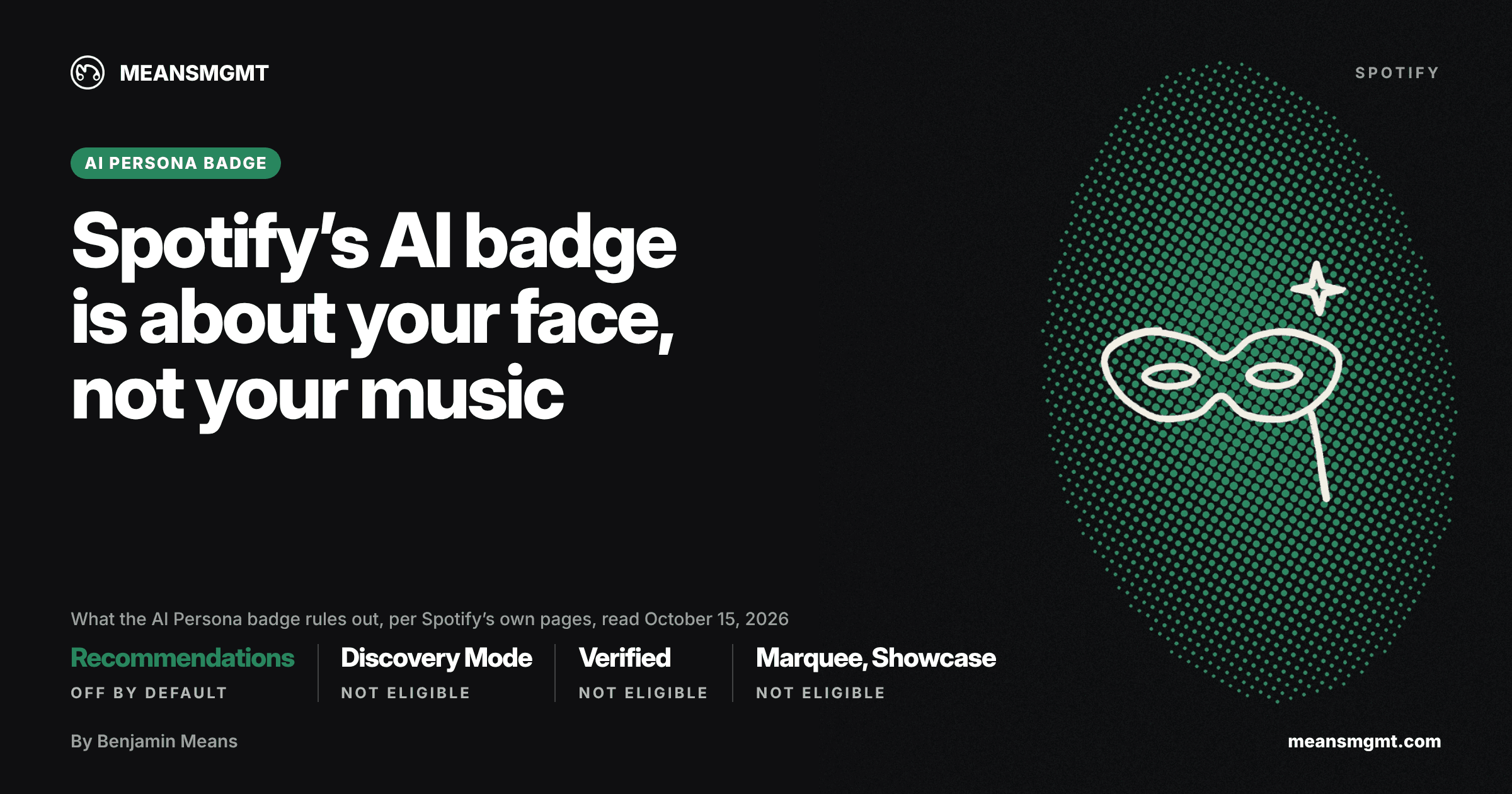
Spotify announced its AI Persona badge on August 11, 2026, and said it would start showing up on some artist profiles from mid-September. A lot of what I've read about the Spotify AI badge treats it as a label for AI-made songs. Spotify's own announcement says the opposite: "This badge is about the artist's public identity, not about how the music was made."
Three different things get called the Spotify AI badge
Artists and press run three separate systems together. Only the Persona badge is a public label that keeps an artist out of recommendations.

System | Since | What triggers it | Where listeners see it | Effect on recommendations |
|---|---|---|---|---|
AI Persona badge | Announced Aug 11, 2026 | A photorealistic AI-generated human representing the artist | Artist profile, Artist Details, Search and Now Playing. Playlist track rows: listed on Spotify's artist page, "coming soon" on its listener page | Left out of editorial and algorithmic recommendations by default |
AI credits | Beta since Apr 16, 2026 | Optional disclosure on individual roles, added through distributors that support them | Mobile only, in Song credits and the Now Playing view | Spotify says disclosure isn't about down-ranking |
Music spam filter | Announced Sept 25, 2025 | Behavior: mass uploads, duplicates, SEO hacks, artificially short tracks | No public label | Tagged uploaders and tracks stop being recommended |
What triggers the AI Persona badge
Spotify's artist help page defines an AI Persona as "an artist whose public identity represents an AI-generated photorealistic human." That covers AI-generated profile images, header images, album artwork, or other visual elements that represent the artist. Spotify says its review looks at the artist's name as well as the imagery.
It doesn't apply if you use AI tools to make your music but your profile represents a real person. It doesn't apply to a stage name or fictional character that isn't a photorealistic AI person either. By that definition, a faceless project made entirely with AI tools shouldn't get the badge, as long as nobody invented a fake human to front it. It can still be shut out of Verified by Spotify, which uses a wider test.
"AI Persona" is the self-disclosed version, set in Spotify for Artists under Artist Settings > Profile & Identity. "Likely AI Persona" comes from Spotify's own review, which it says started "with artists who have met defined audience thresholds." Spotify hasn't published how it detects a fake face. Music Business Worldwide reported (August 2026) that human reviewers work alongside "AI investigative tools."
Spotify says self-disclosure can't be undone from your side: "You can't turn off the AI Persona setting yourself after you self-disclose." If you turned it on by mistake, Spotify's page says to contact Spotify. A Likely AI Persona badge "remains on your profile" if you don't take action. Spotify adds, "We make all final decisions."
Spotify's help page now says "Steps on how to appeal are available in Spotify for Artists." It hasn't said what evidence an appeal needs or how long one takes. Changing your artist name, profile image or bio later can send the profile back for review.
What the Persona badge costs a release
"By default, Spotify will not include AI Personas in any editorial or algorithmic recommendations," the August 2026 announcement says. The exception it gives is listeners who follow an AI Persona. The listener help page phrases it as "intentional engagement signals, like following an AI Persona artist."
Discovery Mode is out. Spotify's Discovery Mode eligibility list (read October 15, 2026) includes "No artist associated with the release has an AI Persona badge." Discovery Mode already needs 25,000 monthly listeners at team level and takes a 30% commission on recording royalties from streams in Discovery Mode contexts. My reading of "No artist associated" is that a human artist featuring a badged act could lose eligibility on that one release. We haven't seen a case yet.
Verified by Spotify is out too, and its bar is wider than the badge. The verification page says profiles that "appear to primarily represent AI-generated or AI-persona artists are not eligible for review or approval." That wording could also cover a faceless project made entirely with AI, badge or no badge. Spotify said in August 2026 that verified profiles represent "more than 99% of the artists Spotify listeners actively search." Artists who use AI tools responsibly are still eligible for verification "as long as they present themselves authentically."
Badged acts can't run Marquee or Showcase either. Spotify now files both under display campaigns, and its display campaign page (read October 15, 2026) says "AI Personas are not eligible to create display campaigns." Its release checklist repeats the Discovery Mode line, "No artist associated with the release has an AI Persona badge." The page also asks for 1,000 streams in 28 days in a target market, and 5,000 monthly active listeners in market for Marquee. Spotify hasn't said the badge changes how a stream is paid.
AI credits and the spam filter work differently
AI credits are the Spotify feature an AI box at upload feeds, if your distributor supports them. Spotify says they're "only available with certain distributors." The same box may also feed other stores or your distributor's own AI policy. AI credits "apply to individual roles, not the whole track," they're in beta, and listeners only see them on mobile in Song credits and the Now Playing view. Spotify says they "don't appear on artist profiles or as track-level labels." Billboard reported in April 2026 that the beta started with DistroKid.
Spotify's September 2025 post said of disclosure, "It's not about punishing artists who use AI responsibly or down-ranking tracks for disclosing information about how they were made." The 2026 update to that post says tens of thousands of AI credits are submitted daily, and that "the absence of a credit doesn't mean AI wasn't used."
The spam filter cuts reach based on behavior. It tags uploaders and tracks using mass uploads, duplicates, SEO hacks and artificially short tracks, then stops recommending them. Spotify said it removed over 75 million spammy tracks in the 12 months before September 2025. We went through what Spotify does and doesn't catch in our post on fake stream detection. What an artificial-streaming flag costs at the distributor is in our post on who owns your music distributor.
What artists get wrong about the Spotify AI label
What gets said | What Spotify's own pages say |
|---|---|
Tick the AI box at your distributor and Spotify suppresses you | AI credits sit on individual roles, and Spotify says disclosure isn't about down-ranking (2025) |
Use an AI tool and you get the badge | The badge needs a photorealistic fake human identity. A real person or a non-photoreal character doesn't trigger it |
Disclosing as an AI Persona protects your reach | Self-disclosure triggers the same recommendation exclusion, and you can't switch it off yourself |
No AI credit means no AI was used | "the absence of a credit doesn't mean AI wasn't used" |
Spotify keeps AI music out of recommendations | That's closer to Deezer's policy. Spotify excludes badged Personas and spam, and says it strives to keep "slop" out of recommendations |
As of October 15, 2026, we couldn't find a Spotify setting that lets listeners hide all AI-generated music. A Spotify spokesperson told the BBC in April 2026 that its priority is spam and impersonation, "rather than trying to filter music based on how it was made." Spotify promised listener reporting of Personas "in the coming months" in August 2026, and as of October 15, 2026 we couldn't find it live.
What the badge means for paid ads
My read, and Spotify hasn't said this, is that ad-driven follows matter more for a badged act than for anyone else. Following is one intentional-engagement signal Spotify names as an exception to the default. It hasn't published the full list, or promised that a follower gets the next release recommended. A follow earned from a Meta campaign is still the only signal Spotify has named. Spotify hasn't said how much a follow counts, or whether saves and playlist adds do the same job.
We already judge ad traffic by what listeners do after the click rather than raw streams, which is the argument in our save rate post. For a badged act it matters more, because recommendations are off by default.
Whether I'd run ads for a badged act depends heavily on what the campaign is for. If the plan leans on Discovery Mode or Marquee, the badge rules those out, and recommendations are off by default for listeners who haven't engaged with the act. If the goal is follows, ads on Meta or TikTok can still go after them.
The badge looks at the artist's name and at profile images, headers, album artwork and other visuals that represent the artist. Spotify doesn't review Meta or TikTok ads, but an ad that reuses a cover with an AI-generated person on it shows listeners the same face. AI-generated people rarely show up in our clients' covers or ad creative. When one does, decide before release day whether that face is the act's public identity. If it is, expect the badge and plan the campaign without Discovery Mode or Marquee. Changing the profile after the fact can send it back for review.
How Spotify's approach compares with Deezer's
Deezer's July 21, 2026 report, using June data, put fully AI-generated tracks at nearly 90,000 a day and more than 50% of daily deliveries on peak days. Those tracks drew between 1 and 3% of streams, and Deezer says up to 85% of their streams were fraudulent in 2025. We broke those numbers down in our AI uploads post.
Deezer excludes detected AI tracks from recommendations, more than 42 million of them between January 2025 and August 2026. On October 13, 2026 it announced a search toggle to hide fully AI tracks, due before the end of 2026. Spotify labels the fake face and filters spam behavior. Its 2026 update says royalties follow listener engagement and "all music is treated equally, regardless of the tools used to make it." Its August 2026 announcement also says it tunes its algorithms "to highlight authentic human artists." The same post says it strives to keep "spam, slop, or low-effort content" out of recommendations, so its line is less clear-cut than Deezer's.
Spotify still hasn't published how appeals are judged, so a badged act's release plan has to assume the badge is still there on release day.
If you're not sure about the artwork on a release you have coming, reach out at meansmgmt.com. We'll look at the cover and profile images before release.
FAQ
Questions we get
If you have a release coming, start your campaign now or book a call first, and we’ll scope it with you. Want the numbers first? The benchmarks report is free.

