You don't submit to the algorithm. You produce the listening it reads, at enough volume, inside a short enough window.
There is no single Spotify algorithm. There are several recommendation systems, each pointed at a different surface, and they all read from the same pool of listener behavior. Discover Weekly, Release Radar, Autoplay, and Radio pick songs different ways for different people, which is why a track can land in one and never touch the others. Once you separate the surfaces, the artist-side question gets much simpler: what behavior do these systems read, and how do you produce enough of it to be noticed? Search results on this topic are either Spotify explaining recommendations to listeners or listeners complaining the recommendations got worse. Here's the version for the person trying to get a song moving.
TL;DR
The Spotify algorithm is several recommendation systems reading one shared pool of listener behavior, not one ranked list.
The behavior that matters is saves, finished plays, repeat listens, and follows. Skips work against you.
Release Radar reaches your followers and recent listeners. Discover Weekly reaches strangers with similar taste. Different doors, different keys.
The 30-second mark is when a stream counts for royalties, not a threshold the algorithm rewards.
Our campaign design target is 10,000 streams in 28 days at a 10 percent save rate. It's a planning target, never a guarantee.
Spotify runs several recommendation systems, not one
When artists say "the algorithm," they usually mean one gatekeeper deciding who gets heard. What actually exists is a set of separate surfaces. Release Radar is a personalized weekly playlist of new music from artists a listener follows or has been listening to. Discover Weekly is a personalized weekly playlist of music the listener hasn't heard, built from what similar listeners play. Autoplay and Radio are the systems that keep playing after your track ends. Editorial playlists sit outside all of this, curated by Spotify's staff, with no algorithmic entry point.
Spotify's own explanation of recommendations describes the inputs in broad terms: your listening history, what listeners with similar habits play, and information about the tracks and artists themselves. The company doesn't publish weightings, and anyone who tells you the exact formula is guessing. It has been moving toward giving listeners more direct control, though. In December 2025 Spotify's Gustav Söderström introduced Prompted Playlists, where a listener describes what they want and sets the rules for their own personalized playlist, drawing on their full listening history. The surfaces are personal, and they move.
That distinction matters commercially. Getting into Release Radar is mostly an audience-you-already-have problem. Getting into Discover Weekly is a similar-listener problem. Getting on an editorial playlist is neither, and no amount of ad spend buys it.
The signals it actually reads
So how does the Spotify algorithm work from the artist's side? It watches what people do with your song and treats the strong actions as evidence. A save is the strongest, because saving a track costs the listener something (space in their own library) and predicts they'll come back. Finishing a song matters. Playing it again days later matters more. Following the artist after hearing one track is a loud signal. Skipping in the first few seconds is the signal working against you, and it's the one most cheap traffic produces.
None of that is exotic. It's the same logic any recommender uses: find behavior that's expensive to fake and expensive to do accidentally, then weight it. Which is why we grade campaigns on save rate rather than stream count. Save rate is the share of listeners who add the track to their library, and it's the cleanest read on whether the attention you bought found people who like the music. Below 8 percent, something's wrong: wrong audience, wrong song, or the creative isn't landing. Between 8 and 15 percent is solid. Above 15 percent is strong, and above 20 percent is where organic placements tend to follow on their own. We make the longer case for why save rate beats raw stream count separately, but the short version is that 50,000 streams at a 3 percent save rate is a worse outcome than 20,000 at 15 percent.
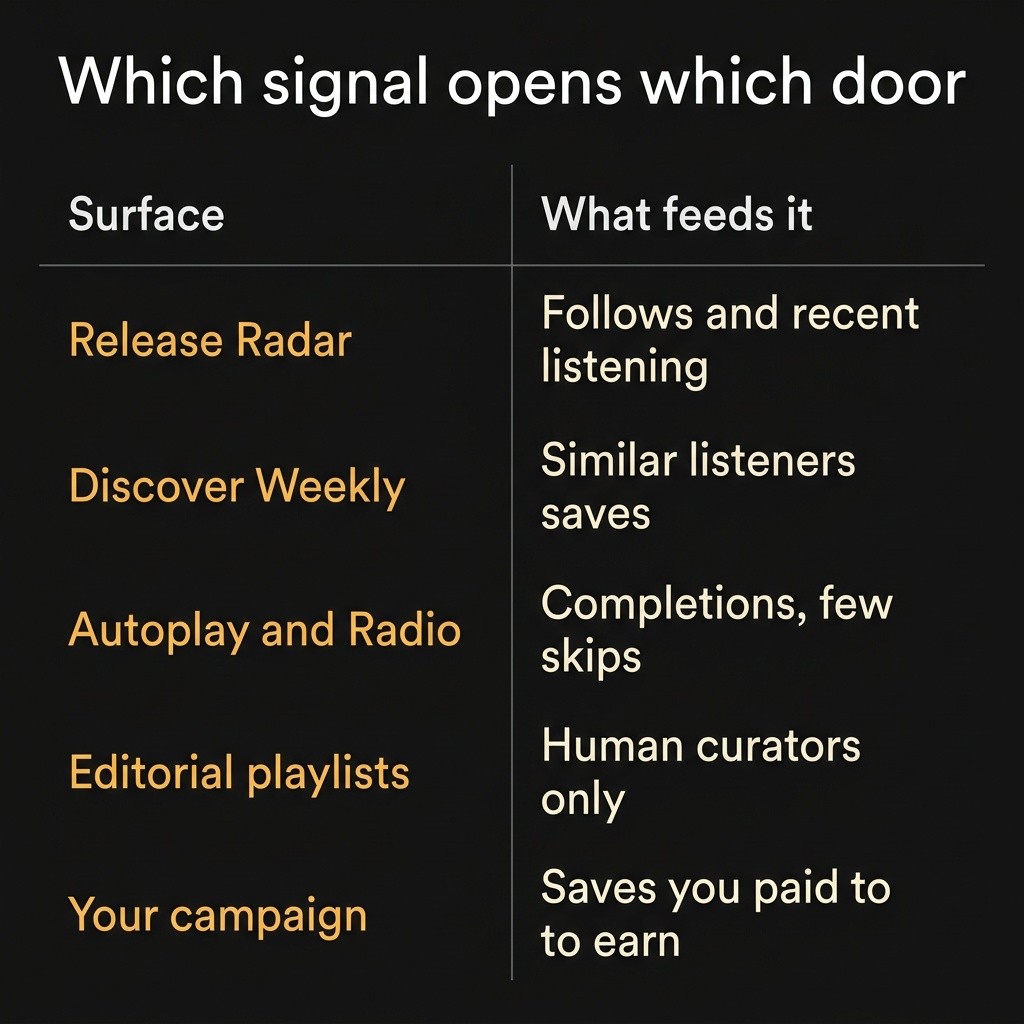
Release Radar and Discover Weekly are different doors
Treating these two as one target is the most common planning mistake we see. Release Radar leans on connection. Spotify says it serves listeners new music from artists they follow, artists they listen to, and other artists it thinks they'll like, so your followers are the reliable core of it and your recent listeners extend the edge. Grow both and Release Radar grows with them, automatically, every Friday. It's the closest thing to an owned algorithmic surface you have.
Discover Weekly is the opposite. It reaches people who have never heard you, chosen because listeners with overlapping taste engaged with your track. You can't follow your way in. The only route is a body of real listening from people whose profiles resemble the audience you want next, which is exactly what a well-targeted campaign produces and exactly what bought streams do not. Bot traffic has scrambled geography and near-zero saves, so it teaches the similarity model nothing useful and can make your recommendations worse.
Radio and Autoplay are quieter and worth naming because they reward a different thing: staying power. If listeners let your track finish and don't skip out of the session, you keep getting served. Catalog tracks often earn more from this surface than from either weekly playlist, which is part of why a five-year-old release can still be worth advertising.
The 30-second rule and other things artists get wrong
The 30-second rule is real and it's misunderstood. A play counts as a stream, and pays, once the listener passes 30 seconds. That's an accounting threshold. Spotify has never said crossing 30 seconds makes the algorithm favor your song, and structuring a track to bait that mark is optimizing for the wrong thing. It's a floor for the stream existing, not a lever.
A few more worth dropping. "You can't influence algorithmic playlists at all" is wrong in one specific, useful way: Spotify says that if you pitch an unreleased song through Spotify for Artists at least seven days before release, it becomes eligible for Release Radar even if no editor picks it up. That is the one form worth filling in, and most artists miss the deadline. Playlist follower counts, meanwhile, don't tell you much on their own, since a 500,000-follower user playlist can deliver low-engagement streams that dilute your signal rather than build it. And the flood of low-effort uploads is a real background condition, not a conspiracy against you: Spotify removed more than 75 million spammy tracks in the twelve months to September 2025 and added a spam filter aimed at mass uploads, duplicates, and artificially short tracks. Roughly 106,000 new tracks arrive daily (Luminate, 2025). We wrote a full piece on what the AI upload flood does and doesn't do to your streams if you want the numbers behind that.
The through-line: the systems are getting more defensive about signal quality, which raises the value of listening that's obviously human.
How to feed it: produce the signals on purpose
You can't submit to these systems and you can't trick them, so the only move left is to manufacture the behavior they read, at enough volume, inside a short enough window that it reads as a pattern rather than noise.
Our design target across campaigns is roughly 10,000 streams in 28 days with a 10 percent save rate. That's the range where algorithmic consideration tends to start. It's a planning target we build toward, not a promise Spotify makes, and hitting it never guarantees placement. The song, the listener behavior, and Spotify's own priorities all get a vote.
What that costs depends on genre and creative quality. Across our streaming campaigns a save typically averages about $0.20 in Tier 1 premium markets for Rap and HipHop and about $0.15 in Tier 2 growth markets, while Pop runs nearer $0.45 in Tier 1 and $0.30 in Tier 2. Those are typical averaged figures, not a rate card, and it's ad spend billed to your own ad account on your own card rather than a fee we mark up. Run the same math on Meta and you get the cost-per-save picture across genres.
At MeansMGMT we build campaigns backwards from that window: pick the track with the best shot, concentrate spend so the listening lands close together, and watch save rate daily as the read on whether the audience is right. You can see it work in an EDM and trance playlist growth campaign we ran on Meta to grow a Spotify playlist: $1,000 over a month produced more than 14,900 playlist streams and 992 saves, at about $0.06 a stream. The mechanism isn't a secret and the thresholds aren't magic. The work is producing real listening fast enough to look like momentum, and there's a longer strategy piece on breaking an artist that way if you want the campaign-level view.
FAQ
What is the 30 second rule on Spotify?
How do you get the Spotify algorithm to pick up your song?
What is the top 0.005% on Spotify?
How many streams on Spotify do you need to make $10,000?

This is the work we do all day.
If you have a release coming, the 3-minute intake tells us everything we need to scope your campaign. Want the numbers first? The benchmarks report is free.