

The flood is in the upload pipe, not in anyone's ears. What it costs you is signal, not plays.
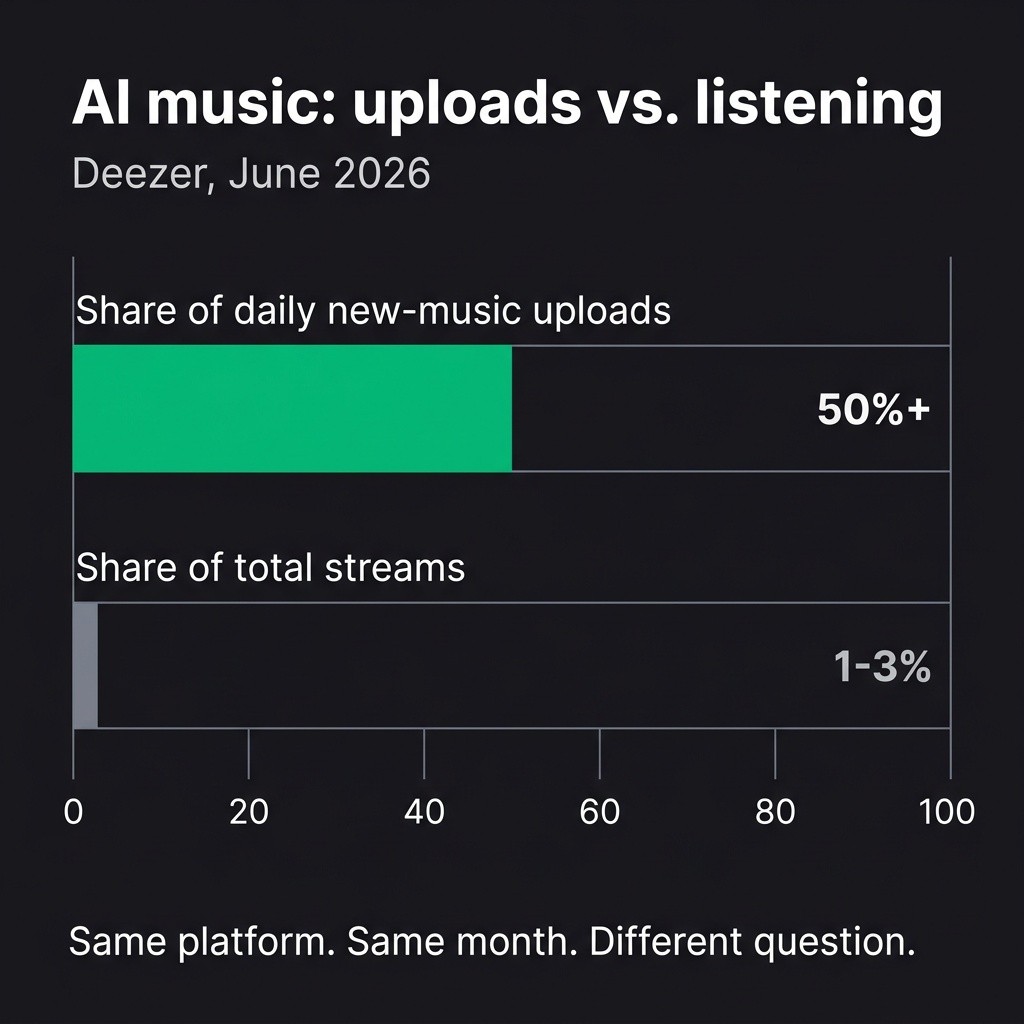
Two numbers came out of Deezer in June 2026 and they belong in the same sentence far less often than they appear in one. The first: fully AI-generated tracks passed 50 percent of daily new-music uploads in June 2026, peaking around 90,000 tracks a day. The second, from the same report: those tracks account for between 1 and 3 percent of total streams. One measures what gets pushed into the pipe. The other measures what anybody actually listens to. Almost every headline quotes the first and stops, which leaves working artists with the impression that half their competition is now a machine. It isn't, and the real problem is more interesting than the one they're worried about.
The two numbers everyone runs together
Deezer has been publishing this since it launched AI detection in January 2025, when the figure was about 10,000 tracks a day. By April 2026 it was 44 percent of uploads, around 75,000 a day. Two months later it crossed half. The trajectory is genuinely steep and worth paying attention to.
But upload share measures supply, and supply stopped being the constraint long before AI arrived. Luminate counted roughly 106,000 new tracks delivered to streaming services a day across the industry in 2025, and most of the catalog already sat at near-zero streams. Deezer's own intake runs well above that, which is rather the point: pouring more tracks into a system where the majority of human-made music already goes unheard doesn't change the competitive picture much. The constraint was never how many songs exist. It was always attention.
The listening number tells you that directly. One to three percent. If AI music were quietly eating the audience, that figure would be climbing toward the upload figure. It isn't.
Why the flood barely reaches listeners
The gap is enforcement, not accident. Deezer says it excludes AI-detected tracks from algorithmic recommendations and editorial playlists, which cuts off the main road any track travels to reach a stranger. A song nobody is recommended and nobody searches for gets played by nobody, however many of them you upload.
Spotify came at it from a different angle and landed somewhere similar. In September 2025 it announced it had removed over 75 million spammy tracks in the previous twelve months, along with a music spam filter aimed at "mass uploads, duplicates, SEO hacks, artificially short track abuse, and other forms of slop," plus impersonation enforcement and AI disclosure credits. Worth being precise about what that is: Spotify did not ban AI music. Its stated position is that AI is fine as a tool and the target is content farms and bad actors. The policy is aimed at behavior, not at the technology.
There's a fraud dimension too. Deezer reports that up to 85 percent of the streams that fully AI-generated tracks did produce in 2025 were fraudulent. So a good chunk of that 1 to 3 percent is bots draining the royalty pool rather than anybody listening. Which makes the actual human appetite for this material smaller than even the small number suggests.
Velvet Sundown is the clearest case. The AI-generated "band" crossed a million Spotify monthly listeners in early July 2025 and peaked near 1.4 million on the back of enormous press coverage. By mid-August it was down to roughly 594,000 (Music Ally). Novelty and news cycles can produce a spike. Neither produces a fanbase.
Where the slop actually costs you
None of this means the flood is harmless. It just means the damage lands somewhere other than where artists expect.
Discovery surfaces get noisier. Every recommendation system, on every platform, is trying to infer taste from behavior, and it now does that inside a catalog where an increasing share of the items are generated to game the system rather than to be enjoyed. Platforms respond by getting more conservative and leaning harder on signals that are expensive to fake. That's rational, and it quietly raises the bar for a real artist with a small footprint.
Ad targeting degrades the same way, for the same reason. The behavioral pools that Meta and TikTok build audiences from get muddier when a slice of the underlying activity is synthetic.
The third cost is the one nobody itemizes. It's attention from the people who decide things. Editors, playlist curators, and A&R staff are all now filtering harder because the volume forces them to. Being obviously human is becoming a credential.
Clean signal is the scarce thing now
Here's the conclusion we'd draw from running campaigns rather than reading headlines. When machine-made supply is unlimited and cheap, the scarce commodity is proof that real people chose your song on purpose. That's measurable.
Save rate is the test. It's the share of listeners who add a track to their own library, and it's expensive to fake and impossible to do by accident. Below 8 percent, something's off. Between 8 and 15 percent is solid, above 15 percent is strong, and above 20 percent is where organic momentum tends to follow. Bought and bot-driven streams sit near zero, which is exactly why they're detectable, and we've written separately about why save rate beats stream count as the number to run a campaign on.
Real ad-driven listening produces the opposite profile. Across our campaigns a click converts to roughly 0.38 saves in Rap and HipHop, 0.51 in Pop, and 0.88 in Rock and Alternative, varying with genre and creative quality. Those are people who heard a song, liked it enough to keep it, and left a trail that reads unmistakably human. That trail is what feeds the recommendation systems we broke down separately, and it's what compounds into algorithmic lift over a catalog's life.
So the strategic read on 50 percent is almost the opposite of the panic. The flood is real, it's in the upload pipe, and it's making legible human listening more valuable, not less. The artists who struggle in this environment will be the ones chasing volume, because volume is the one thing a machine can produce infinitely and for nothing. The ones who do fine will be the ones who can point at a number and say people actually chose this. We build campaigns to produce exactly that number, judged on the metrics that separate listening from traffic, and you can see what it looks like at scale in a six million stream Spotify playlist campaign we ran on Meta.
FAQ
How much of the music uploaded to streaming services is AI-generated?
How much of what people actually stream is AI-generated?
Is Spotify removing AI music?
Does AI-generated music hurt independent artists?

This is the work we do all day.
If you have a release coming, the 3-minute intake tells us everything we need to scope your campaign. Want the numbers first? The benchmarks report is free.

