
·
Strategy
·
Should You Keep Running Ads After a Release?
How long to run ads for a song depends on the payoff. A release campaign ends when that window closes, and a catalog campaign can run evergreen.

MeansMGMT
If you're asking how long to run ads for a song, start with what the ad is supposed to pay back. Most release campaigns run on a timeline toward a payoff that isn't a stream. That payoff is a pre-order, a ticket, a merch sale or a sign-up to something you own. When that window closes, the release campaign should close with it.
Streaming and playlist campaigns can work differently. Behind a proven song or a catalog title, they can run evergreen.
Part 1 on Spotify ad attribution covered what Spotify's ad reports count and where the 14-day count stops.
Most hits peak in their first week
Chartmetric data analyzed by Stat Significant (2025) found that nearly 40% of tracks in Spotify's Top 50 peak on release day, and 65% in all plateau within a week. That is Top 50 tracks only. It says nothing directly about a smaller release.
Spotify likely builds part of that early curve itself. Release Radar updates every Friday, and Spotify will "include a song for up to 4 weeks if a listener hasn't heard it" (Spotify for Artists, accessed October 2026). After week four, any ad you run is working without that playlist behind it.
So a new song gets help in its first month that ads can't buy later, Release Radar included. That doesn't tell you when its ads should stop, and neither does the curve flattening out. Where release money goes depends on the payoff date.
A release campaign ends on its payoff date
Pre-saves pay in release week. As we laid out in the pre-save post, they're the launch layer of a paid campaign in the weeks before release. You judge them on release-week streams and save rate. Once release week is over, a pre-save campaign has nothing left to sell.
Tickets run from on-sale to show night. Our tour marketing post puts the start of a ticket campaign 3 to 4 months before the date, with one month as the floor. The end is fixed too. Somewhere between a third and more than half of tickets sell in the final week, depending on whose data you trust. Eventbrite's 2024 Music Edit, reported by Pollstar, put it at 57% of US music tickets on its platform bought a week or less out, January to April 2024. RSVPify's 2026 platform data put shows and performances at 32.7%.
That makes the last week before a show the heaviest sales week of a ticket campaign. Those are sales numbers, not a spending plan. Keep ticket ads running through that week, and set the spending curve from the show's own sales pace and results. Then the show happens and the campaign is done.
Merch at the show follows the tour. atVenu's 2025 Year in Review found 21% of fans buy merch at concerts. Average merch spend was $10.24 per attendee, buyers and non-buyers together. atVenu also expects more merch pop-ups and drops tied to album releases, outside the venue. Online merch, pre-orders and direct-to-fan drops run to whatever date you set.
None of this means the return stops when the spend stops. Our income streams post works from an internal heuristic, adapted from legacy audio ROI studies and not third-party research. It puts 24% of ad value back in week one, 18% across weeks two to thirteen, and 58% from week fourteen out to two years. Treat that as a planning assumption, not a measurement. It's a reason not to judge a release campaign only on what came in while it ran, and it doesn't set a stop date.
In my experience, merch and direct to fan pay back the ad spend most often, ahead of tickets.
When evergreen makes sense
Catalog is most of the market. Luminate's 2025 Year-End Report counted 334.0 billion US on-demand audio streams of current music (18 months old or newer) out of roughly 1.4 trillion total (via Variety, January 2026). That leaves catalog at about three in four. MBW (February 2026) put catalog over 75% for the first time.
An evergreen campaign fits a song that has already proven itself. In practice that means a cost per stream that holds steady week to week. It also means a save rate judged against the artist's own months with no ads, not a benchmark. By save rate we mean saves divided by streams. A flight save rate mostly reads the paid audience, so for the three artists we checked, it ran above those months anyway. Clearing them is the floor, not proof.
Andrew Southworth makes a similar case in a 2026 video. His bar for a winner is a cost per conversion "like 25 cents or under," plus strong engagement, save rate and algorithmic pickup. For a song like that, his view is "why turn it off?" He also argues against cramming a launch budget into its first three to seven days, since Meta costs usually fall for weeks after launch. I agree on keeping a proven winner running. The step I'd add is checking whether it's still a release campaign whose payoff date has passed.
There's also a maintenance reason to keep older songs funded. Spotify's 1,000-stream minimum is counted over a rolling 12 months, which we covered in the 1,000-stream post. That post makes the case that keeping older releases above the line is its own reason to fund back catalog. It puts clearing the line at roughly $20 to $35 in ad spend at our rates, so it's a small top-up, not an evergreen budget.
In August 2026 we pulled Meta Ad Library ad entries for 51 legacy artists, covering July 2025 to August 2026, EU and UK delivery only. Among artists with at least 20 ad entries, median activity covered six months for estates and eight for living legacy acts in that window. Median launch-day counts were 21 and 28. Across all 51 artists, 44 of 1,044 ad-start days still landed on an exact release date, against 12 expected by chance. Within a week of a release date, it was 293 against 127.
Even always-on catalog ads still launch around dated products. I'd plan an evergreen budget with dated pushes hung off it, like a reissue, a sync, a tour or an anniversary edition. Our catalog marketing post covers the cost side of that.
Pushes came out ahead for 3 of 4 artists
We ran a study across 9 artists, 132 source-of-streams windows of 28 days each, and 139 Meta campaigns, with data through September 2026, re-audited on 2026-09-22. The full write-up is in our Spotify for Artists data post.
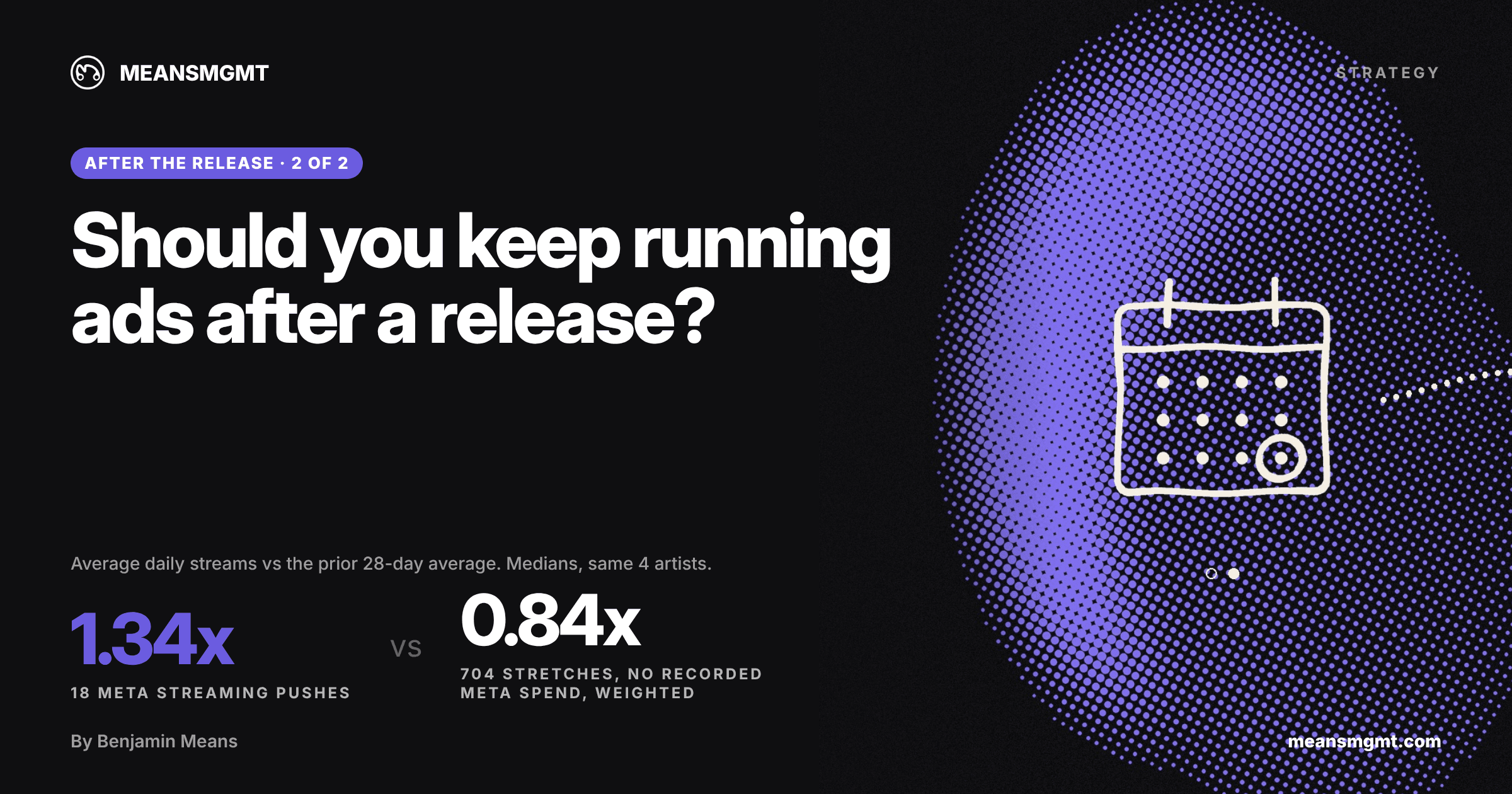
The cleanest comparison puts each artist against their own stretches with no recorded Meta spend. Four of the 9 artists had both. During their 18 Meta streaming pushes, average daily streams ran a median 1.34x their average for the 28 days before. Their 704 overlapping 30-day stretches with no recorded Meta spend, measured the same way and weighted to match where the pushes happened, ran 0.84x.
Pushes came out ahead for 3 of 4 artists. With four artists, that's a direction, not a test. Three or more of four would come out ahead about a third of the time by chance alone. For two of the four, streams slid in stretches with no recorded Meta spend, so a push that only held flat still beat their own trend.
Across all 32 pushes for 7 artists, on the same daily-average measure, the median was 1.14x and 34% came in under 1.0x. And in 28-day windows with more than $300 of Meta spend, algorithmic streams ran higher for 5 of 6 artists than in quiet months.

None of this proves the ads caused the lift. The biggest confound is release timing. Of all 32 pushes, at least 11 of the 29 with release data started within a week of a release. Release Radar shows up in the same algorithmic row, so part of any paid-month lift is the release itself. There's no holdout either, and "no recorded Meta spend" doesn't rule out TikTok or YouTube spend. Trust the direction of these numbers more than their size.
Release or evergreen: a decision table
Release campaign | Evergreen catalog campaign | |
|---|---|---|
What it's for | A dated off-stream payoff: pre-order, ticket, merch, direct to fan | Streams and saves on a song that has already proven itself |
When it ends | When the payoff window closes | When it keeps missing the goal agreed before launch |
What to judge it on | Release-week streams and save rate, tickets, orders against the date | Cost per stream, and saves per stream against the artist's no-ad months |
Budget shape | Set by the release plan: even, front-loaded or back-loaded toward the date | Steady base, with pushes on dated hooks |
Good fit | New single, album, tour leg | Catalog title with a steady cost per stream |
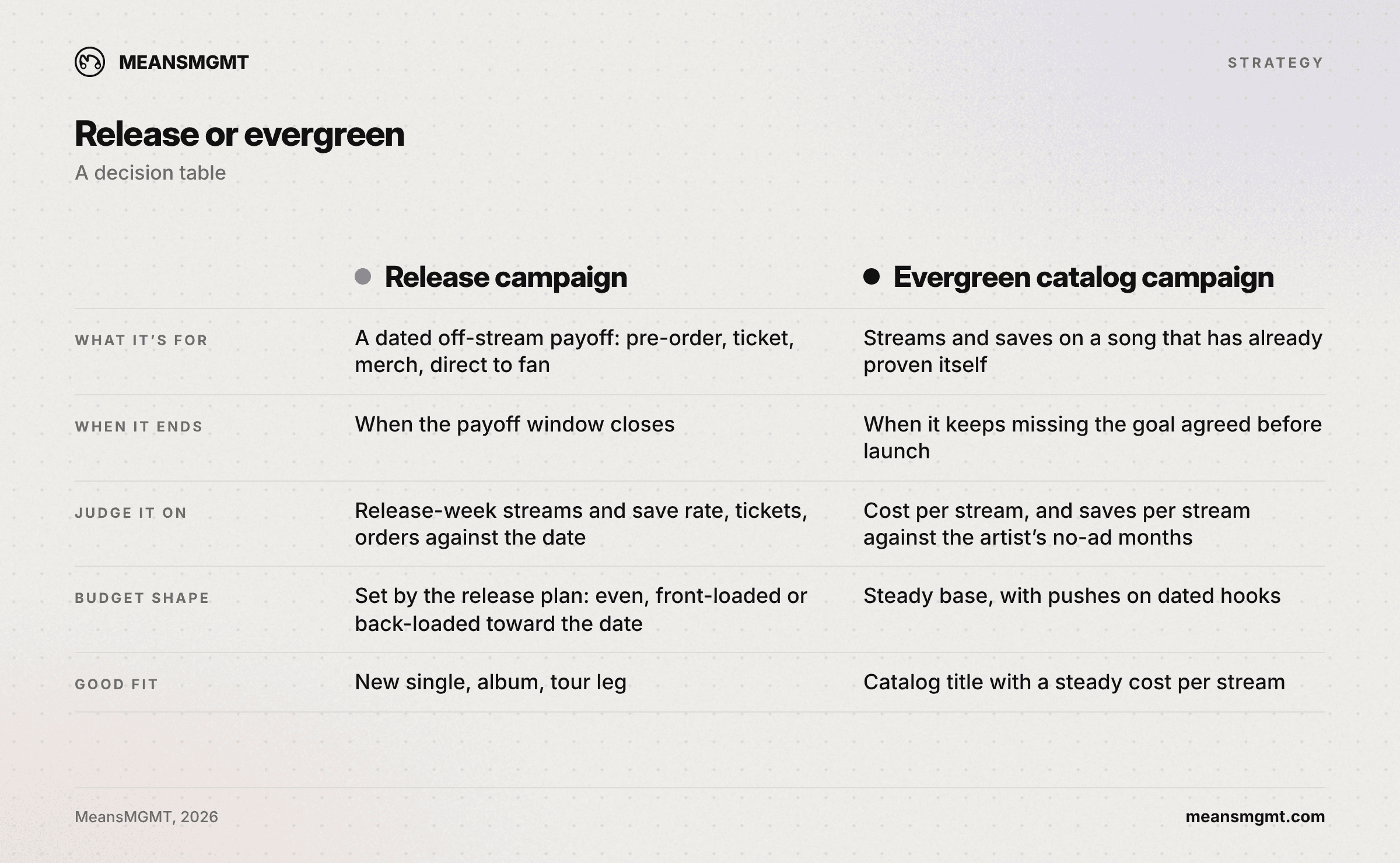
How I split a budget between release week and after depends heavily on the release plan. Some plans split it evenly. Others are front-loaded into release week, or back-loaded toward a later payoff date like a show.
When to stop either one
When I tell a client to stop depends on their goal. A release campaign stops on its date. Spending past show night, or past release week on a pre-save campaign, buys streams for a campaign whose payoff has already happened.
For an evergreen campaign, agree on that goal before it starts, and on what missing it looks like. Measure each 28-day window's average daily streams against the 28 days before and against the artist's own months with no ads. One window under the month before isn't a stop signal on its own. A third of our 32 pushes came in under 1.0x against the 28 days before. A song that keeps coming in under its own baseline, or whose cost per stream climbs past what the stream is worth to you, has stopped being evergreen.
What happens to streams after a run ends is the part we can't answer yet. The closest case we have is one artist whose single-song campaigns wound down.
Indexed to 100 in the last full window of single-song spend, total streams fell to 67, 47, 37 and 31 over the next four 28-day windows. A playlist campaign ran through all of it, and the first window still carried some single-song and traffic spend. The 100 window was the artist's peak and held a new release.
In a stretch with no recorded Meta spend the year before, the same artist's streams fell at a similar rate. It reads more like a release cycle running down than an ad stop.
Spotify for Artists says saves and playlist adds are linked to a 2.5x increase in streaming of an artist six months later (Spotify for Artists support, accessed October 2026). Spotify's 2023 reporting guide for display campaigns gives the same 2.5x as a correlation, with no published method. That's an association, not a measure of what an ad leaves behind. Ads Manager and Marquee stop counting streams 14 days after exposure.
If you have a release window closing, or a catalog song that keeps earning its spend, I'm happy to look at the numbers with you. Send me the campaign and the dates through meansmgmt.com.
FAQ
Questions we get
If you have a release coming, start your campaign now or book a call first, and we’ll scope it with you. Want the numbers first? The benchmarks report is free.

