·
Spotify
·
Do Spotify Pre-Saves Actually Work? What Moves Streams
Spotify pre-saves only pay off if real release-day demand shows up. Here's what a pre-save actually does now, what it costs, and how to make it move streams.

MeansMGMT
A pre-save is a reminder, not a listen. It's worth exactly as much as the demand standing behind it.
Pre-saves work, but not the way most guides sell them. A pre-save does one useful thing: on release day it drops your new track into a listener's library and sends a notification to go play it. Spotify says nearly 70 percent of people who pre-save an album stream it in the release week. Collect 40 pre-saves from friends and you get 40 library adds nobody acts on. The pre-saves that move streams come from a paid release campaign that puts the song in front of people who will actually press play.
TL;DR
A Spotify pre-save adds your release to a listener's library and notifies them on release day. It does not follow you and does not guarantee a stream.
Spotify says nearly 70 percent of people who pre-save an album stream it in the release week, so the value is the release-day listen, not the save itself.
A pre-save is only worth the demand behind it: 40 from friends move nothing, while thousands from a paid campaign build day-one velocity.
In our campaigns a pre-save runs about $1.20 in Tier 1 premium markets for Rap and Pop, and about $0.56 blended across tiers, billed to your own ad account.
Judge a pre-save campaign by whether those saves convert to release-week streams at a save rate above 8 percent, not by the pre-save count.
What a Spotify pre-save actually does now
A pre-save reserves a not-yet-released track so it lands in the listener's Spotify library the moment it drops. Spotify's own version of this is the Countdown Page, a pre-release page it introduced in July 2024 where fans can pre-save a release, preview the tracklist, and watch countdown videos. When the release goes live, Spotify does two things and only two things: it adds the track to every pre-saver's library and sends them a push notification. It does not auto-follow you and it does not drop the song into a personalized playlist.
You can run the same idea off-platform with a third-party smart link (we use Feature.fm), which gives you a single pre-save link to share and a pixel you can retarget. Setting one up is quick: connect the release, pick the date, share the link. What decides whether any of it matters is who is on the other end of that link, which is where most pre-save advice goes quiet.
Why a pre-save is worthless without release-day demand
A library add is a reminder, not a listen. The skeptical Reddit threads and "unfortunate truth" blog posts that show up when you search this are half right. Pre-saves gathered from your existing small network do almost nothing, because those people were going to hear the song anyway. The number that actually matters is release-week streams, and specifically whether the people who saved the track come back and play it.
That is why we grade a release on save rate, not pre-save count. Save rate is the share of listeners who add the song to their library, and it tells you whether the attention found people who like the music. This is saves divided by listeners, so don't compare it with saves-per-stream figures. Below 8 percent is a problem, 8 to 15 percent is solid, above 15 percent is strong. A campaign that banks 2,000 pre-saves and converts almost none of them on release day lost the plot. We make the full case for why save rate beats stream count separately.
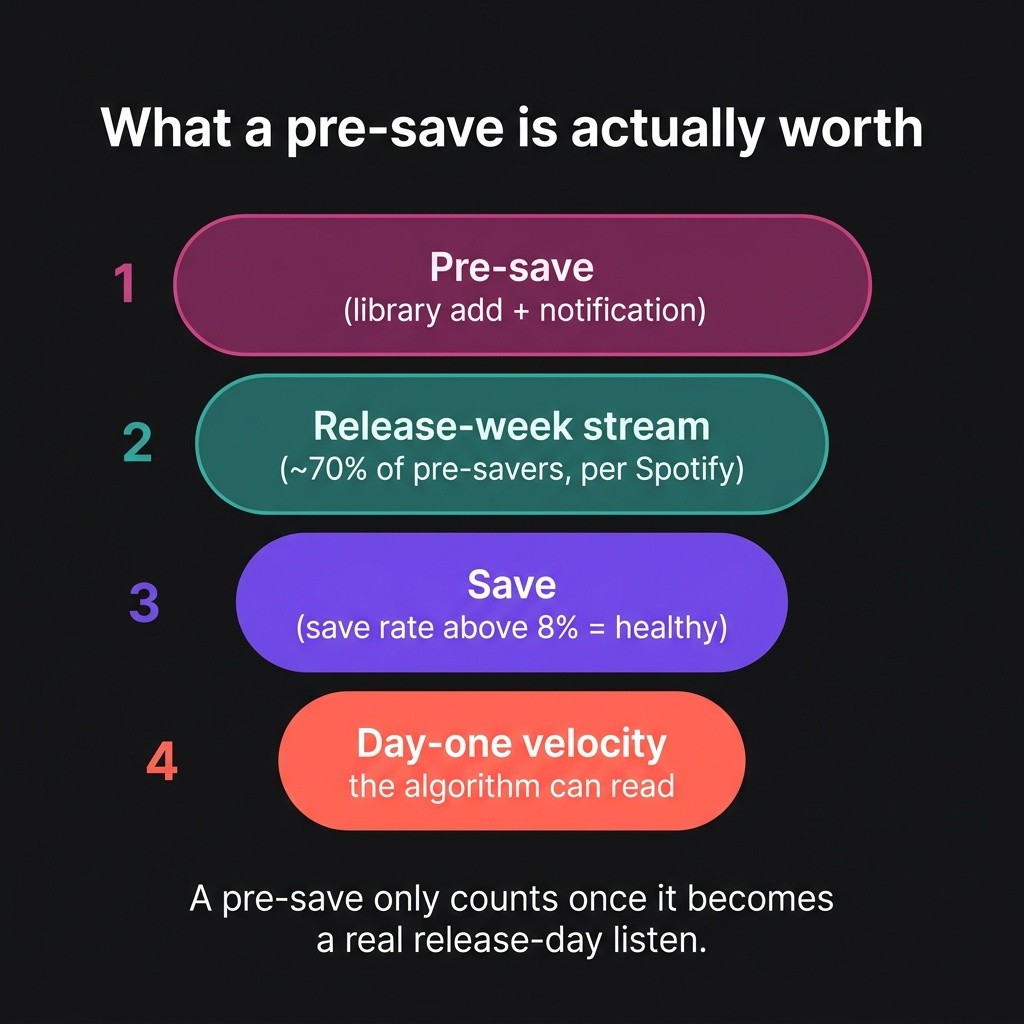
What pre-saves are genuinely good for: day-one velocity
A pre-save campaign concentrates listening into release day instead of spreading it across a slow week, and that burst of day-one activity is a signal Spotify's recommendations respond to. Spotify ranks new music in features like Release Radar by how much it thinks a listener will like a song, based on their past listening. It also puts your new release in front of people who already follow you. Following and pre-saving stack: the follow gets you into Release Radar, the pre-save turns the release-day notification into an actual play.
None of that is a guaranteed placement, and no honest number tells you a pre-save count forces the algorithm's hand. What we can say from running campaigns is a planning target, not a promise. A release that reaches roughly 10,000 streams in its first 28 days at a 10 percent save rate is in the range where algorithmic playlists start to consider it. Pre-saves help you hit that window on day one instead of hoping listeners trickle in.
What a pre-save actually costs
Pre-saves are not free to gather at any real scale, because reaching people beyond your own followers means paying to put the link in front of them. In our campaigns, cost per pre-save runs about $1.20 in Tier 1 premium markets for Rap and Pop, and about $0.56 blended across tiers. It climbs for Rock and Alternative (around $2.60 in Tier 1). It moves with genre and creative quality, and about 55 percent of the people who click a well-built pre-save link follow through. All of that is ad spend billed to your own ad account on your own card, not a fee we mark up.
Keep the money in perspective. Spotify does not pay a fixed per-stream rate. Payouts come out of a revenue pool by streamshare and vary by country, listener tier, and your distribution deal. Common third-party estimates put it around $0.003 to $0.005 per stream. So you never run a pre-save campaign to earn stream royalties back. You run it to manufacture day-one demand and an audience you can reach again, the same logic behind the cost-per-save math on Meta.
How to make pre-saves work: a paid release campaign
The version that works is a Spotify pre-save campaign, run like any other paid release. Ads on Meta or TikTok run in the weeks before release, pointed at a smart link that offers the pre-save. That builds a retargetable audience and a pool of people primed to stream on day one. Then you convert that audience on release day and judge the whole thing by release-week streams and save rate. Pair it with the metrics that actually matter in a release-strategy scorecard. Day-one velocity is only step one, because your first 1,000 streams earn nothing at all until the track clears Spotify's monetization floor.
That's how we run pre-saves at MeansMGMT: as the launch layer of a paid campaign on your own ad accounts, measured by whether the saves convert. You can see the shape of it in a real Spotify pre-save Meta Ads campaign and in a Rock and Metal pre-save campaign we ran, with its real numbers. A pre-save link is easy. Getting real demand behind it is the work.
FAQ
Questions we get
If you have a release coming, start your campaign now or book a call first, and we’ll scope it with you. Want the numbers first? The benchmarks report is free.