
·
Paid ads
·
Paid Music Promotion: What Are You Actually Buying?
Two artists, $10,000 in ad spend each, two different goals. How to plan paid music promotion around listening, income, and what you keep when the ads stop.

MeansMGMT
If you're paying to grow something and you don't retain anything, what are you paying for?

Two artists each have $10,000 for paid music promotion. That's ad spend only. Recording, content and management fees sit outside it. Both are hypothetical.
The first artist made an album they love and wants people who like their kind of music to hear it. The second wants the release to help pay rent.
They have the same budget and the same platforms. I'd still build them two different plans, and judge them on two different things.
Listening and income are different goals
An album doesn't have to pay for itself to be worth making or promoting. Plenty of artists fund a record the way other people fund a hobby they take seriously. They want it heard, and that's the whole goal.
Wanting music to be your living is just as valid. It's a specific decision, though, to make the thing that gathers attention also be the thing that makes you money. A lot of people assume the two come tied together. They don't have to.
Day jobs tell you little about which camp someone is in. The 2023 UK Musicians' Census surveyed 5,867 musicians. 53% sourced income outside music to sustain their careers, and 75% of those said they took that work only for financial reasons. That's UK respondents in early 2023, not every musician. It still means "has a day job" and "doesn't care about income" are not the same artist.
So the first question I ask is what the release is for. The platform comes after.
Paying for attention is old news
None of this started with Meta. Artists and labels have always paid to get music in front of people, through posters, street teams, radio promotion and press. IFPI's Investing in Music put record-company spend on A&R and marketing above US$4.5 billion in 2015.
One line to draw clearly: payola is not that. Paying for radio airplay in secret was illegal, and the New York attorney general's 2005 Sony settlement is the textbook case. Lawful ads and street teams are a different thing.
What changed is that today's paid reach can leave something behind you control. Whether it does depends on how you buy it.

Artist A is buying listening
For the first artist, I'd start small. Take a short video cut from the best moment of the record and aim it at people who already stream similar artists. Send them to a clean release page, not a link tree with twelve buttons.
As a plan, I'd test with about $1,500 over two weeks and hold the other $8,500 until I'd read the reports. Those are planning numbers for this example, not a forecast.
A click on a streaming button means someone picked a destination. It doesn't mean they played the song. What I'd check is listening during the campaign, saves, and whether listening holds after the ads pause. Our post on Spotify's 14-day attribution window covers where those reports stop counting.
Be careful with platform studies here. Spotify's 2022 Marquee study reported 10x more Spotify listeners per dollar than comparable social ads. It covered 10 releases from artists with 300,000 to 16 million monthly listeners, and Spotify sells Marquee. That's useful context, not a forecast for a new artist.
Exposure also works on long timelines nobody can fully attribute. Luminate's 2025 year-end report still has Fleetwood Mac's "Dreams" in the US Top 30 for audio streaming, five years after its 2020 viral moment. That shows the song kept its demand. It doesn't show which clip or which viewer did it.
If Artist A ends the campaign with a few thousand real listeners and no profit, that can be a win. It was the goal.
Artist B is buying income
For the second artist, I'd look at what they can actually sell before choosing where the ads go. Vinyl, merch, tickets, a paid community. Our artist income post lays out the usual options. Streaming income counts too, but it's slow and split many ways.
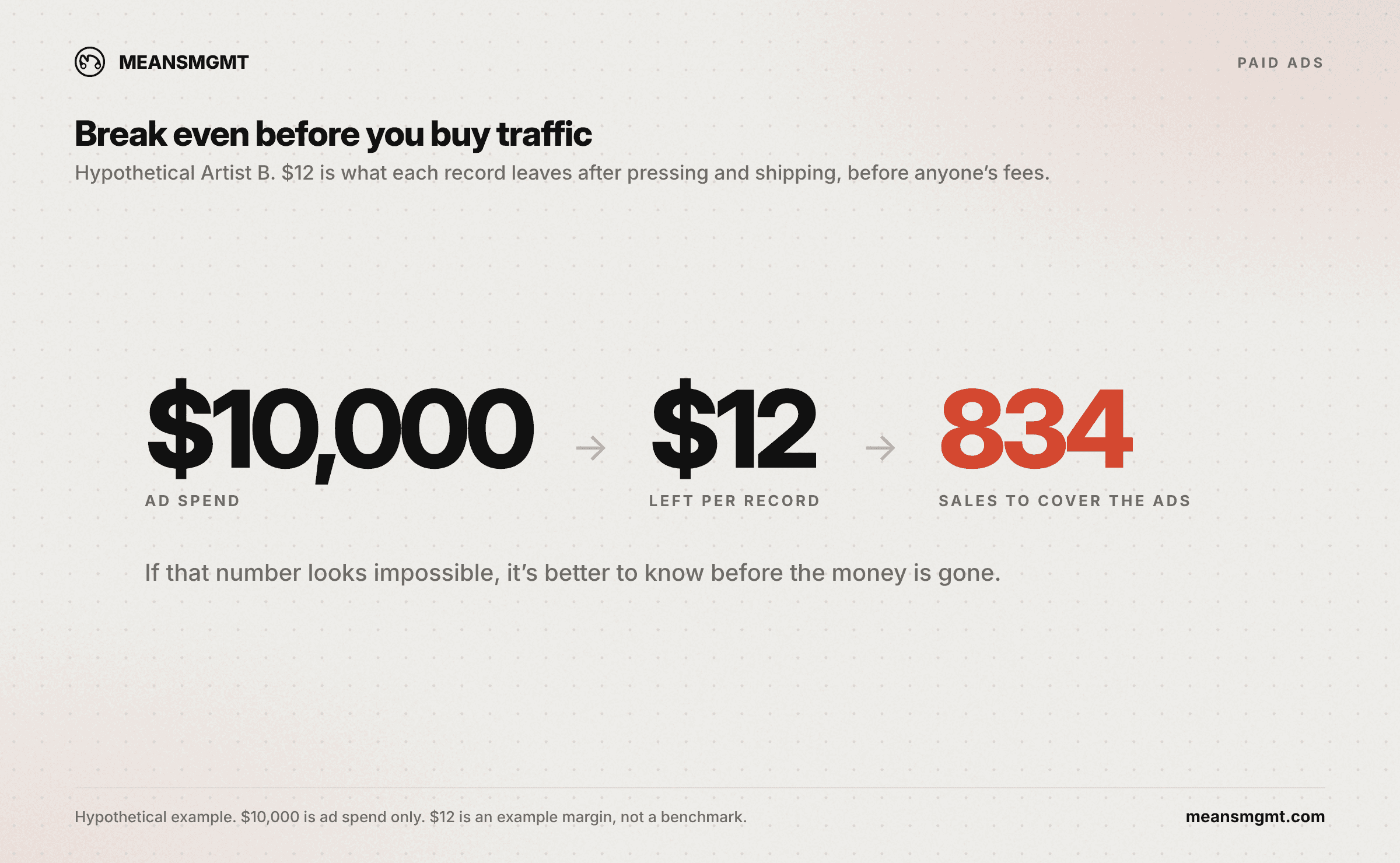
Then do the break-even math first. Say each record leaves $12 after pressing and shipping. Covering $10,000 in ads takes about 834 sales, before anyone's fees. If that number looks impossible, it's better to know before the money is gone.
Streams need the same honesty. I wouldn't forecast payback from a fixed per-stream rate. What reaches the artist depends on the service, the territory, recording versus publishing rights, and any recoupment in their deal. The UK Competition and Markets Authority's 2022 streaming report walks through how those splits work, and how hard earnings can be to verify. Read your own statements. Our distributor ownership post covers who sits between the stream and your account.
Genre matters here as well. Some genres pull harder in some regions, and Luminate's 2025 report tracks shifts like Latin music's growth in Europe. For an income goal, I'd test the markets where the genre already has demand and where those listeners can realistically buy the record or the ticket.
A campaign can grow streams while the artist's actual payout barely moves. That's why Artist B needs a retargeting and data plan from day one, not a bigger stream count.
What do you keep when the ads stop?
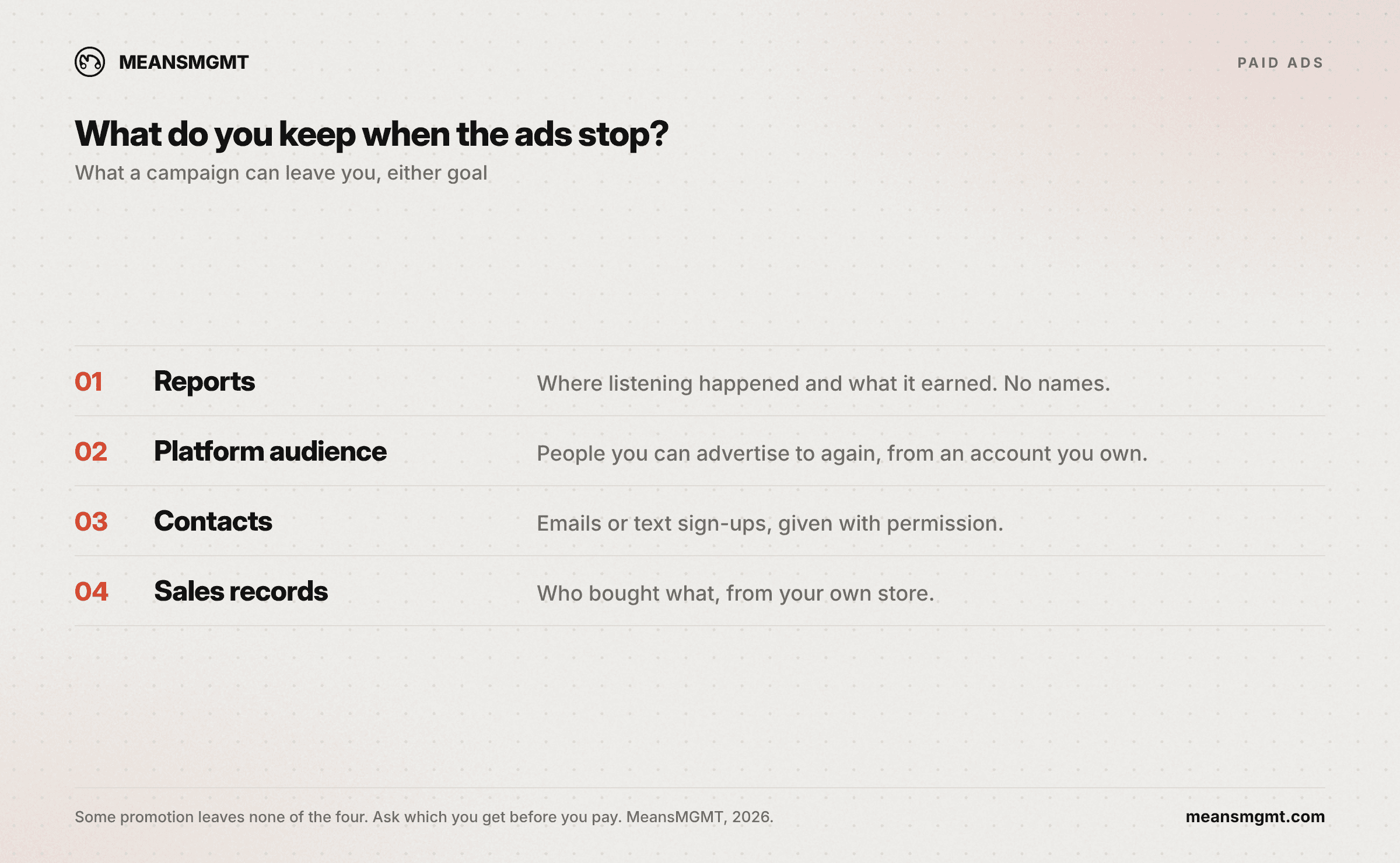
If you're paying to grow something and you don't retain anything, what are you paying for? I'd ask that of any campaign, whatever the goal. It can leave you four things:
Reports that show where listening happened and what it earned. They don't name anyone, but they make the next budget smarter.
A platform audience, like people who watched your video or engaged with your page. You can advertise to them again, inside that platform, from an account you own.
Contacts, like emails or text sign-ups, given with permission. You can reach them without paying a platform every time.
Sales records from your own store, which show who bought and what.
Not every listener needs to hand over an email. Artist A might only want the reports. But some of the promotion sold to artists right now leaves none of the four. Pay-per-view clip pages and anonymous playlist pushes can post big numbers, and the artist walks away with a screenshot. We covered how to tell real listening from bought numbers in our save rate post.
Before paying anyone, ask which of these you get, and whether you keep access if you stop working with them.
Before you spend the $10,000
Write down five things first:
The goal: listening, income, or something else specific.
Where the ad sends people, and that the page works.
The test amount, and what stays in reserve.
The review date, and what you'll check on it.
What you'll still own when the campaign ends.
If income is the goal, add the break-even number. Place a test order on your own store and see what a sale actually leaves you.
Both artists can come out of this with a good result. They just need to know what they bought. If you want a second set of eyes on a plan like this, send it through meansmgmt.com.
Sources
Help Musicians and Musicians' Union. Musicians' Census: Financial Insight Report, September 2023.
IFPI and WIN. Investing in Music, 2016.
New York State Attorney General. "Sony Settles Payola Investigation", July 25, 2005.
Spotify for Artists. Marquee comparison study, November 17, 2022.
Luminate. 2025 Year-End Music Report.
Competition and Markets Authority. Music and streaming market study: final report, executive summary, November 29, 2022.
FAQ
Questions we getIf you have a release coming, start your campaign now or book a call first, and we’ll scope it with you. Want the numbers first? The benchmarks report is free.

